

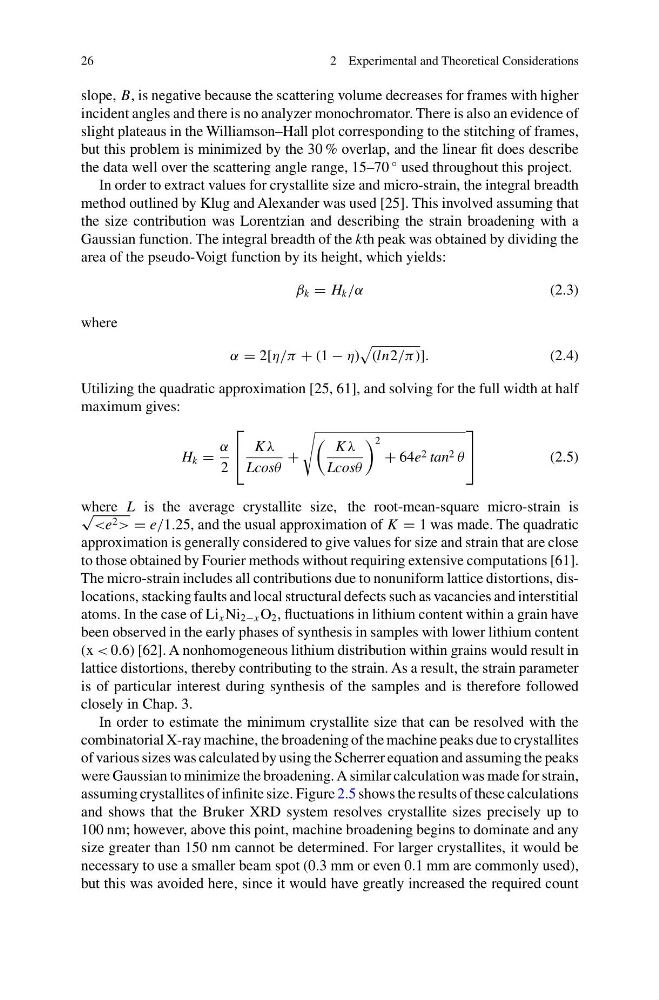
26
2 Experimental and Theoretical Considerations
slope, B, is negative because the scattering volume decreases for frames with higher
incident angles and there is no analyzer monochromator. There is also an evidence of
slight plateaus in the Williamson–Hall plot corresponding to the stitching of frames,
but this problem is minimized by the 30 % overlap, and the linear fit does describe
the data well over the scattering angle range, 15–70
◦ used throughout this project.
In order to extract values for crystallite size and micro-strain, the integral breadth
method outlined by Klug and Alexander was used [25]. This involved assuming that
the size contribution was Lorentzian and describing the strain broadening with a
Gaussian function. The integral breadth of the kth peak was obtained by dividing the
area of the pseudo-Voigt function by its height, which yields:
β k = H k /α
(2.3)
where
α = 2[η/π + (1 − η)
(ln2/π )].
(2.4)
Utilizing the quadratic approximation [25, 61], and solving for the full width at half
maximum gives:
H k =
α
2
⎡
⎣ Kλ
Lcosθ
+
Kλ
Lcosθ
2
+ 64e 2 tan 2 θ
⎤
⎦
(2.5)
where L is the average crystallite size, the root-mean-square micro-strain is
√
= e/1.25, and the usual approximation of K = 1 was made. The quadratic
approximation is generally considered to give values for size and strain that are close
to those obtained by Fourier methods without requiring extensive computations [61].
The micro-strain includes all contributions due to nonuniform lattice distortions, dislocations, stacking faults and local structural defects such as vacancies and interstitial
atoms. In the case of Li x Ni 2−x O 2 , fluctuations in lithium content within a grain have
been observed in the early phases of synthesis in samples with lower lithium content
(x < 0.6) [62]. A nonhomogeneous lithium distribution within grains would result in
lattice distortions, thereby contributing to the strain. As a result, the strain parameter
is of particular interest during synthesis of the samples and is therefore followed
closely in Chap. 3.
In order to estimate the minimum crystallite size that can be resolved with the
combinatorial X-ray machine, the broadening of the machine peaks due to crystallites
of various sizes was calculated by using the Scherrer equation and assuming the peaks
were Gaussian to minimize the broadening. A similar calculation was made for strain,
assuming crystallites of infinite size. Figure 2.5 shows the results of these calculations
and shows that the Bruker XRD system resolves crystallite sizes precisely up to
100 nm; however, above this point, machine broadening begins to dominate and any
size greater than 150 nm cannot be determined. For larger crystallites, it would be
necessary to use a smaller beam spot (0.3 mm or even 0.1 mm are commonly used),
but this was avoided here, since it would have greatly increased the required count
2 Experimental and Theoretical Considerations
slope, B, is negative because the scattering volume decreases for frames with higher
incident angles and there is no analyzer monochromator. There is also an evidence of
slight plateaus in the Williamson–Hall plot corresponding to the stitching of frames,
but this problem is minimized by the 30 % overlap, and the linear fit does describe
the data well over the scattering angle range, 15–70
◦ used throughout this project.
In order to extract values for crystallite size and micro-strain, the integral breadth
method outlined by Klug and Alexander was used [25]. This involved assuming that
the size contribution was Lorentzian and describing the strain broadening with a
Gaussian function. The integral breadth of the kth peak was obtained by dividing the
area of the pseudo-Voigt function by its height, which yields:
β k = H k /α
(2.3)
where
α = 2[η/π + (1 − η)
(ln2/π )].
(2.4)
Utilizing the quadratic approximation [25, 61], and solving for the full width at half
maximum gives:
H k =
α
2
⎡
⎣ Kλ
Lcosθ
+
Kλ
Lcosθ
2
+ 64e 2 tan 2 θ
⎤
⎦
(2.5)
where L is the average crystallite size, the root-mean-square micro-strain is
√
approximation is generally considered to give values for size and strain that are close
to those obtained by Fourier methods without requiring extensive computations [61].
The micro-strain includes all contributions due to nonuniform lattice distortions, dislocations, stacking faults and local structural defects such as vacancies and interstitial
atoms. In the case of Li x Ni 2−x O 2 , fluctuations in lithium content within a grain have
been observed in the early phases of synthesis in samples with lower lithium content
(x < 0.6) [62]. A nonhomogeneous lithium distribution within grains would result in
lattice distortions, thereby contributing to the strain. As a result, the strain parameter
is of particular interest during synthesis of the samples and is therefore followed
closely in Chap. 3.
In order to estimate the minimum crystallite size that can be resolved with the
combinatorial X-ray machine, the broadening of the machine peaks due to crystallites
of various sizes was calculated by using the Scherrer equation and assuming the peaks
were Gaussian to minimize the broadening. A similar calculation was made for strain,
assuming crystallites of infinite size. Figure 2.5 shows the results of these calculations
and shows that the Bruker XRD system resolves crystallite sizes precisely up to
100 nm; however, above this point, machine broadening begins to dominate and any
size greater than 150 nm cannot be determined. For larger crystallites, it would be
necessary to use a smaller beam spot (0.3 mm or even 0.1 mm are commonly used),
but this was avoided here, since it would have greatly increased the required count