

16
1 Introduction
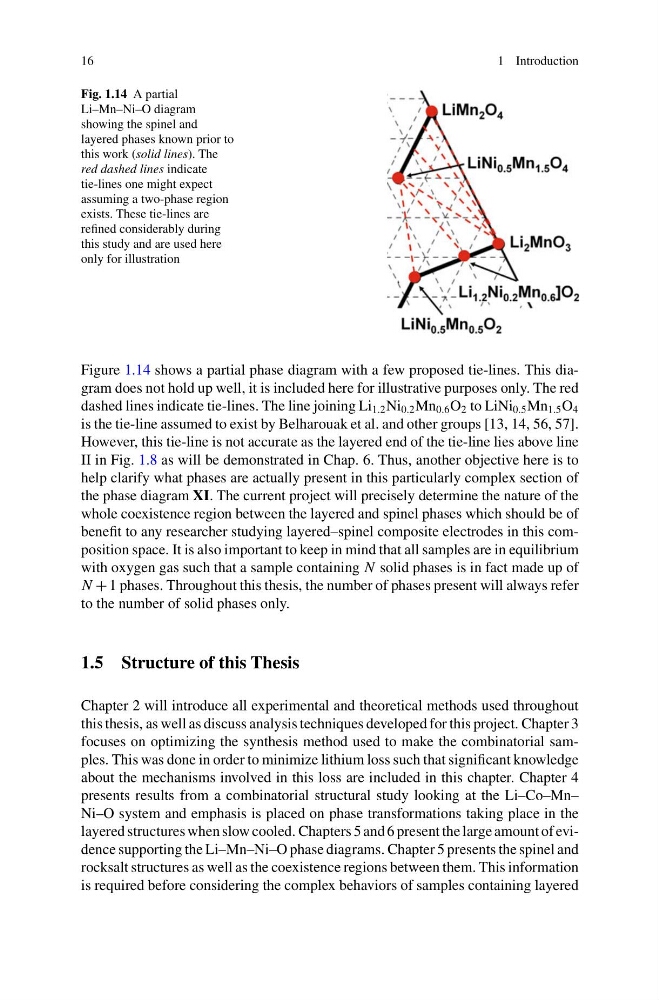
Fig. 1.14 A partial
Li–Mn–Ni–O diagram
showing the spinel and
layered phases known prior to
this work (solid lines). The
red dashed lines indicate
tie-lines one might expect
assuming a two-phase region
exists. These tie-lines are
refined considerably during
this study and are used here
only for illustration
Figure 1.14 shows a partial phase diagram with a few proposed tie-lines. This diagram does not hold up well, it is included here for illustrative purposes only. The red
dashed lines indicate tie-lines. The line joining Li 1.2 Ni 0.2 Mn 0.6 O 2 to LiNi 0.5 Mn 1.5 O 4
is the tie-line assumed to exist by Belharouak et al. and other groups [13, 14, 56, 57].
However, this tie-line is not accurate as the layered end of the tie-line lies above line
II in Fig. 1.8 as will be demonstrated in Chap. 6. Thus, another objective here is to
help clarify what phases are actually present in this particularly complex section of
the phase diagram XI. The current project will precisely determine the nature of the
whole coexistence region between the layered and spinel phases which should be of
benefit to any researcher studying layered–spinel composite electrodes in this composition space. It is also important to keep in mind that all samples are in equilibrium
with oxygen gas such that a sample containing N solid phases is in fact made up of
N + 1 phases. Throughout this thesis, the number of phases present will always refer
to the number of solid phases only.
1.5 Structure of this Thesis
Chapter 2 will introduce all experimental and theoretical methods used throughout
this thesis, as well as discuss analysis techniques developed for this project. Chapter 3
focuses on optimizing the synthesis method used to make the combinatorial samples. This was done in order to minimize lithium loss such that significant knowledge
about the mechanisms involved in this loss are included in this chapter. Chapter 4
presents results from a combinatorial structural study looking at the Li–Co–Mn–
Ni–O system and emphasis is placed on phase transformations taking place in the
layered structures when slow cooled. Chapters 5 and 6 present the large amount of evidence supporting the Li–Mn–Ni–O phase diagrams. Chapter 5 presents the spinel and
rocksalt structures as well as the coexistence regions between them. This information
is required before considering the complex behaviors of samples containing layered
1 Introduction
Fig. 1.14 A partial
Li–Mn–Ni–O diagram
showing the spinel and
layered phases known prior to
this work (solid lines). The
red dashed lines indicate
tie-lines one might expect
assuming a two-phase region
exists. These tie-lines are
refined considerably during
this study and are used here
only for illustration
Figure 1.14 shows a partial phase diagram with a few proposed tie-lines. This diagram does not hold up well, it is included here for illustrative purposes only. The red
dashed lines indicate tie-lines. The line joining Li 1.2 Ni 0.2 Mn 0.6 O 2 to LiNi 0.5 Mn 1.5 O 4
is the tie-line assumed to exist by Belharouak et al. and other groups [13, 14, 56, 57].
However, this tie-line is not accurate as the layered end of the tie-line lies above line
II in Fig. 1.8 as will be demonstrated in Chap. 6. Thus, another objective here is to
help clarify what phases are actually present in this particularly complex section of
the phase diagram XI. The current project will precisely determine the nature of the
whole coexistence region between the layered and spinel phases which should be of
benefit to any researcher studying layered–spinel composite electrodes in this composition space. It is also important to keep in mind that all samples are in equilibrium
with oxygen gas such that a sample containing N solid phases is in fact made up of
N + 1 phases. Throughout this thesis, the number of phases present will always refer
to the number of solid phases only.
1.5 Structure of this Thesis
Chapter 2 will introduce all experimental and theoretical methods used throughout
this thesis, as well as discuss analysis techniques developed for this project. Chapter 3
focuses on optimizing the synthesis method used to make the combinatorial samples. This was done in order to minimize lithium loss such that significant knowledge
about the mechanisms involved in this loss are included in this chapter. Chapter 4
presents results from a combinatorial structural study looking at the Li–Co–Mn–
Ni–O system and emphasis is placed on phase transformations taking place in the
layered structures when slow cooled. Chapters 5 and 6 present the large amount of evidence supporting the Li–Mn–Ni–O phase diagrams. Chapter 5 presents the spinel and
rocksalt structures as well as the coexistence regions between them. This information
is required before considering the complex behaviors of samples containing layered