

9.5 Electrochemical Measurements
125
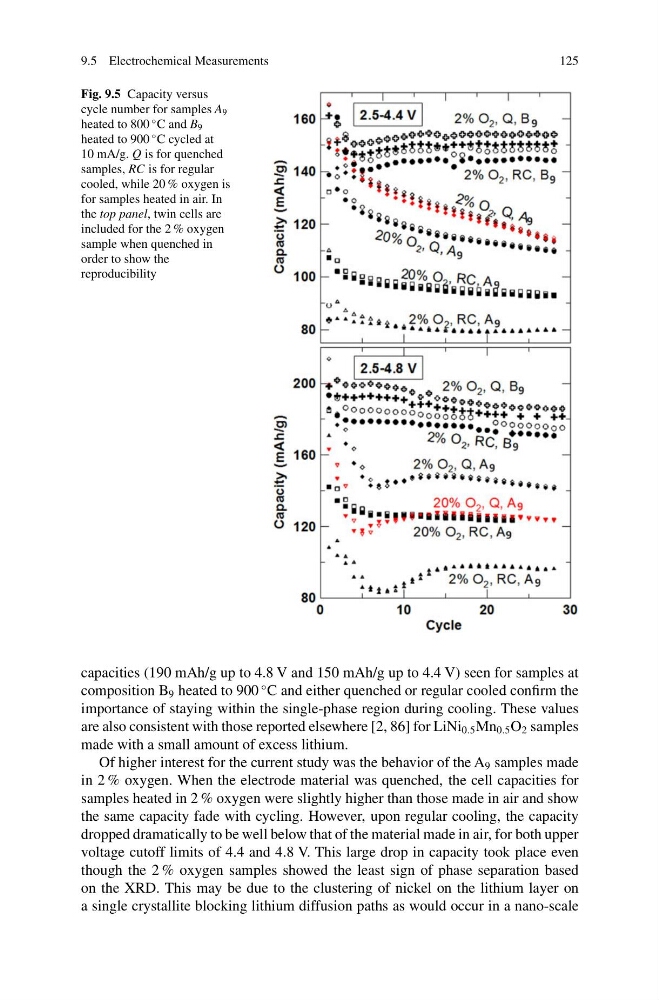
Fig. 9.5 Capacity versus
cycle number for samples A 9
heated to 800
◦ C and B 9
heated to 900
◦ C cycled at
10 mA/g. Q is for quenched
samples, RC is for regular
cooled, while 20 % oxygen is
for samples heated in air. In
the top panel, twin cells are
included for the 2 % oxygen
sample when quenched in
order to show the
reproducibility
capacities (190 mAh/g up to 4.8 V and 150 mAh/g up to 4.4 V) seen for samples at
composition B 9 heated to 900
◦ C and either quenched or regular cooled confirm the
importance of staying within the single-phase region during cooling. These values
are also consistent with those reported elsewhere [2, 86] for LiNi 0.5 Mn 0.5 O 2 samples
made with a small amount of excess lithium.
Of higher interest for the current study was the behavior of the A 9 samples made
in 2 % oxygen. When the electrode material was quenched, the cell capacities for
samples heated in 2 % oxygen were slightly higher than those made in air and show
the same capacity fade with cycling. However, upon regular cooling, the capacity
dropped dramatically to be well below that of the material made in air, for both upper
voltage cutoff limits of 4.4 and 4.8 V. This large drop in capacity took place even
though the 2 % oxygen samples showed the least sign of phase separation based
on the XRD. This may be due to the clustering of nickel on the lithium layer on
a single crystallite blocking lithium diffusion paths as would occur in a nano-scale
125
Fig. 9.5 Capacity versus
cycle number for samples A 9
heated to 800
◦ C and B 9
heated to 900
◦ C cycled at
10 mA/g. Q is for quenched
samples, RC is for regular
cooled, while 20 % oxygen is
for samples heated in air. In
the top panel, twin cells are
included for the 2 % oxygen
sample when quenched in
order to show the
reproducibility
capacities (190 mAh/g up to 4.8 V and 150 mAh/g up to 4.4 V) seen for samples at
composition B 9 heated to 900
◦ C and either quenched or regular cooled confirm the
importance of staying within the single-phase region during cooling. These values
are also consistent with those reported elsewhere [2, 86] for LiNi 0.5 Mn 0.5 O 2 samples
made with a small amount of excess lithium.
Of higher interest for the current study was the behavior of the A 9 samples made
in 2 % oxygen. When the electrode material was quenched, the cell capacities for
samples heated in 2 % oxygen were slightly higher than those made in air and show
the same capacity fade with cycling. However, upon regular cooling, the capacity
dropped dramatically to be well below that of the material made in air, for both upper
voltage cutoff limits of 4.4 and 4.8 V. This large drop in capacity took place even
though the 2 % oxygen samples showed the least sign of phase separation based
on the XRD. This may be due to the clustering of nickel on the lithium layer on
a single crystallite blocking lithium diffusion paths as would occur in a nano-scale