

5.5 Spinel–Ordered Rocksalt Coexistence Region
73
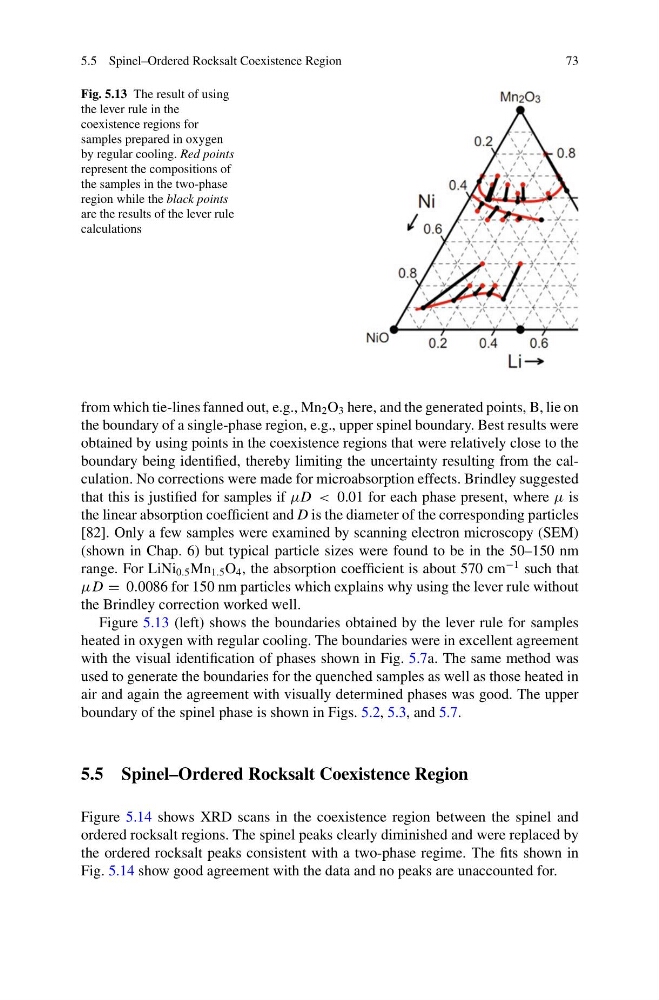
Fig. 5.13 The result of using
the lever rule in the
coexistence regions for
samples prepared in oxygen
by regular cooling. Red points
represent the compositions of
the samples in the two-phase
region while the black points
are the results of the lever rule
calculations
from which tie-lines fanned out, e.g., Mn 2 O 3 here, and the generated points, B, lie on
the boundary of a single-phase region, e.g., upper spinel boundary. Best results were
obtained by using points in the coexistence regions that were relatively close to the
boundary being identified, thereby limiting the uncertainty resulting from the calculation. No corrections were made for microabsorption effects. Brindley suggested
that this is justified for samples if μD < 0.01 for each phase present, where μ is
the linear absorption coefficient and D is the diameter of the corresponding particles
[82]. Only a few samples were examined by scanning electron microscopy (SEM)
(shown in Chap. 6) but typical particle sizes were found to be in the 50–150 nm
range. For LiNi 0.5 Mn 1.5 O 4 , the absorption coefficient is about 570 cm
−1 such that
μD = 0.0086 for 150 nm particles which explains why using the lever rule without
the Brindley correction worked well.
Figure 5.13 (left) shows the boundaries obtained by the lever rule for samples
heated in oxygen with regular cooling. The boundaries were in excellent agreement
with the visual identification of phases shown in Fig. 5.7a. The same method was
used to generate the boundaries for the quenched samples as well as those heated in
air and again the agreement with visually determined phases was good. The upper
boundary of the spinel phase is shown in Figs. 5.2, 5.3, and 5.7.
5.5 Spinel–Ordered Rocksalt Coexistence Region
Figure 5.14 shows XRD scans in the coexistence region between the spinel and
ordered rocksalt regions. The spinel peaks clearly diminished and were replaced by
the ordered rocksalt peaks consistent with a two-phase regime. The fits shown in
Fig. 5.14 show good agreement with the data and no peaks are unaccounted for.
73
Fig. 5.13 The result of using
the lever rule in the
coexistence regions for
samples prepared in oxygen
by regular cooling. Red points
represent the compositions of
the samples in the two-phase
region while the black points
are the results of the lever rule
calculations
from which tie-lines fanned out, e.g., Mn 2 O 3 here, and the generated points, B, lie on
the boundary of a single-phase region, e.g., upper spinel boundary. Best results were
obtained by using points in the coexistence regions that were relatively close to the
boundary being identified, thereby limiting the uncertainty resulting from the calculation. No corrections were made for microabsorption effects. Brindley suggested
that this is justified for samples if μD < 0.01 for each phase present, where μ is
the linear absorption coefficient and D is the diameter of the corresponding particles
[82]. Only a few samples were examined by scanning electron microscopy (SEM)
(shown in Chap. 6) but typical particle sizes were found to be in the 50–150 nm
range. For LiNi 0.5 Mn 1.5 O 4 , the absorption coefficient is about 570 cm
−1 such that
μD = 0.0086 for 150 nm particles which explains why using the lever rule without
the Brindley correction worked well.
Figure 5.13 (left) shows the boundaries obtained by the lever rule for samples
heated in oxygen with regular cooling. The boundaries were in excellent agreement
with the visual identification of phases shown in Fig. 5.7a. The same method was
used to generate the boundaries for the quenched samples as well as those heated in
air and again the agreement with visually determined phases was good. The upper
boundary of the spinel phase is shown in Figs. 5.2, 5.3, and 5.7.
5.5 Spinel–Ordered Rocksalt Coexistence Region
Figure 5.14 shows XRD scans in the coexistence region between the spinel and
ordered rocksalt regions. The spinel peaks clearly diminished and were replaced by
the ordered rocksalt peaks consistent with a two-phase regime. The fits shown in
Fig. 5.14 show good agreement with the data and no peaks are unaccounted for.