

54
T. Okino and K. Yamanouchi
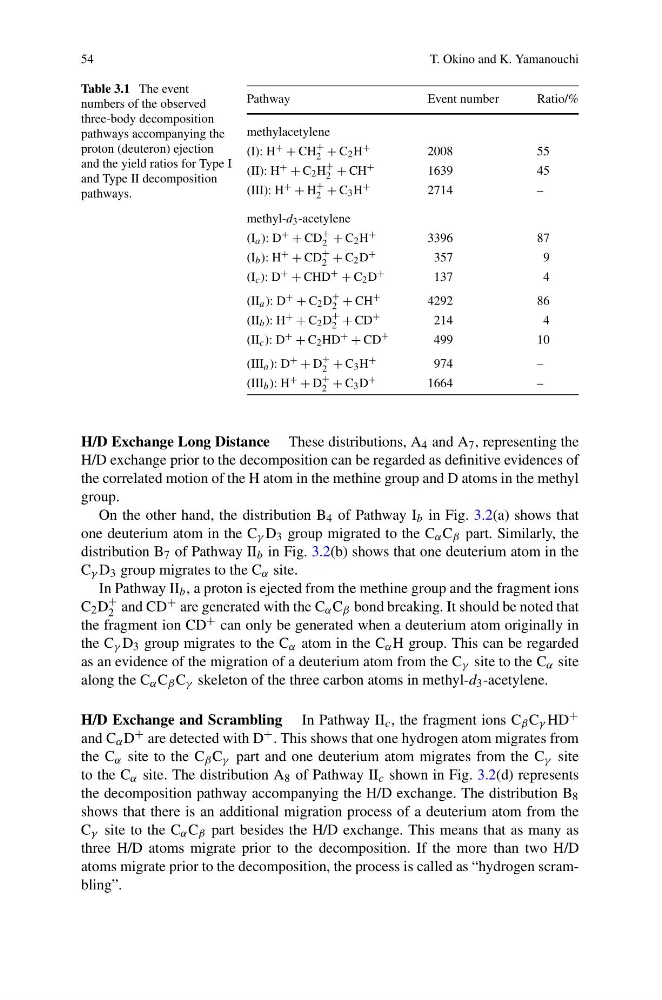
Table 3.1 The event
numbers of the observed
three-body decomposition
pathways accompanying the
proton (deuteron) ejection
and the yield ratios for Type I
and Type II decomposition
pathways.
Pathway
Event number
Ratio/%
methylacetylene
(I): H + + CH
+
2 + C 2 H +
2008
55
(II): H + + C 2 H
+
2 + CH
+
1639
45
(III): H + + H
+
2 + C 3 H +
2714
–
methyl-d 3 -acetylene
(I a ): D + + CD
+
2 + C 2 H +
3396
87
(I b ): H + + CD
+
2 + C 2 D +
357
9
(I c ): D + + CHD
+ + C 2 D +
137
4
(II a ): D + + C 2 D
+
2 + CH
+
4292
86
(II b ): H + + C 2 D
+
2 + CD
+
214
4
(II c ): D + + C 2 HD + + CD
+
499
10
(III a ): D + + D
+
2 + C 3 H +
974
–
(III b ): H + + D
+
2 + C 3 D +
1664
–
H/D Exchange Long Distance These distributions, A 4 and A 7 , representing the
H/D exchange prior to the decomposition can be regarded as definitive evidences of
the correlated motion of the H atom in the methine group and D atoms in the methyl
group.
On the other hand, the distribution B 4 of Pathway I b in Fig. 3.2(a) shows that
one deuterium atom in the C γ D 3 group migrated to the C α C β part. Similarly, the
distribution B 7 of Pathway II b in Fig. 3.2(b) shows that one deuterium atom in the
C γ D 3 group migrates to the C α site.
In Pathway II b , a proton is ejected from the methine group and the fragment ions
C 2 D
+
2 and CD + are generated with the C α C β bond breaking. It should be noted that
the fragment ion CD + can only be generated when a deuterium atom originally in
the C γ D 3 group migrates to the C α atom in the C α H group. This can be regarded
as an evidence of the migration of a deuterium atom from the C γ site to the C α site
along the C α C β C γ skeleton of the three carbon atoms in methyl-d 3 -acetylene.
H/D Exchange and Scrambling In Pathway II c , the fragment ions C β C γ HD +
and C α D + are detected with D + . This shows that one hydrogen atom migrates from
the C α site to the C β C γ part and one deuterium atom migrates from the C γ site
to the C α site. The distribution A 8 of Pathway II c shown in Fig. 3.2(d) represents
the decomposition pathway accompanying the H/D exchange. The distribution B 8
shows that there is an additional migration process of a deuterium atom from the
C γ site to the C α C β part besides the H/D exchange. This means that as many as
three H/D atoms migrate prior to the decomposition. If the more than two H/D
atoms migrate prior to the decomposition, the process is called as “hydrogen scrambling”.
T. Okino and K. Yamanouchi
Table 3.1 The event
numbers of the observed
three-body decomposition
pathways accompanying the
proton (deuteron) ejection
and the yield ratios for Type I
and Type II decomposition
pathways.
Pathway
Event number
Ratio/%
methylacetylene
(I): H + + CH
+
2 + C 2 H +
2008
55
(II): H + + C 2 H
+
2 + CH
+
1639
45
(III): H + + H
+
2 + C 3 H +
2714
–
methyl-d 3 -acetylene
(I a ): D + + CD
+
2 + C 2 H +
3396
87
(I b ): H + + CD
+
2 + C 2 D +
357
9
(I c ): D + + CHD
+ + C 2 D +
137
4
(II a ): D + + C 2 D
+
2 + CH
+
4292
86
(II b ): H + + C 2 D
+
2 + CD
+
214
4
(II c ): D + + C 2 HD + + CD
+
499
10
(III a ): D + + D
+
2 + C 3 H +
974
–
(III b ): H + + D
+
2 + C 3 D +
1664
–
H/D Exchange Long Distance These distributions, A 4 and A 7 , representing the
H/D exchange prior to the decomposition can be regarded as definitive evidences of
the correlated motion of the H atom in the methine group and D atoms in the methyl
group.
On the other hand, the distribution B 4 of Pathway I b in Fig. 3.2(a) shows that
one deuterium atom in the C γ D 3 group migrated to the C α C β part. Similarly, the
distribution B 7 of Pathway II b in Fig. 3.2(b) shows that one deuterium atom in the
C γ D 3 group migrates to the C α site.
In Pathway II b , a proton is ejected from the methine group and the fragment ions
C 2 D
+
2 and CD + are generated with the C α C β bond breaking. It should be noted that
the fragment ion CD + can only be generated when a deuterium atom originally in
the C γ D 3 group migrates to the C α atom in the C α H group. This can be regarded
as an evidence of the migration of a deuterium atom from the C γ site to the C α site
along the C α C β C γ skeleton of the three carbon atoms in methyl-d 3 -acetylene.
H/D Exchange and Scrambling In Pathway II c , the fragment ions C β C γ HD +
and C α D + are detected with D + . This shows that one hydrogen atom migrates from
the C α site to the C β C γ part and one deuterium atom migrates from the C γ site
to the C α site. The distribution A 8 of Pathway II c shown in Fig. 3.2(d) represents
the decomposition pathway accompanying the H/D exchange. The distribution B 8
shows that there is an additional migration process of a deuterium atom from the
C γ site to the C α C β part besides the H/D exchange. This means that as many as
three H/D atoms migrate prior to the decomposition. If the more than two H/D
atoms migrate prior to the decomposition, the process is called as “hydrogen scrambling”.