

2 XUV Lasers for Ultrafast Electronic Control in H 2
41
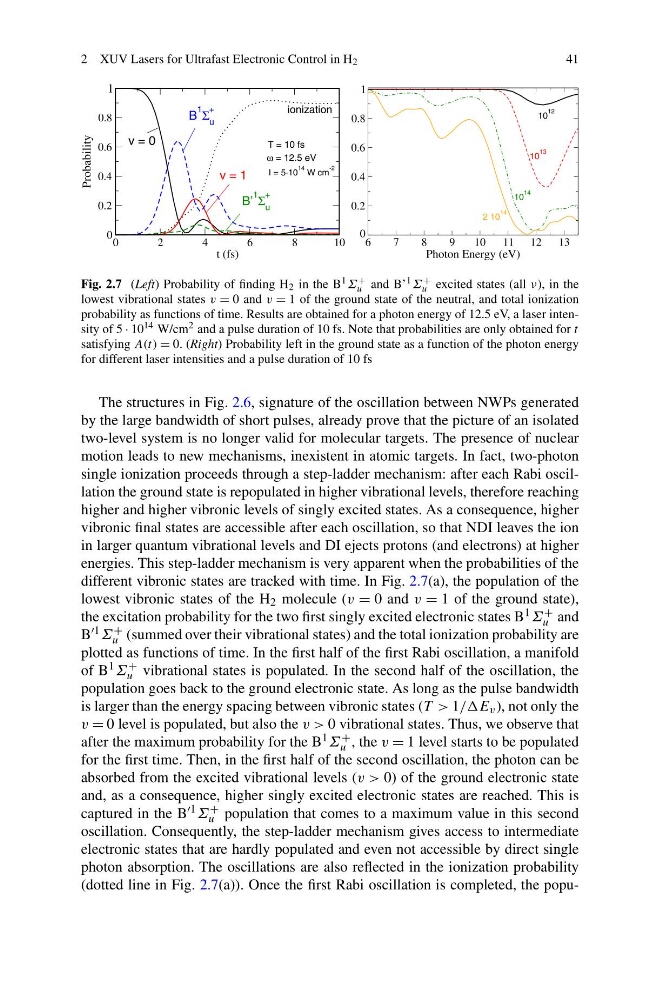
Fig. 2.7 (Left) Probability of finding H 2 in the B 1 Σ +
u and B’ 1 Σ +
u excited states (all ν), in the
lowest vibrational states v = 0 and v = 1 of the ground state of the neutral, and total ionization
probability as functions of time. Results are obtained for a photon energy of 12.5 eV, a laser intensity of 5 · 10 14 W/cm 2 and a pulse duration of 10 fs. Note that probabilities are only obtained for t
satisfying A(t) = 0. (Right) Probability left in the ground state as a function of the photon energy
for different laser intensities and a pulse duration of 10 fs
The structures in Fig. 2.6, signature of the oscillation between NWPs generated
by the large bandwidth of short pulses, already prove that the picture of an isolated
two-level system is no longer valid for molecular targets. The presence of nuclear
motion leads to new mechanisms, inexistent in atomic targets. In fact, two-photon
single ionization proceeds through a step-ladder mechanism: after each Rabi oscillation the ground state is repopulated in higher vibrational levels, therefore reaching
higher and higher vibronic levels of singly excited states. As a consequence, higher
vibronic final states are accessible after each oscillation, so that NDI leaves the ion
in larger quantum vibrational levels and DI ejects protons (and electrons) at higher
energies. This step-ladder mechanism is very apparent when the probabilities of the
different vibronic states are tracked with time. In Fig. 2.7(a), the population of the
lowest vibronic states of the H 2 molecule (v = 0 and v = 1 of the ground state),
the excitation probability for the two first singly excited electronic states B 1 Σ +
u and
B 1 Σ +
u (summed over their vibrational states) and the total ionization probability are
plotted as functions of time. In the first half of the first Rabi oscillation, a manifold
of B 1 Σ +
u vibrational states is populated. In the second half of the oscillation, the
population goes back to the ground electronic state. As long as the pulse bandwidth
is larger than the energy spacing between vibronic states (T > 1//E v ), not only the
v = 0 level is populated, but also the v > 0 vibrational states. Thus, we observe that
after the maximum probability for the B 1 Σ +
u , the v = 1 level starts to be populated
for the first time. Then, in the first half of the second oscillation, the photon can be
absorbed from the excited vibrational levels (v > 0) of the ground electronic state
and, as a consequence, higher singly excited electronic states are reached. This is
captured in the B 1 Σ +
u population that comes to a maximum value in this second
oscillation. Consequently, the step-ladder mechanism gives access to intermediate
electronic states that are hardly populated and even not accessible by direct single
photon absorption. The oscillations are also reflected in the ionization probability
(dotted line in Fig. 2.7(a)). Once the first Rabi oscillation is completed, the popu-
41
Fig. 2.7 (Left) Probability of finding H 2 in the B 1 Σ +
u and B’ 1 Σ +
u excited states (all ν), in the
lowest vibrational states v = 0 and v = 1 of the ground state of the neutral, and total ionization
probability as functions of time. Results are obtained for a photon energy of 12.5 eV, a laser intensity of 5 · 10 14 W/cm 2 and a pulse duration of 10 fs. Note that probabilities are only obtained for t
satisfying A(t) = 0. (Right) Probability left in the ground state as a function of the photon energy
for different laser intensities and a pulse duration of 10 fs
The structures in Fig. 2.6, signature of the oscillation between NWPs generated
by the large bandwidth of short pulses, already prove that the picture of an isolated
two-level system is no longer valid for molecular targets. The presence of nuclear
motion leads to new mechanisms, inexistent in atomic targets. In fact, two-photon
single ionization proceeds through a step-ladder mechanism: after each Rabi oscillation the ground state is repopulated in higher vibrational levels, therefore reaching
higher and higher vibronic levels of singly excited states. As a consequence, higher
vibronic final states are accessible after each oscillation, so that NDI leaves the ion
in larger quantum vibrational levels and DI ejects protons (and electrons) at higher
energies. This step-ladder mechanism is very apparent when the probabilities of the
different vibronic states are tracked with time. In Fig. 2.7(a), the population of the
lowest vibronic states of the H 2 molecule (v = 0 and v = 1 of the ground state),
the excitation probability for the two first singly excited electronic states B 1 Σ +
u and
B 1 Σ +
u (summed over their vibrational states) and the total ionization probability are
plotted as functions of time. In the first half of the first Rabi oscillation, a manifold
of B 1 Σ +
u vibrational states is populated. In the second half of the oscillation, the
population goes back to the ground electronic state. As long as the pulse bandwidth
is larger than the energy spacing between vibronic states (T > 1//E v ), not only the
v = 0 level is populated, but also the v > 0 vibrational states. Thus, we observe that
after the maximum probability for the B 1 Σ +
u , the v = 1 level starts to be populated
for the first time. Then, in the first half of the second oscillation, the photon can be
absorbed from the excited vibrational levels (v > 0) of the ground electronic state
and, as a consequence, higher singly excited electronic states are reached. This is
captured in the B 1 Σ +
u population that comes to a maximum value in this second
oscillation. Consequently, the step-ladder mechanism gives access to intermediate
electronic states that are hardly populated and even not accessible by direct single
photon absorption. The oscillations are also reflected in the ionization probability
(dotted line in Fig. 2.7(a)). Once the first Rabi oscillation is completed, the popu-