

40
A. Palacios et al.
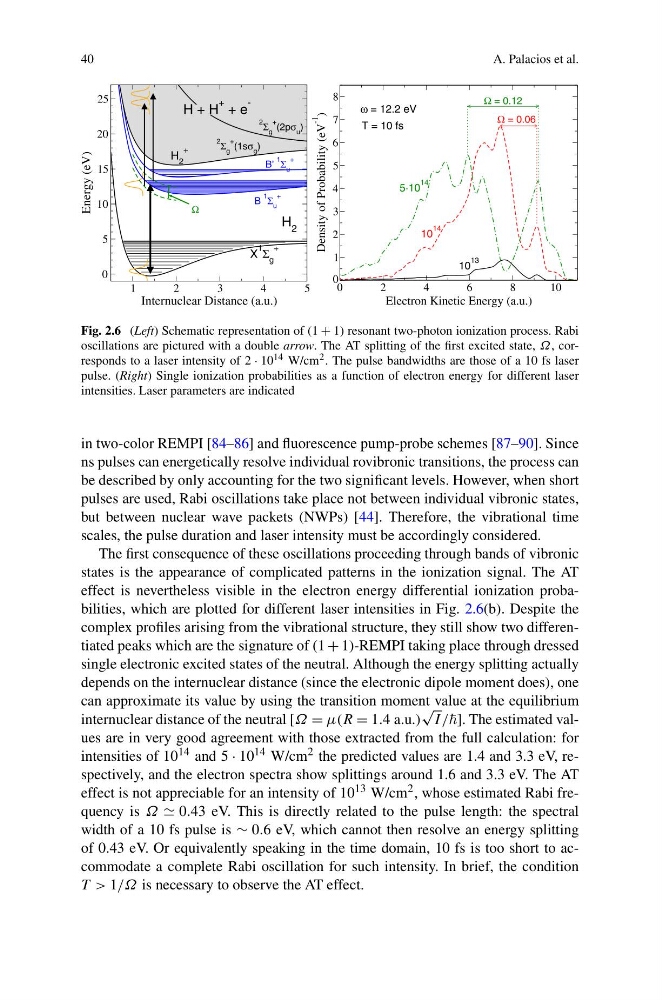
Fig. 2.6 (Left) Schematic representation of (1 + 1) resonant two-photon ionization process. Rabi
oscillations are pictured with a double arrow. The AT splitting of the first excited state, Ω, corresponds to a laser intensity of 2 · 10 14 W/cm 2 . The pulse bandwidths are those of a 10 fs laser
pulse. (Right) Single ionization probabilities as a function of electron energy for different laser
intensities. Laser parameters are indicated
in two-color REMPI [84–86] and fluorescence pump-probe schemes [87–90]. Since
ns pulses can energetically resolve individual rovibronic transitions, the process can
be described by only accounting for the two significant levels. However, when short
pulses are used, Rabi oscillations take place not between individual vibronic states,
but between nuclear wave packets (NWPs) [44]. Therefore, the vibrational time
scales, the pulse duration and laser intensity must be accordingly considered.
The first consequence of these oscillations proceeding through bands of vibronic
states is the appearance of complicated patterns in the ionization signal. The AT
effect is nevertheless visible in the electron energy differential ionization probabilities, which are plotted for different laser intensities in Fig. 2.6(b). Despite the
complex profiles arising from the vibrational structure, they still show two differentiated peaks which are the signature of (1 + 1)-REMPI taking place through dressed
single electronic excited states of the neutral. Although the energy splitting actually
depends on the internuclear distance (since the electronic dipole moment does), one
can approximate its value by using the transition moment value at the equilibrium
internuclear distance of the neutral [Ω = μ(R = 1.4 a.u.)
√
I /]. The estimated values are in very good agreement with those extracted from the full calculation: for
intensities of 10 14 and 5 · 10 14 W/cm 2 the predicted values are 1.4 and 3.3 eV, respectively, and the electron spectra show splittings around 1.6 and 3.3 eV. The AT
effect is not appreciable for an intensity of 10 13 W/cm 2 , whose estimated Rabi frequency is Ω 0.43 eV. This is directly related to the pulse length: the spectral
width of a 10 fs pulse is ∼ 0.6 eV, which cannot then resolve an energy splitting
of 0.43 eV. Or equivalently speaking in the time domain, 10 fs is too short to accommodate a complete Rabi oscillation for such intensity. In brief, the condition
T > 1/Ω is necessary to observe the AT effect.
A. Palacios et al.
Fig. 2.6 (Left) Schematic representation of (1 + 1) resonant two-photon ionization process. Rabi
oscillations are pictured with a double arrow. The AT splitting of the first excited state, Ω, corresponds to a laser intensity of 2 · 10 14 W/cm 2 . The pulse bandwidths are those of a 10 fs laser
pulse. (Right) Single ionization probabilities as a function of electron energy for different laser
intensities. Laser parameters are indicated
in two-color REMPI [84–86] and fluorescence pump-probe schemes [87–90]. Since
ns pulses can energetically resolve individual rovibronic transitions, the process can
be described by only accounting for the two significant levels. However, when short
pulses are used, Rabi oscillations take place not between individual vibronic states,
but between nuclear wave packets (NWPs) [44]. Therefore, the vibrational time
scales, the pulse duration and laser intensity must be accordingly considered.
The first consequence of these oscillations proceeding through bands of vibronic
states is the appearance of complicated patterns in the ionization signal. The AT
effect is nevertheless visible in the electron energy differential ionization probabilities, which are plotted for different laser intensities in Fig. 2.6(b). Despite the
complex profiles arising from the vibrational structure, they still show two differentiated peaks which are the signature of (1 + 1)-REMPI taking place through dressed
single electronic excited states of the neutral. Although the energy splitting actually
depends on the internuclear distance (since the electronic dipole moment does), one
can approximate its value by using the transition moment value at the equilibrium
internuclear distance of the neutral [Ω = μ(R = 1.4 a.u.)
√
I /]. The estimated values are in very good agreement with those extracted from the full calculation: for
intensities of 10 14 and 5 · 10 14 W/cm 2 the predicted values are 1.4 and 3.3 eV, respectively, and the electron spectra show splittings around 1.6 and 3.3 eV. The AT
effect is not appreciable for an intensity of 10 13 W/cm 2 , whose estimated Rabi frequency is Ω 0.43 eV. This is directly related to the pulse length: the spectral
width of a 10 fs pulse is ∼ 0.6 eV, which cannot then resolve an energy splitting
of 0.43 eV. Or equivalently speaking in the time domain, 10 fs is too short to accommodate a complete Rabi oscillation for such intensity. In brief, the condition
T > 1/Ω is necessary to observe the AT effect.