

36
A. Palacios et al.
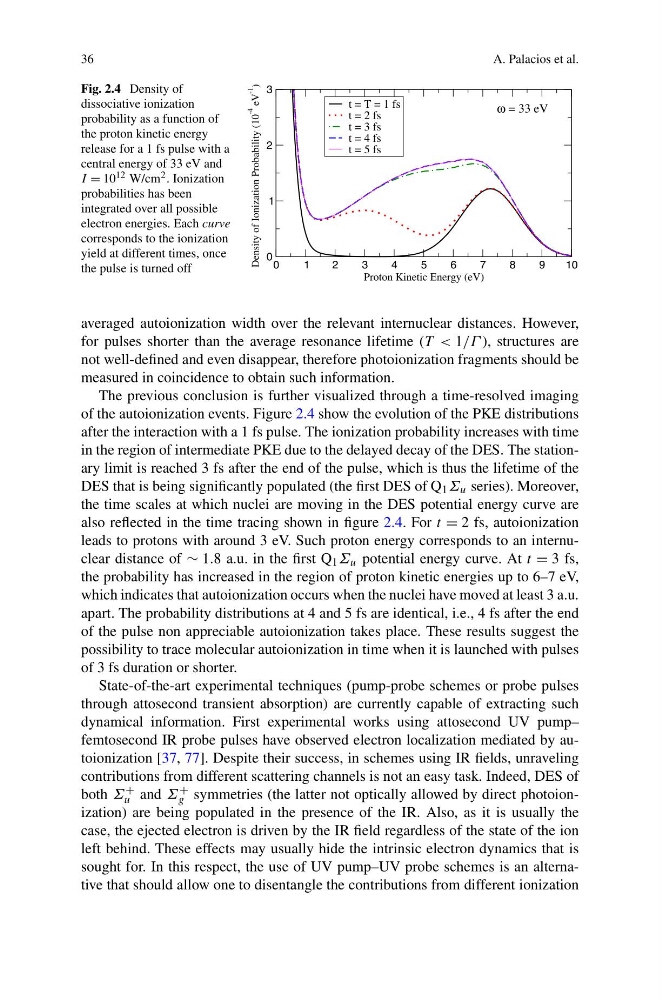
Fig. 2.4 Density of
dissociative ionization
probability as a function of
the proton kinetic energy
release for a 1 fs pulse with a
central energy of 33 eV and
I = 10 12 W/cm 2 . Ionization
probabilities has been
integrated over all possible
electron energies. Each curve
corresponds to the ionization
yield at different times, once
the pulse is turned off
averaged autoionization width over the relevant internuclear distances. However,
for pulses shorter than the average resonance lifetime (T < 1/Γ ), structures are
not well-defined and even disappear, therefore photoionization fragments should be
measured in coincidence to obtain such information.
The previous conclusion is further visualized through a time-resolved imaging
of the autoionization events. Figure 2.4 show the evolution of the PKE distributions
after the interaction with a 1 fs pulse. The ionization probability increases with time
in the region of intermediate PKE due to the delayed decay of the DES. The stationary limit is reached 3 fs after the end of the pulse, which is thus the lifetime of the
DES that is being significantly populated (the first DES of Q 1 Σ u series). Moreover,
the time scales at which nuclei are moving in the DES potential energy curve are
also reflected in the time tracing shown in figure 2.4. For t = 2 fs, autoionization
leads to protons with around 3 eV. Such proton energy corresponds to an internuclear distance of ∼ 1.8 a.u. in the first Q 1 Σ u potential energy curve. At t = 3 fs,
the probability has increased in the region of proton kinetic energies up to 6–7 eV,
which indicates that autoionization occurs when the nuclei have moved at least 3 a.u.
apart. The probability distributions at 4 and 5 fs are identical, i.e., 4 fs after the end
of the pulse non appreciable autoionization takes place. These results suggest the
possibility to trace molecular autoionization in time when it is launched with pulses
of 3 fs duration or shorter.
State-of-the-art experimental techniques (pump-probe schemes or probe pulses
through attosecond transient absorption) are currently capable of extracting such
dynamical information. First experimental works using attosecond UV pump–
femtosecond IR probe pulses have observed electron localization mediated by autoionization [37, 77]. Despite their success, in schemes using IR fields, unraveling
contributions from different scattering channels is not an easy task. Indeed, DES of
both Σ +
u and Σ +
g symmetries (the latter not optically allowed by direct photoionization) are being populated in the presence of the IR. Also, as it is usually the
case, the ejected electron is driven by the IR field regardless of the state of the ion
left behind. These effects may usually hide the intrinsic electron dynamics that is
sought for. In this respect, the use of UV pump–UV probe schemes is an alternative that should allow one to disentangle the contributions from different ionization
A. Palacios et al.
Fig. 2.4 Density of
dissociative ionization
probability as a function of
the proton kinetic energy
release for a 1 fs pulse with a
central energy of 33 eV and
I = 10 12 W/cm 2 . Ionization
probabilities has been
integrated over all possible
electron energies. Each curve
corresponds to the ionization
yield at different times, once
the pulse is turned off
averaged autoionization width over the relevant internuclear distances. However,
for pulses shorter than the average resonance lifetime (T < 1/Γ ), structures are
not well-defined and even disappear, therefore photoionization fragments should be
measured in coincidence to obtain such information.
The previous conclusion is further visualized through a time-resolved imaging
of the autoionization events. Figure 2.4 show the evolution of the PKE distributions
after the interaction with a 1 fs pulse. The ionization probability increases with time
in the region of intermediate PKE due to the delayed decay of the DES. The stationary limit is reached 3 fs after the end of the pulse, which is thus the lifetime of the
DES that is being significantly populated (the first DES of Q 1 Σ u series). Moreover,
the time scales at which nuclei are moving in the DES potential energy curve are
also reflected in the time tracing shown in figure 2.4. For t = 2 fs, autoionization
leads to protons with around 3 eV. Such proton energy corresponds to an internuclear distance of ∼ 1.8 a.u. in the first Q 1 Σ u potential energy curve. At t = 3 fs,
the probability has increased in the region of proton kinetic energies up to 6–7 eV,
which indicates that autoionization occurs when the nuclei have moved at least 3 a.u.
apart. The probability distributions at 4 and 5 fs are identical, i.e., 4 fs after the end
of the pulse non appreciable autoionization takes place. These results suggest the
possibility to trace molecular autoionization in time when it is launched with pulses
of 3 fs duration or shorter.
State-of-the-art experimental techniques (pump-probe schemes or probe pulses
through attosecond transient absorption) are currently capable of extracting such
dynamical information. First experimental works using attosecond UV pump–
femtosecond IR probe pulses have observed electron localization mediated by autoionization [37, 77]. Despite their success, in schemes using IR fields, unraveling
contributions from different scattering channels is not an easy task. Indeed, DES of
both Σ +
u and Σ +
g symmetries (the latter not optically allowed by direct photoionization) are being populated in the presence of the IR. Also, as it is usually the
case, the ejected electron is driven by the IR field regardless of the state of the ion
left behind. These effects may usually hide the intrinsic electron dynamics that is
sought for. In this respect, the use of UV pump–UV probe schemes is an alternative that should allow one to disentangle the contributions from different ionization