

30
A. Palacios et al.
and ˆ
V (r, t) the interaction potential with the field. The laser-molecule interaction
is treated under the dipole approximation and the electromagnetic field is written
within the semiclassical approximation, which are valid for the wavelengths used in
the present work, in the UV and XUV regions.
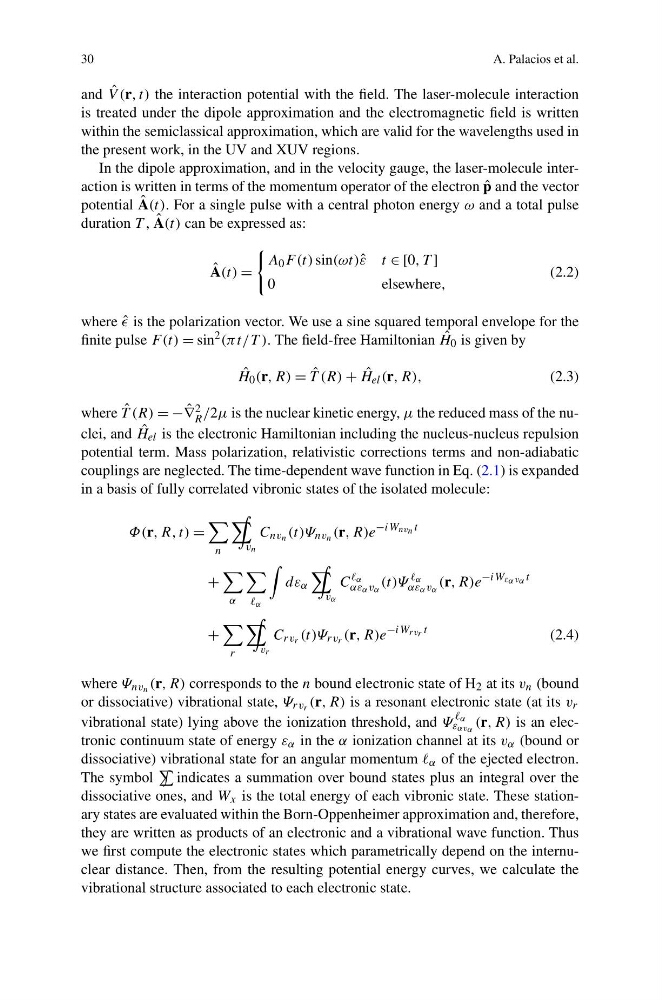
In the dipole approximation, and in the velocity gauge, the laser-molecule interaction is written in terms of the momentum operator of the electron ˆ
p and the vector
potential ˆ
A(t). For a single pulse with a central photon energy ω and a total pulse
duration T , ˆ
A(t) can be expressed as:
ˆ
A(t) =
A 0 F (t) sin(ωt)ˆ ε t ∈ [0, T ]
0
elsewhere,
(2.2)
where ˆ
is the polarization vector. We use a sine squared temporal envelope for the
finite pulse F (t) = sin
2 (πt/T ). The field-free Hamiltonian ˆ
H 0 is given by
ˆ
H 0 (r, R) = ˆ
T (R) + ˆ
H el (r, R),
(2.3)
where ˆ
T (R) = − ˆ
∇ 2
R /2μ is the nuclear kinetic energy, μ the reduced mass of the nuclei, and ˆ
H el is the electronic Hamiltonian including the nucleus-nucleus repulsion
potential term. Mass polarization, relativistic corrections terms and non-adiabatic
couplings are neglected. The time-dependent wave function in Eq. (2.1) is expanded
in a basis of fully correlated vibronic states of the isolated molecule:
Φ(r, R, t) =
n
v n
C nv n (t)Ψ nv n (r, R)e
−iW nvn t
+
α
α
dε α
v α
C
α
αε α v α
(t)Ψ
α
αε α v α
(r, R)e
−iW εα vα t
+
r
v r
C rv r (t)Ψ rv r (r, R)e
−iW rvr t
(2.4)
where Ψ nv n (r, R) corresponds to the n bound electronic state of H 2 at its v n (bound
or dissociative) vibrational state, Ψ rv r (r, R) is a resonant electronic state (at its v r
vibrational state) lying above the ionization threshold, and Ψ
α
ε αvα (r, R) is an electronic continuum state of energy ε α in the α ionization channel at its v α (bound or
dissociative) vibrational state for an angular momentum α of the ejected electron.
The symbol
indicates a summation over bound states plus an integral over the
dissociative ones, and W x is the total energy of each vibronic state. These stationary states are evaluated within the Born-Oppenheimer approximation and, therefore,
they are written as products of an electronic and a vibrational wave function. Thus
we first compute the electronic states which parametrically depend on the internuclear distance. Then, from the resulting potential energy curves, we calculate the
vibrational structure associated to each electronic state.
A. Palacios et al.
and ˆ
V (r, t) the interaction potential with the field. The laser-molecule interaction
is treated under the dipole approximation and the electromagnetic field is written
within the semiclassical approximation, which are valid for the wavelengths used in
the present work, in the UV and XUV regions.
In the dipole approximation, and in the velocity gauge, the laser-molecule interaction is written in terms of the momentum operator of the electron ˆ
p and the vector
potential ˆ
A(t). For a single pulse with a central photon energy ω and a total pulse
duration T , ˆ
A(t) can be expressed as:
ˆ
A(t) =
A 0 F (t) sin(ωt)ˆ ε t ∈ [0, T ]
0
elsewhere,
(2.2)
where ˆ
is the polarization vector. We use a sine squared temporal envelope for the
finite pulse F (t) = sin
2 (πt/T ). The field-free Hamiltonian ˆ
H 0 is given by
ˆ
H 0 (r, R) = ˆ
T (R) + ˆ
H el (r, R),
(2.3)
where ˆ
T (R) = − ˆ
∇ 2
R /2μ is the nuclear kinetic energy, μ the reduced mass of the nuclei, and ˆ
H el is the electronic Hamiltonian including the nucleus-nucleus repulsion
potential term. Mass polarization, relativistic corrections terms and non-adiabatic
couplings are neglected. The time-dependent wave function in Eq. (2.1) is expanded
in a basis of fully correlated vibronic states of the isolated molecule:
Φ(r, R, t) =
n
v n
C nv n (t)Ψ nv n (r, R)e
−iW nvn t
+
α
α
dε α
v α
C
α
αε α v α
(t)Ψ
α
αε α v α
(r, R)e
−iW εα vα t
+
r
v r
C rv r (t)Ψ rv r (r, R)e
−iW rvr t
(2.4)
where Ψ nv n (r, R) corresponds to the n bound electronic state of H 2 at its v n (bound
or dissociative) vibrational state, Ψ rv r (r, R) is a resonant electronic state (at its v r
vibrational state) lying above the ionization threshold, and Ψ
α
ε αvα (r, R) is an electronic continuum state of energy ε α in the α ionization channel at its v α (bound or
dissociative) vibrational state for an angular momentum α of the ejected electron.
The symbol
indicates a summation over bound states plus an integral over the
dissociative ones, and W x is the total energy of each vibronic state. These stationary states are evaluated within the Born-Oppenheimer approximation and, therefore,
they are written as products of an electronic and a vibrational wave function. Thus
we first compute the electronic states which parametrically depend on the internuclear distance. Then, from the resulting potential energy curves, we calculate the
vibrational structure associated to each electronic state.