

2 XUV Lasers for Ultrafast Electronic Control in H 2
29
The advent of ultrashort laser technology, producing actual time-resolved pictures of electron dynamics in small molecules [16, 18, 19, 50], posed the challenge
for homologous time-dependent theoretical approaches. Full dimensional methods
in the time domain have been recently developed, thus opening the way to explore
multiphoton single ionization processes on hydrogen molecules subject to ultrashort pulses [51–54]. The essence of these methods is given in this section. Further
methodological and computational details can be found in [54].
Despite the demonstrated suitability of existing methods for a large number of
fundamental problems induced by diverse radiation sources in hydrogen molecules,
the study of double ionization by including the nuclear motion remains an unresolved matter. The main difficulties, which particularly make spectral methods illsuited, are the large size of the problem and the correct description of the full-body
Coulomb break-up. Within the FNA, several attempts to solve one-photon double
ionization of H 2 have made use of close-coupling methods [55–58] or pure numerical representations of the wave packet [59–61]. In reference [62], the nuclear motion
was taken into account within the Born-Oppenheimer (BO) approximation. These
numerical approaches are promising and, although still restricted to the FNA or the
BO approximation, they have already provided first results on two-photon double
ionization of H 2 [63–65], for which experiments were recently carried out [33, 34].
In spite of the good qualitative agreement shown with experimental data, the theoretical calculations reported in [33, 34] assumed the separability of each photon
absorption, thus preventing a quantitative comparison. Undoubtedly, further theoretical and computational efforts are still required to describe molecular multiphoton
double ionization and the molecular motion associated with it.
In the following, we focus on molecular single ionization processes induced by
UV and XUV ultrashort pulses, which demand time-dependent, full dimensional
theoretical approaches. The theoretical methodology here described has been presented in detail in previous works. The fundaments to compute the molecular structure within the Feshbach theory can be found in [45, 66]. The latter developments of
this formalism within a time-dependent treatment are explained in [53, 54]. We next
summarize the key steps in the theoretical method and its current implementation.
Atomic units are used throughout unless otherwise indicated.
2.3.1 Time-Dependent Spectral Method
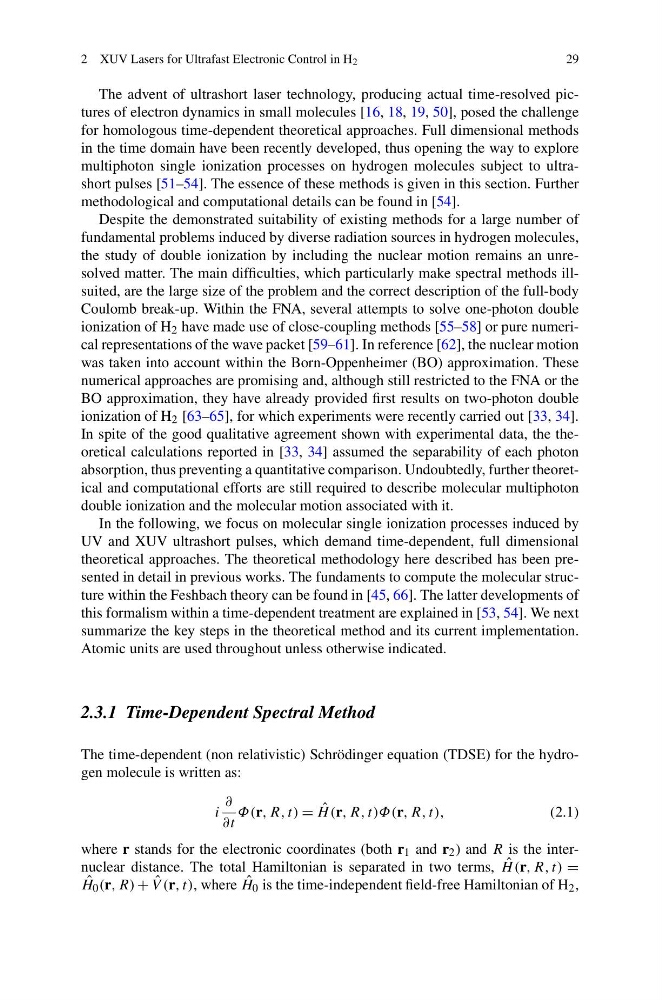
The time-dependent (non relativistic) Schrödinger equation (TDSE) for the hydrogen molecule is written as:
i
∂
∂t
Φ(r, R, t) = ˆ
H (r, R, t)Φ(r, R, t),
(2.1)
where r stands for the electronic coordinates (both r 1 and r 2 ) and R is the internuclear distance. The total Hamiltonian is separated in two terms, ˆ
H (r, R, t) =
ˆ
H 0 (r, R) + ˆ
V (r, t), where ˆ
H 0 is the time-independent field-free Hamiltonian of H 2 ,
29
The advent of ultrashort laser technology, producing actual time-resolved pictures of electron dynamics in small molecules [16, 18, 19, 50], posed the challenge
for homologous time-dependent theoretical approaches. Full dimensional methods
in the time domain have been recently developed, thus opening the way to explore
multiphoton single ionization processes on hydrogen molecules subject to ultrashort pulses [51–54]. The essence of these methods is given in this section. Further
methodological and computational details can be found in [54].
Despite the demonstrated suitability of existing methods for a large number of
fundamental problems induced by diverse radiation sources in hydrogen molecules,
the study of double ionization by including the nuclear motion remains an unresolved matter. The main difficulties, which particularly make spectral methods illsuited, are the large size of the problem and the correct description of the full-body
Coulomb break-up. Within the FNA, several attempts to solve one-photon double
ionization of H 2 have made use of close-coupling methods [55–58] or pure numerical representations of the wave packet [59–61]. In reference [62], the nuclear motion
was taken into account within the Born-Oppenheimer (BO) approximation. These
numerical approaches are promising and, although still restricted to the FNA or the
BO approximation, they have already provided first results on two-photon double
ionization of H 2 [63–65], for which experiments were recently carried out [33, 34].
In spite of the good qualitative agreement shown with experimental data, the theoretical calculations reported in [33, 34] assumed the separability of each photon
absorption, thus preventing a quantitative comparison. Undoubtedly, further theoretical and computational efforts are still required to describe molecular multiphoton
double ionization and the molecular motion associated with it.
In the following, we focus on molecular single ionization processes induced by
UV and XUV ultrashort pulses, which demand time-dependent, full dimensional
theoretical approaches. The theoretical methodology here described has been presented in detail in previous works. The fundaments to compute the molecular structure within the Feshbach theory can be found in [45, 66]. The latter developments of
this formalism within a time-dependent treatment are explained in [53, 54]. We next
summarize the key steps in the theoretical method and its current implementation.
Atomic units are used throughout unless otherwise indicated.
2.3.1 Time-Dependent Spectral Method
The time-dependent (non relativistic) Schrödinger equation (TDSE) for the hydrogen molecule is written as:
i
∂
∂t
Φ(r, R, t) = ˆ
H (r, R, t)Φ(r, R, t),
(2.1)
where r stands for the electronic coordinates (both r 1 and r 2 ) and R is the internuclear distance. The total Hamiltonian is separated in two terms, ˆ
H (r, R, t) =
ˆ
H 0 (r, R) + ˆ
V (r, t), where ˆ
H 0 is the time-independent field-free Hamiltonian of H 2 ,