

18
A. Rouzée et al.
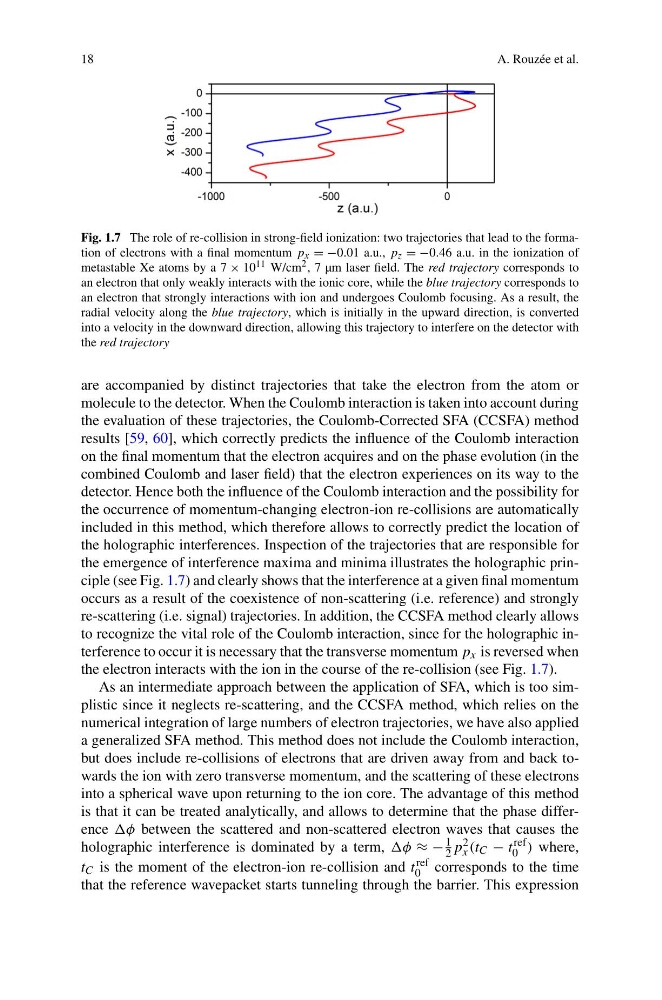
Fig. 1.7 The role of re-collision in strong-field ionization: two trajectories that lead to the formation of electrons with a final momentum p x = −0.01 a.u., p z = −0.46 a.u. in the ionization of
metastable Xe atoms by a 7 × 10 11 W/cm
2 , 7 µm laser field. The red trajectory corresponds to
an electron that only weakly interacts with the ionic core, while the blue trajectory corresponds to
an electron that strongly interactions with ion and undergoes Coulomb focusing. As a result, the
radial velocity along the blue trajectory, which is initially in the upward direction, is converted
into a velocity in the downward direction, allowing this trajectory to interfere on the detector with
the red trajectory
are accompanied by distinct trajectories that take the electron from the atom or
molecule to the detector. When the Coulomb interaction is taken into account during
the evaluation of these trajectories, the Coulomb-Corrected SFA (CCSFA) method
results [59, 60], which correctly predicts the influence of the Coulomb interaction
on the final momentum that the electron acquires and on the phase evolution (in the
combined Coulomb and laser field) that the electron experiences on its way to the
detector. Hence both the influence of the Coulomb interaction and the possibility for
the occurrence of momentum-changing electron-ion re-collisions are automatically
included in this method, which therefore allows to correctly predict the location of
the holographic interferences. Inspection of the trajectories that are responsible for
the emergence of interference maxima and minima illustrates the holographic principle (see Fig. 1.7) and clearly shows that the interference at a given final momentum
occurs as a result of the coexistence of non-scattering (i.e. reference) and strongly
re-scattering (i.e. signal) trajectories. In addition, the CCSFA method clearly allows
to recognize the vital role of the Coulomb interaction, since for the holographic interference to occur it is necessary that the transverse momentum p x is reversed when
the electron interacts with the ion in the course of the re-collision (see Fig. 1.7).
As an intermediate approach between the application of SFA, which is too simplistic since it neglects re-scattering, and the CCSFA method, which relies on the
numerical integration of large numbers of electron trajectories, we have also applied
a generalized SFA method. This method does not include the Coulomb interaction,
but does include re-collisions of electrons that are driven away from and back towards the ion with zero transverse momentum, and the scattering of these electrons
into a spherical wave upon returning to the ion core. The advantage of this method
is that it can be treated analytically, and allows to determine that the phase difference φ between the scattered and non-scattered electron waves that causes the
holographic interference is dominated by a term, φ ≈ −
1
2 p 2
x (t C − t ref
0 ) where,
t C is the moment of the electron-ion re-collision and t ref
0 corresponds to the time
that the reference wavepacket starts tunneling through the barrier. This expression
A. Rouzée et al.
Fig. 1.7 The role of re-collision in strong-field ionization: two trajectories that lead to the formation of electrons with a final momentum p x = −0.01 a.u., p z = −0.46 a.u. in the ionization of
metastable Xe atoms by a 7 × 10 11 W/cm
2 , 7 µm laser field. The red trajectory corresponds to
an electron that only weakly interacts with the ionic core, while the blue trajectory corresponds to
an electron that strongly interactions with ion and undergoes Coulomb focusing. As a result, the
radial velocity along the blue trajectory, which is initially in the upward direction, is converted
into a velocity in the downward direction, allowing this trajectory to interfere on the detector with
the red trajectory
are accompanied by distinct trajectories that take the electron from the atom or
molecule to the detector. When the Coulomb interaction is taken into account during
the evaluation of these trajectories, the Coulomb-Corrected SFA (CCSFA) method
results [59, 60], which correctly predicts the influence of the Coulomb interaction
on the final momentum that the electron acquires and on the phase evolution (in the
combined Coulomb and laser field) that the electron experiences on its way to the
detector. Hence both the influence of the Coulomb interaction and the possibility for
the occurrence of momentum-changing electron-ion re-collisions are automatically
included in this method, which therefore allows to correctly predict the location of
the holographic interferences. Inspection of the trajectories that are responsible for
the emergence of interference maxima and minima illustrates the holographic principle (see Fig. 1.7) and clearly shows that the interference at a given final momentum
occurs as a result of the coexistence of non-scattering (i.e. reference) and strongly
re-scattering (i.e. signal) trajectories. In addition, the CCSFA method clearly allows
to recognize the vital role of the Coulomb interaction, since for the holographic interference to occur it is necessary that the transverse momentum p x is reversed when
the electron interacts with the ion in the course of the re-collision (see Fig. 1.7).
As an intermediate approach between the application of SFA, which is too simplistic since it neglects re-scattering, and the CCSFA method, which relies on the
numerical integration of large numbers of electron trajectories, we have also applied
a generalized SFA method. This method does not include the Coulomb interaction,
but does include re-collisions of electrons that are driven away from and back towards the ion with zero transverse momentum, and the scattering of these electrons
into a spherical wave upon returning to the ion core. The advantage of this method
is that it can be treated analytically, and allows to determine that the phase difference φ between the scattered and non-scattered electron waves that causes the
holographic interference is dominated by a term, φ ≈ −
1
2 p 2
x (t C − t ref
0 ) where,
t C is the moment of the electron-ion re-collision and t ref
0 corresponds to the time
that the reference wavepacket starts tunneling through the barrier. This expression