

278
F. Chaussard et al.
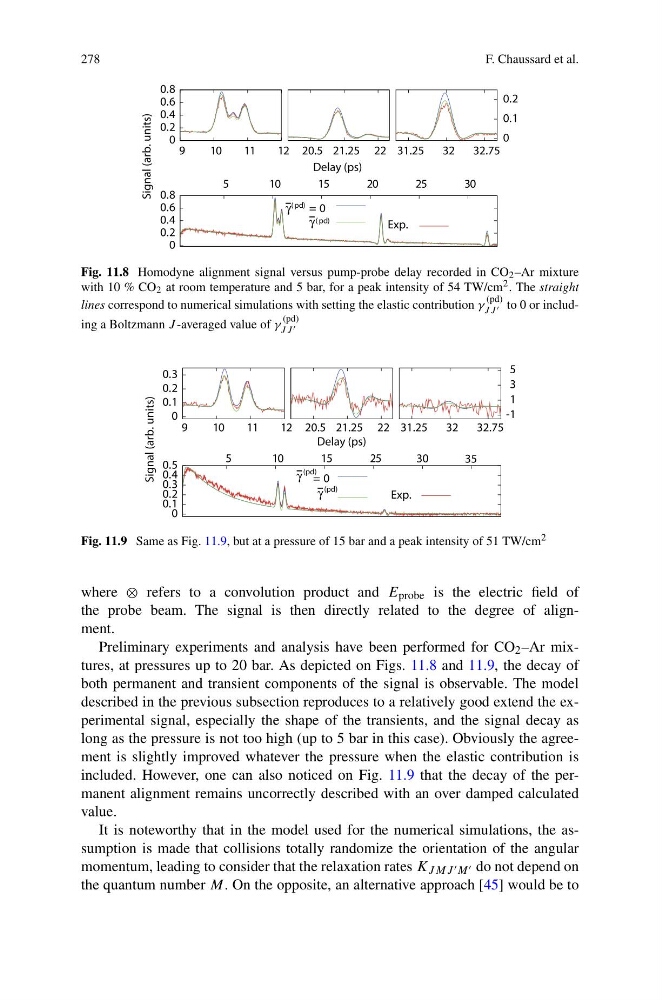
Fig. 11.8 Homodyne alignment signal versus pump-probe delay recorded in CO 2 –Ar mixture
with 10 % CO 2 at room temperature and 5 bar, for a peak intensity of 54 TW/cm 2 . The straight
lines correspond to numerical simulations with setting the elastic contribution γ
(pd)
J J to 0 or including a Boltzmann J -averaged value of γ
(pd)
J J
Fig. 11.9 Same as Fig. 11.9, but at a pressure of 15 bar and a peak intensity of 51 TW/cm 2
where ⊗ refers to a convolution product and E probe is the electric field of
the probe beam. The signal is then directly related to the degree of alignment.
Preliminary experiments and analysis have been performed for CO 2 –Ar mixtures, at pressures up to 20 bar. As depicted on Figs. 11.8 and 11.9, the decay of
both permanent and transient components of the signal is observable. The model
described in the previous subsection reproduces to a relatively good extend the experimental signal, especially the shape of the transients, and the signal decay as
long as the pressure is not too high (up to 5 bar in this case). Obviously the agreement is slightly improved whatever the pressure when the elastic contribution is
included. However, one can also noticed on Fig. 11.9 that the decay of the permanent alignment remains uncorrectly described with an over damped calculated
value.
It is noteworthy that in the model used for the numerical simulations, the assumption is made that collisions totally randomize the orientation of the angular
momentum, leading to consider that the relaxation rates K J MJ M do not depend on
the quantum number M. On the opposite, an alternative approach [45] would be to
F. Chaussard et al.
Fig. 11.8 Homodyne alignment signal versus pump-probe delay recorded in CO 2 –Ar mixture
with 10 % CO 2 at room temperature and 5 bar, for a peak intensity of 54 TW/cm 2 . The straight
lines correspond to numerical simulations with setting the elastic contribution γ
(pd)
J J to 0 or including a Boltzmann J -averaged value of γ
(pd)
J J
Fig. 11.9 Same as Fig. 11.9, but at a pressure of 15 bar and a peak intensity of 51 TW/cm 2
where ⊗ refers to a convolution product and E probe is the electric field of
the probe beam. The signal is then directly related to the degree of alignment.
Preliminary experiments and analysis have been performed for CO 2 –Ar mixtures, at pressures up to 20 bar. As depicted on Figs. 11.8 and 11.9, the decay of
both permanent and transient components of the signal is observable. The model
described in the previous subsection reproduces to a relatively good extend the experimental signal, especially the shape of the transients, and the signal decay as
long as the pressure is not too high (up to 5 bar in this case). Obviously the agreement is slightly improved whatever the pressure when the elastic contribution is
included. However, one can also noticed on Fig. 11.9 that the decay of the permanent alignment remains uncorrectly described with an over damped calculated
value.
It is noteworthy that in the model used for the numerical simulations, the assumption is made that collisions totally randomize the orientation of the angular
momentum, leading to consider that the relaxation rates K J MJ M do not depend on
the quantum number M. On the opposite, an alternative approach [45] would be to