

11 Optical Diagnostics with Ultrafast and Strong Field Raman Techniques
267
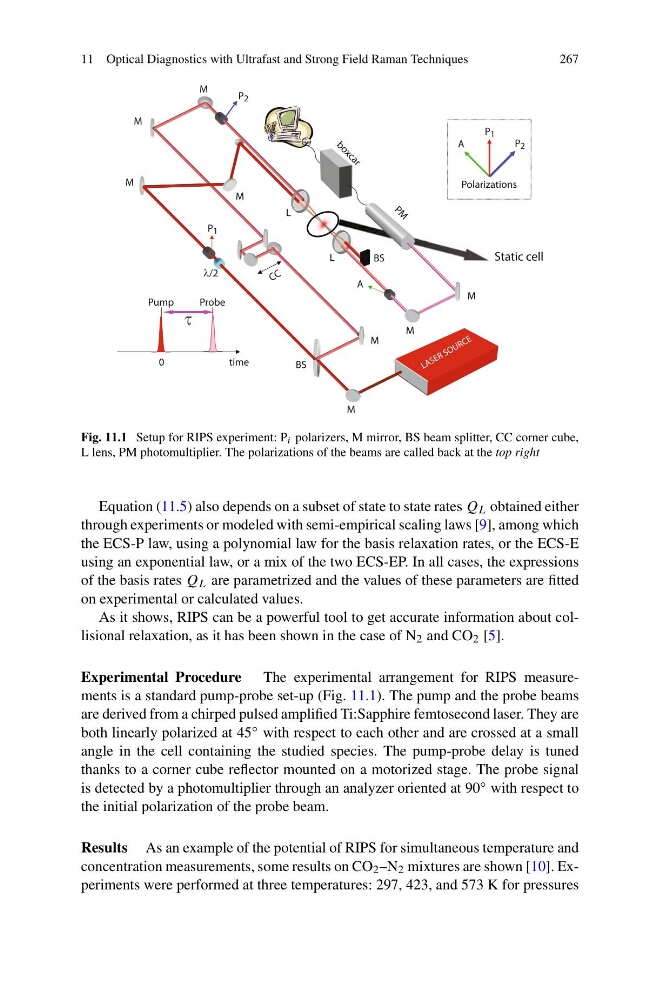
Fig. 11.1 Setup for RIPS experiment: P i polarizers, M mirror, BS beam splitter, CC corner cube,
L lens, PM photomultiplier. The polarizations of the beams are called back at the top right
Equation (11.5) also depends on a subset of state to state rates Q L obtained either
through experiments or modeled with semi-empirical scaling laws [9], among which
the ECS-P law, using a polynomial law for the basis relaxation rates, or the ECS-E
using an exponential law, or a mix of the two ECS-EP. In all cases, the expressions
of the basis rates Q L are parametrized and the values of these parameters are fitted
on experimental or calculated values.
As it shows, RIPS can be a powerful tool to get accurate information about collisional relaxation, as it has been shown in the case of N 2 and CO 2 [5].
Experimental Procedure The experimental arrangement for RIPS measurements is a standard pump-probe set-up (Fig. 11.1). The pump and the probe beams
are derived from a chirped pulsed amplified Ti:Sapphire femtosecond laser. They are
both linearly polarized at 45 ◦ with respect to each other and are crossed at a small
angle in the cell containing the studied species. The pump-probe delay is tuned
thanks to a corner cube reflector mounted on a motorized stage. The probe signal
is detected by a photomultiplier through an analyzer oriented at 90 ◦ with respect to
the initial polarization of the probe beam.
Results As an example of the potential of RIPS for simultaneous temperature and
concentration measurements, some results on CO 2 –N 2 mixtures are shown [10]. Experiments were performed at three temperatures: 297, 423, and 573 K for pressures
267
Fig. 11.1 Setup for RIPS experiment: P i polarizers, M mirror, BS beam splitter, CC corner cube,
L lens, PM photomultiplier. The polarizations of the beams are called back at the top right
Equation (11.5) also depends on a subset of state to state rates Q L obtained either
through experiments or modeled with semi-empirical scaling laws [9], among which
the ECS-P law, using a polynomial law for the basis relaxation rates, or the ECS-E
using an exponential law, or a mix of the two ECS-EP. In all cases, the expressions
of the basis rates Q L are parametrized and the values of these parameters are fitted
on experimental or calculated values.
As it shows, RIPS can be a powerful tool to get accurate information about collisional relaxation, as it has been shown in the case of N 2 and CO 2 [5].
Experimental Procedure The experimental arrangement for RIPS measurements is a standard pump-probe set-up (Fig. 11.1). The pump and the probe beams
are derived from a chirped pulsed amplified Ti:Sapphire femtosecond laser. They are
both linearly polarized at 45 ◦ with respect to each other and are crossed at a small
angle in the cell containing the studied species. The pump-probe delay is tuned
thanks to a corner cube reflector mounted on a motorized stage. The probe signal
is detected by a photomultiplier through an analyzer oriented at 90 ◦ with respect to
the initial polarization of the probe beam.
Results As an example of the potential of RIPS for simultaneous temperature and
concentration measurements, some results on CO 2 –N 2 mixtures are shown [10]. Experiments were performed at three temperatures: 297, 423, and 573 K for pressures