

10 Surface-Aligned Femtochemistry: Dynamics on Oxide Surfaces
253
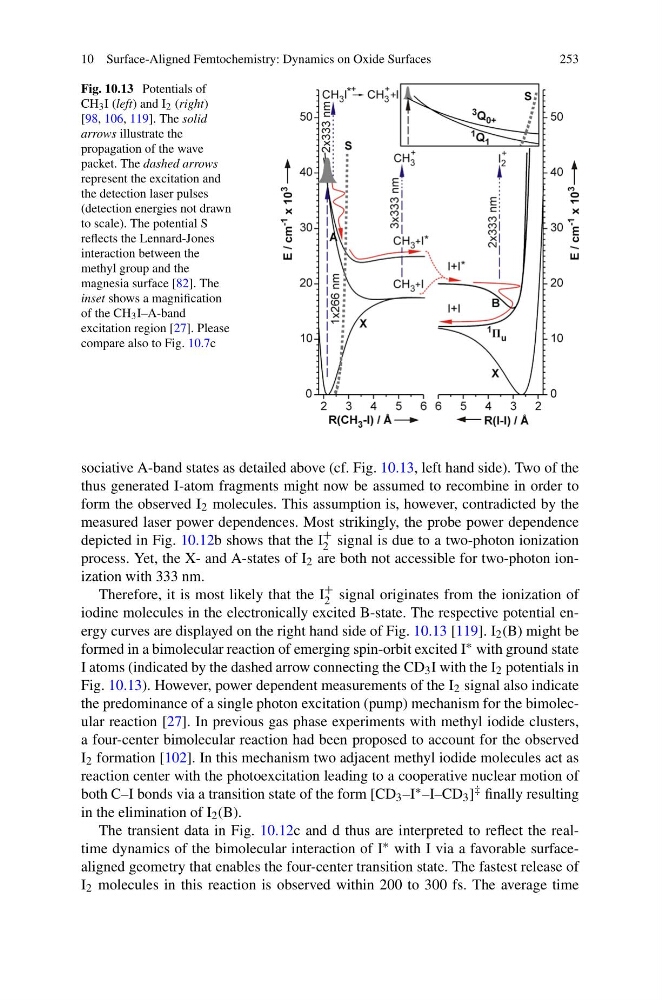
Fig. 10.13 Potentials of
CH 3 I (left) and I 2 (right)
[98, 106, 119]. The solid
arrows illustrate the
propagation of the wave
packet. The dashed arrows
represent the excitation and
the detection laser pulses
(detection energies not drawn
to scale). The potential S
reflects the Lennard-Jones
interaction between the
methyl group and the
magnesia surface [82]. The
inset shows a magnification
of the CH 3 I–A-band
excitation region [27]. Please
compare also to Fig. 10.7c
sociative A-band states as detailed above (cf. Fig. 10.13, left hand side). Two of the
thus generated I-atom fragments might now be assumed to recombine in order to
form the observed I 2 molecules. This assumption is, however, contradicted by the
measured laser power dependences. Most strikingly, the probe power dependence
depicted in Fig. 10.12b shows that the I
+
2 signal is due to a two-photon ionization
process. Yet, the X- and A-states of I 2 are both not accessible for two-photon ionization with 333 nm.
Therefore, it is most likely that the I
+
2 signal originates from the ionization of
iodine molecules in the electronically excited B-state. The respective potential energy curves are displayed on the right hand side of Fig. 10.13 [119]. I 2 (B) might be
formed in a bimolecular reaction of emerging spin-orbit excited I ∗ with ground state
I atoms (indicated by the dashed arrow connecting the CD 3 I with the I 2 potentials in
Fig. 10.13). However, power dependent measurements of the I 2 signal also indicate
the predominance of a single photon excitation (pump) mechanism for the bimolecular reaction [27]. In previous gas phase experiments with methyl iodide clusters,
a four-center bimolecular reaction had been proposed to account for the observed
I 2 formation [102]. In this mechanism two adjacent methyl iodide molecules act as
reaction center with the photoexcitation leading to a cooperative nuclear motion of
both C–I bonds via a transition state of the form [CD 3 –I ∗ –I–CD 3 ] ‡ finally resulting
in the elimination of I 2 (B).
The transient data in Fig. 10.12c and d thus are interpreted to reflect the realtime dynamics of the bimolecular interaction of I ∗ with I via a favorable surfacealigned geometry that enables the four-center transition state. The fastest release of
I 2 molecules in this reaction is observed within 200 to 300 fs. The average time
253
Fig. 10.13 Potentials of
CH 3 I (left) and I 2 (right)
[98, 106, 119]. The solid
arrows illustrate the
propagation of the wave
packet. The dashed arrows
represent the excitation and
the detection laser pulses
(detection energies not drawn
to scale). The potential S
reflects the Lennard-Jones
interaction between the
methyl group and the
magnesia surface [82]. The
inset shows a magnification
of the CH 3 I–A-band
excitation region [27]. Please
compare also to Fig. 10.7c
sociative A-band states as detailed above (cf. Fig. 10.13, left hand side). Two of the
thus generated I-atom fragments might now be assumed to recombine in order to
form the observed I 2 molecules. This assumption is, however, contradicted by the
measured laser power dependences. Most strikingly, the probe power dependence
depicted in Fig. 10.12b shows that the I
+
2 signal is due to a two-photon ionization
process. Yet, the X- and A-states of I 2 are both not accessible for two-photon ionization with 333 nm.
Therefore, it is most likely that the I
+
2 signal originates from the ionization of
iodine molecules in the electronically excited B-state. The respective potential energy curves are displayed on the right hand side of Fig. 10.13 [119]. I 2 (B) might be
formed in a bimolecular reaction of emerging spin-orbit excited I ∗ with ground state
I atoms (indicated by the dashed arrow connecting the CD 3 I with the I 2 potentials in
Fig. 10.13). However, power dependent measurements of the I 2 signal also indicate
the predominance of a single photon excitation (pump) mechanism for the bimolecular reaction [27]. In previous gas phase experiments with methyl iodide clusters,
a four-center bimolecular reaction had been proposed to account for the observed
I 2 formation [102]. In this mechanism two adjacent methyl iodide molecules act as
reaction center with the photoexcitation leading to a cooperative nuclear motion of
both C–I bonds via a transition state of the form [CD 3 –I ∗ –I–CD 3 ] ‡ finally resulting
in the elimination of I 2 (B).
The transient data in Fig. 10.12c and d thus are interpreted to reflect the realtime dynamics of the bimolecular interaction of I ∗ with I via a favorable surfacealigned geometry that enables the four-center transition state. The fastest release of
I 2 molecules in this reaction is observed within 200 to 300 fs. The average time