

252
M.E. Vaida and T.M. Bernhardt
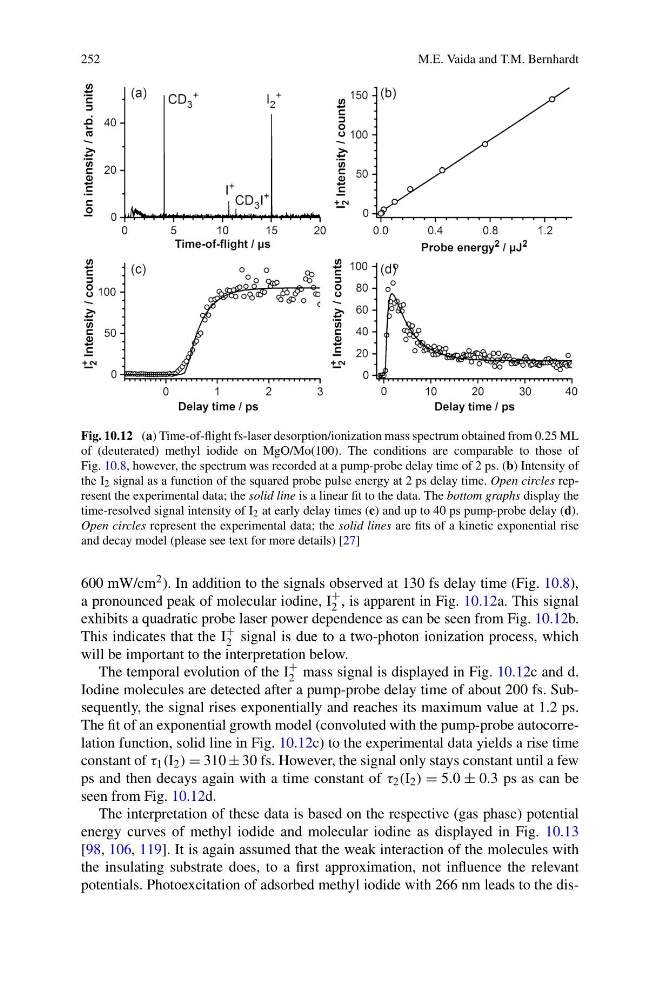
Fig. 10.12 (a) Time-of-flight fs-laser desorption/ionization mass spectrum obtained from 0.25 ML
of (deuterated) methyl iodide on MgO/Mo(100). The conditions are comparable to those of
Fig. 10.8, however, the spectrum was recorded at a pump-probe delay time of 2 ps. (b) Intensity of
the I 2 signal as a function of the squared probe pulse energy at 2 ps delay time. Open circles represent the experimental data; the solid line is a linear fit to the data. The bottom graphs display the
time-resolved signal intensity of I 2 at early delay times (c) and up to 40 ps pump-probe delay (d).
Open circles represent the experimental data; the solid lines are fits of a kinetic exponential rise
and decay model (please see text for more details) [27]
600 mW/cm 2 ). In addition to the signals observed at 130 fs delay time (Fig. 10.8),
a pronounced peak of molecular iodine, I
+
2 , is apparent in Fig. 10.12a. This signal
exhibits a quadratic probe laser power dependence as can be seen from Fig. 10.12b.
This indicates that the I
+
2 signal is due to a two-photon ionization process, which
will be important to the interpretation below.
The temporal evolution of the I
+
2 mass signal is displayed in Fig. 10.12c and d.
Iodine molecules are detected after a pump-probe delay time of about 200 fs. Subsequently, the signal rises exponentially and reaches its maximum value at 1.2 ps.
The fit of an exponential growth model (convoluted with the pump-probe autocorrelation function, solid line in Fig. 10.12c) to the experimental data yields a rise time
constant of τ 1 (I 2 ) = 310 ± 30 fs. However, the signal only stays constant until a few
ps and then decays again with a time constant of τ 2 (I 2 ) = 5.0 ± 0.3 ps as can be
seen from Fig. 10.12d.
The interpretation of these data is based on the respective (gas phase) potential
energy curves of methyl iodide and molecular iodine as displayed in Fig. 10.13
[98, 106, 119]. It is again assumed that the weak interaction of the molecules with
the insulating substrate does, to a first approximation, not influence the relevant
potentials. Photoexcitation of adsorbed methyl iodide with 266 nm leads to the dis-
M.E. Vaida and T.M. Bernhardt
Fig. 10.12 (a) Time-of-flight fs-laser desorption/ionization mass spectrum obtained from 0.25 ML
of (deuterated) methyl iodide on MgO/Mo(100). The conditions are comparable to those of
Fig. 10.8, however, the spectrum was recorded at a pump-probe delay time of 2 ps. (b) Intensity of
the I 2 signal as a function of the squared probe pulse energy at 2 ps delay time. Open circles represent the experimental data; the solid line is a linear fit to the data. The bottom graphs display the
time-resolved signal intensity of I 2 at early delay times (c) and up to 40 ps pump-probe delay (d).
Open circles represent the experimental data; the solid lines are fits of a kinetic exponential rise
and decay model (please see text for more details) [27]
600 mW/cm 2 ). In addition to the signals observed at 130 fs delay time (Fig. 10.8),
a pronounced peak of molecular iodine, I
+
2 , is apparent in Fig. 10.12a. This signal
exhibits a quadratic probe laser power dependence as can be seen from Fig. 10.12b.
This indicates that the I
+
2 signal is due to a two-photon ionization process, which
will be important to the interpretation below.
The temporal evolution of the I
+
2 mass signal is displayed in Fig. 10.12c and d.
Iodine molecules are detected after a pump-probe delay time of about 200 fs. Subsequently, the signal rises exponentially and reaches its maximum value at 1.2 ps.
The fit of an exponential growth model (convoluted with the pump-probe autocorrelation function, solid line in Fig. 10.12c) to the experimental data yields a rise time
constant of τ 1 (I 2 ) = 310 ± 30 fs. However, the signal only stays constant until a few
ps and then decays again with a time constant of τ 2 (I 2 ) = 5.0 ± 0.3 ps as can be
seen from Fig. 10.12d.
The interpretation of these data is based on the respective (gas phase) potential
energy curves of methyl iodide and molecular iodine as displayed in Fig. 10.13
[98, 106, 119]. It is again assumed that the weak interaction of the molecules with
the insulating substrate does, to a first approximation, not influence the relevant
potentials. Photoexcitation of adsorbed methyl iodide with 266 nm leads to the dis-