

10 Surface-Aligned Femtochemistry: Dynamics on Oxide Surfaces
249
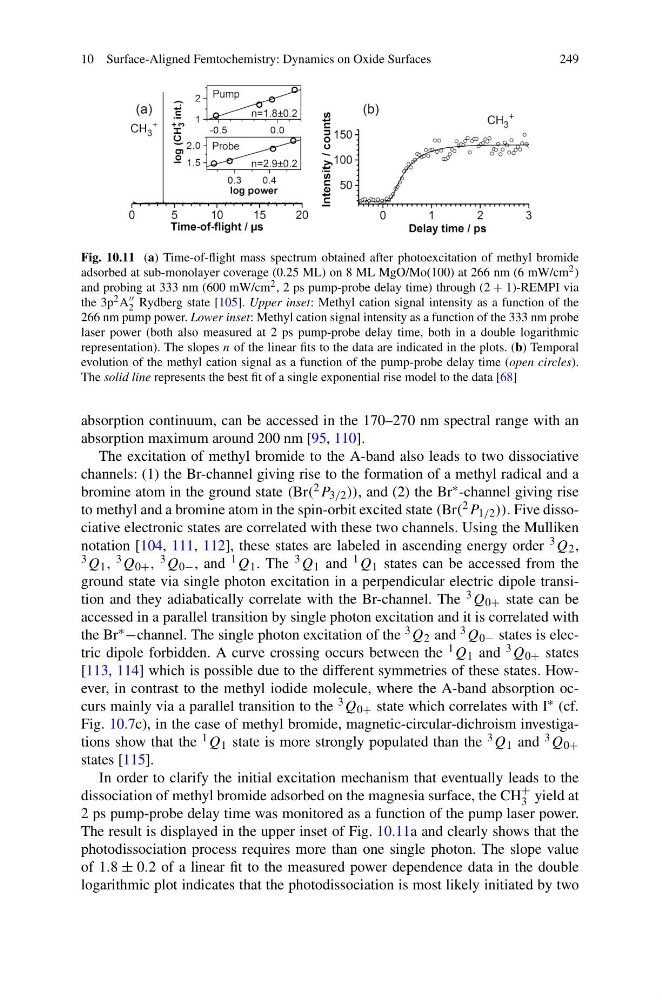
Fig. 10.11 (a) Time-of-flight mass spectrum obtained after photoexcitation of methyl bromide
adsorbed at sub-monolayer coverage (0.25 ML) on 8 ML MgO/Mo(100) at 266 nm (6 mW/cm 2 )
and probing at 333 nm (600 mW/cm 2 , 2 ps pump-probe delay time) through (2 + 1)-REMPI via
the 3p 2 A
2 Rydberg state [105]. Upper inset: Methyl cation signal intensity as a function of the
266 nm pump power. Lower inset: Methyl cation signal intensity as a function of the 333 nm probe
laser power (both also measured at 2 ps pump-probe delay time, both in a double logarithmic
representation). The slopes n of the linear fits to the data are indicated in the plots. (b) Temporal
evolution of the methyl cation signal as a function of the pump-probe delay time (open circles).
The solid line represents the best fit of a single exponential rise model to the data [68]
absorption continuum, can be accessed in the 170–270 nm spectral range with an
absorption maximum around 200 nm [95, 110].
The excitation of methyl bromide to the A-band also leads to two dissociative
channels: (1) the Br-channel giving rise to the formation of a methyl radical and a
bromine atom in the ground state (Br( 2 P 3/2 )), and (2) the Br ∗ -channel giving rise
to methyl and a bromine atom in the spin-orbit excited state (Br( 2 P 1/2 )). Five dissociative electronic states are correlated with these two channels. Using the Mulliken
notation [104, 111, 112], these states are labeled in ascending energy order 3 Q 2 ,
3 Q 1 , 3 Q 0+ , 3 Q 0− , and 1 Q 1 . The 3 Q 1 and 1 Q 1 states can be accessed from the
ground state via single photon excitation in a perpendicular electric dipole transition and they adiabatically correlate with the Br-channel. The 3 Q 0+ state can be
accessed in a parallel transition by single photon excitation and it is correlated with
the Br ∗ −channel. The single photon excitation of the 3 Q 2 and 3 Q 0− states is electric dipole forbidden. A curve crossing occurs between the 1 Q 1 and 3 Q 0+ states
[113, 114] which is possible due to the different symmetries of these states. However, in contrast to the methyl iodide molecule, where the A-band absorption occurs mainly via a parallel transition to the 3 Q 0+ state which correlates with I ∗ (cf.
Fig. 10.7c), in the case of methyl bromide, magnetic-circular-dichroism investigations show that the 1 Q 1 state is more strongly populated than the 3 Q 1 and 3 Q 0+
states [115].
In order to clarify the initial excitation mechanism that eventually leads to the
dissociation of methyl bromide adsorbed on the magnesia surface, the CH
+
3 yield at
2 ps pump-probe delay time was monitored as a function of the pump laser power.
The result is displayed in the upper inset of Fig. 10.11a and clearly shows that the
photodissociation process requires more than one single photon. The slope value
of 1.8 ± 0.2 of a linear fit to the measured power dependence data in the double
logarithmic plot indicates that the photodissociation is most likely initiated by two
249
Fig. 10.11 (a) Time-of-flight mass spectrum obtained after photoexcitation of methyl bromide
adsorbed at sub-monolayer coverage (0.25 ML) on 8 ML MgO/Mo(100) at 266 nm (6 mW/cm 2 )
and probing at 333 nm (600 mW/cm 2 , 2 ps pump-probe delay time) through (2 + 1)-REMPI via
the 3p 2 A
2 Rydberg state [105]. Upper inset: Methyl cation signal intensity as a function of the
266 nm pump power. Lower inset: Methyl cation signal intensity as a function of the 333 nm probe
laser power (both also measured at 2 ps pump-probe delay time, both in a double logarithmic
representation). The slopes n of the linear fits to the data are indicated in the plots. (b) Temporal
evolution of the methyl cation signal as a function of the pump-probe delay time (open circles).
The solid line represents the best fit of a single exponential rise model to the data [68]
absorption continuum, can be accessed in the 170–270 nm spectral range with an
absorption maximum around 200 nm [95, 110].
The excitation of methyl bromide to the A-band also leads to two dissociative
channels: (1) the Br-channel giving rise to the formation of a methyl radical and a
bromine atom in the ground state (Br( 2 P 3/2 )), and (2) the Br ∗ -channel giving rise
to methyl and a bromine atom in the spin-orbit excited state (Br( 2 P 1/2 )). Five dissociative electronic states are correlated with these two channels. Using the Mulliken
notation [104, 111, 112], these states are labeled in ascending energy order 3 Q 2 ,
3 Q 1 , 3 Q 0+ , 3 Q 0− , and 1 Q 1 . The 3 Q 1 and 1 Q 1 states can be accessed from the
ground state via single photon excitation in a perpendicular electric dipole transition and they adiabatically correlate with the Br-channel. The 3 Q 0+ state can be
accessed in a parallel transition by single photon excitation and it is correlated with
the Br ∗ −channel. The single photon excitation of the 3 Q 2 and 3 Q 0− states is electric dipole forbidden. A curve crossing occurs between the 1 Q 1 and 3 Q 0+ states
[113, 114] which is possible due to the different symmetries of these states. However, in contrast to the methyl iodide molecule, where the A-band absorption occurs mainly via a parallel transition to the 3 Q 0+ state which correlates with I ∗ (cf.
Fig. 10.7c), in the case of methyl bromide, magnetic-circular-dichroism investigations show that the 1 Q 1 state is more strongly populated than the 3 Q 1 and 3 Q 0+
states [115].
In order to clarify the initial excitation mechanism that eventually leads to the
dissociation of methyl bromide adsorbed on the magnesia surface, the CH
+
3 yield at
2 ps pump-probe delay time was monitored as a function of the pump laser power.
The result is displayed in the upper inset of Fig. 10.11a and clearly shows that the
photodissociation process requires more than one single photon. The slope value
of 1.8 ± 0.2 of a linear fit to the measured power dependence data in the double
logarithmic plot indicates that the photodissociation is most likely initiated by two