

248
M.E. Vaida and T.M. Bernhardt
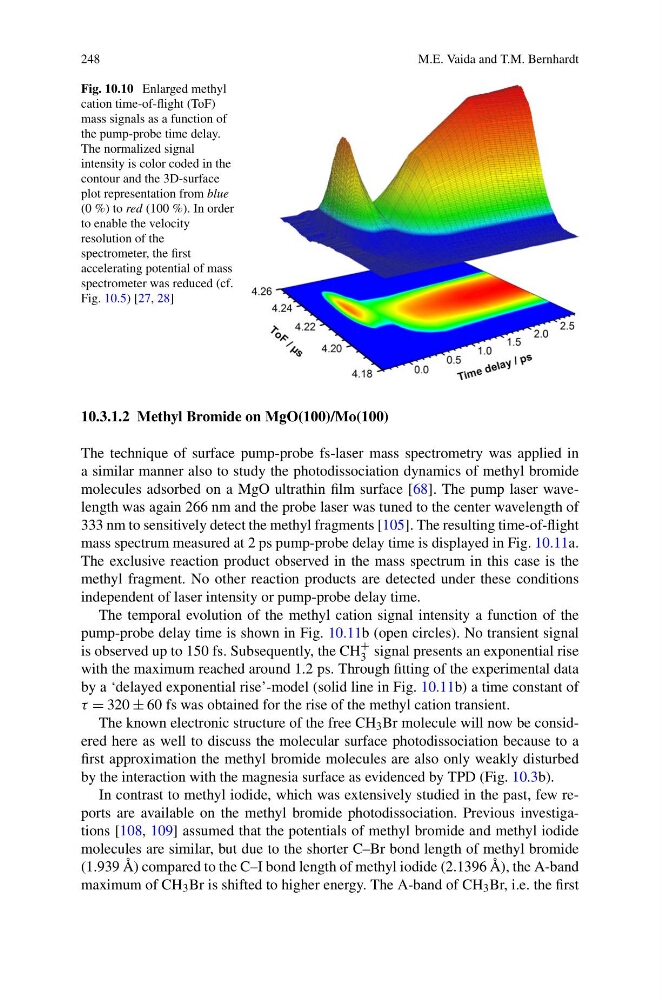
Fig. 10.10 Enlarged methyl
cation time-of-flight (ToF)
mass signals as a function of
the pump-probe time delay.
The normalized signal
intensity is color coded in the
contour and the 3D-surface
plot representation from blue
(0 %) to red (100 %). In order
to enable the velocity
resolution of the
spectrometer, the first
accelerating potential of mass
spectrometer was reduced (cf.
Fig. 10.5) [27, 28]
10.3.1.2 Methyl Bromide on MgO(100)/Mo(100)
The technique of surface pump-probe fs-laser mass spectrometry was applied in
a similar manner also to study the photodissociation dynamics of methyl bromide
molecules adsorbed on a MgO ultrathin film surface [68]. The pump laser wavelength was again 266 nm and the probe laser was tuned to the center wavelength of
333 nm to sensitively detect the methyl fragments [105]. The resulting time-of-flight
mass spectrum measured at 2 ps pump-probe delay time is displayed in Fig. 10.11a.
The exclusive reaction product observed in the mass spectrum in this case is the
methyl fragment. No other reaction products are detected under these conditions
independent of laser intensity or pump-probe delay time.
The temporal evolution of the methyl cation signal intensity a function of the
pump-probe delay time is shown in Fig. 10.11b (open circles). No transient signal
is observed up to 150 fs. Subsequently, the CH
+
3 signal presents an exponential rise
with the maximum reached around 1.2 ps. Through fitting of the experimental data
by a ‘delayed exponential rise’-model (solid line in Fig. 10.11b) a time constant of
τ = 320 ± 60 fs was obtained for the rise of the methyl cation transient.
The known electronic structure of the free CH 3 Br molecule will now be considered here as well to discuss the molecular surface photodissociation because to a
first approximation the methyl bromide molecules are also only weakly disturbed
by the interaction with the magnesia surface as evidenced by TPD (Fig. 10.3b).
In contrast to methyl iodide, which was extensively studied in the past, few reports are available on the methyl bromide photodissociation. Previous investigations [108, 109] assumed that the potentials of methyl bromide and methyl iodide
molecules are similar, but due to the shorter C–Br bond length of methyl bromide
(1.939 Å) compared to the C–I bond length of methyl iodide (2.1396 Å), the A-band
maximum of CH 3 Br is shifted to higher energy. The A-band of CH 3 Br, i.e. the first
M.E. Vaida and T.M. Bernhardt
Fig. 10.10 Enlarged methyl
cation time-of-flight (ToF)
mass signals as a function of
the pump-probe time delay.
The normalized signal
intensity is color coded in the
contour and the 3D-surface
plot representation from blue
(0 %) to red (100 %). In order
to enable the velocity
resolution of the
spectrometer, the first
accelerating potential of mass
spectrometer was reduced (cf.
Fig. 10.5) [27, 28]
10.3.1.2 Methyl Bromide on MgO(100)/Mo(100)
The technique of surface pump-probe fs-laser mass spectrometry was applied in
a similar manner also to study the photodissociation dynamics of methyl bromide
molecules adsorbed on a MgO ultrathin film surface [68]. The pump laser wavelength was again 266 nm and the probe laser was tuned to the center wavelength of
333 nm to sensitively detect the methyl fragments [105]. The resulting time-of-flight
mass spectrum measured at 2 ps pump-probe delay time is displayed in Fig. 10.11a.
The exclusive reaction product observed in the mass spectrum in this case is the
methyl fragment. No other reaction products are detected under these conditions
independent of laser intensity or pump-probe delay time.
The temporal evolution of the methyl cation signal intensity a function of the
pump-probe delay time is shown in Fig. 10.11b (open circles). No transient signal
is observed up to 150 fs. Subsequently, the CH
+
3 signal presents an exponential rise
with the maximum reached around 1.2 ps. Through fitting of the experimental data
by a ‘delayed exponential rise’-model (solid line in Fig. 10.11b) a time constant of
τ = 320 ± 60 fs was obtained for the rise of the methyl cation transient.
The known electronic structure of the free CH 3 Br molecule will now be considered here as well to discuss the molecular surface photodissociation because to a
first approximation the methyl bromide molecules are also only weakly disturbed
by the interaction with the magnesia surface as evidenced by TPD (Fig. 10.3b).
In contrast to methyl iodide, which was extensively studied in the past, few reports are available on the methyl bromide photodissociation. Previous investigations [108, 109] assumed that the potentials of methyl bromide and methyl iodide
molecules are similar, but due to the shorter C–Br bond length of methyl bromide
(1.939 Å) compared to the C–I bond length of methyl iodide (2.1396 Å), the A-band
maximum of CH 3 Br is shifted to higher energy. The A-band of CH 3 Br, i.e. the first