

1 Molecular Movies from Molecular Frame Photoelectron Angular
9
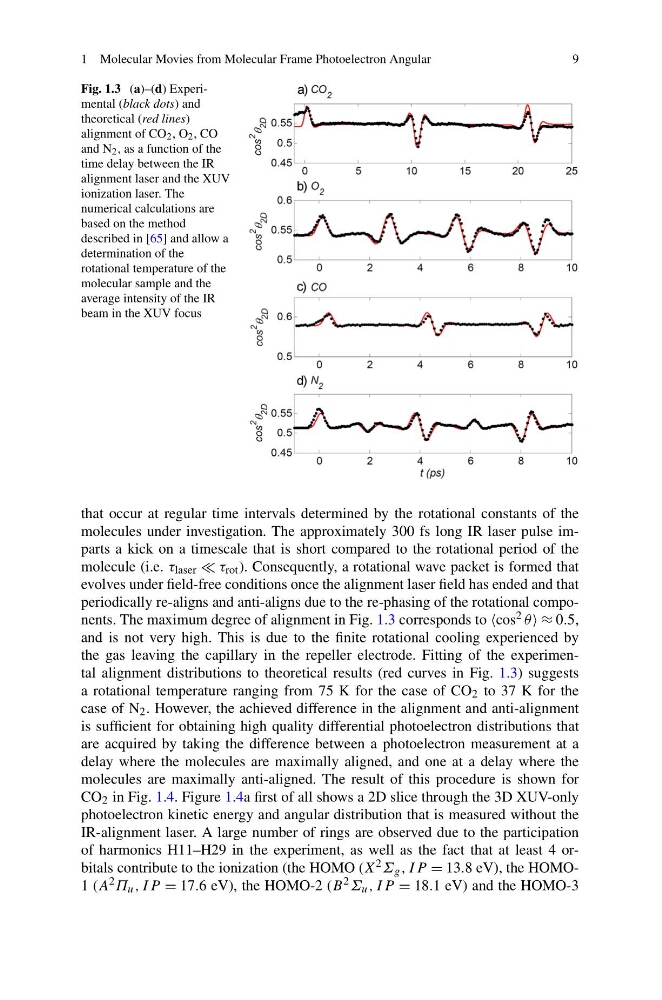
Fig. 1.3 (a)–(d) Experimental (black dots) and
theoretical (red lines)
alignment of CO 2 , O 2 , CO
and N 2 , as a function of the
time delay between the IR
alignment laser and the XUV
ionization laser. The
numerical calculations are
based on the method
described in [65] and allow a
determination of the
rotational temperature of the
molecular sample and the
average intensity of the IR
beam in the XUV focus
that occur at regular time intervals determined by the rotational constants of the
molecules under investigation. The approximately 300 fs long IR laser pulse imparts a kick on a timescale that is short compared to the rotational period of the
molecule (i.e. τ laser τ rot ). Consequently, a rotational wave packet is formed that
evolves under field-free conditions once the alignment laser field has ended and that
periodically re-aligns and anti-aligns due to the re-phasing of the rotational components. The maximum degree of alignment in Fig. 1.3 corresponds to cos 2 θ ≈ 0.5,
and is not very high. This is due to the finite rotational cooling experienced by
the gas leaving the capillary in the repeller electrode. Fitting of the experimental alignment distributions to theoretical results (red curves in Fig. 1.3) suggests
a rotational temperature ranging from 75 K for the case of CO 2 to 37 K for the
case of N 2 . However, the achieved difference in the alignment and anti-alignment
is sufficient for obtaining high quality differential photoelectron distributions that
are acquired by taking the difference between a photoelectron measurement at a
delay where the molecules are maximally aligned, and one at a delay where the
molecules are maximally anti-aligned. The result of this procedure is shown for
CO 2 in Fig. 1.4. Figure 1.4a first of all shows a 2D slice through the 3D XUV-only
photoelectron kinetic energy and angular distribution that is measured without the
IR-alignment laser. A large number of rings are observed due to the participation
of harmonics H11–H29 in the experiment, as well as the fact that at least 4 orbitals contribute to the ionization (the HOMO (X 2 Σ g , I P = 13.8 eV), the HOMO1 (A 2 Π u , I P = 17.6 eV), the HOMO-2 (B 2 Σ u , I P = 18.1 eV) and the HOMO-3
9
Fig. 1.3 (a)–(d) Experimental (black dots) and
theoretical (red lines)
alignment of CO 2 , O 2 , CO
and N 2 , as a function of the
time delay between the IR
alignment laser and the XUV
ionization laser. The
numerical calculations are
based on the method
described in [65] and allow a
determination of the
rotational temperature of the
molecular sample and the
average intensity of the IR
beam in the XUV focus
that occur at regular time intervals determined by the rotational constants of the
molecules under investigation. The approximately 300 fs long IR laser pulse imparts a kick on a timescale that is short compared to the rotational period of the
molecule (i.e. τ laser τ rot ). Consequently, a rotational wave packet is formed that
evolves under field-free conditions once the alignment laser field has ended and that
periodically re-aligns and anti-aligns due to the re-phasing of the rotational components. The maximum degree of alignment in Fig. 1.3 corresponds to cos 2 θ ≈ 0.5,
and is not very high. This is due to the finite rotational cooling experienced by
the gas leaving the capillary in the repeller electrode. Fitting of the experimental alignment distributions to theoretical results (red curves in Fig. 1.3) suggests
a rotational temperature ranging from 75 K for the case of CO 2 to 37 K for the
case of N 2 . However, the achieved difference in the alignment and anti-alignment
is sufficient for obtaining high quality differential photoelectron distributions that
are acquired by taking the difference between a photoelectron measurement at a
delay where the molecules are maximally aligned, and one at a delay where the
molecules are maximally anti-aligned. The result of this procedure is shown for
CO 2 in Fig. 1.4. Figure 1.4a first of all shows a 2D slice through the 3D XUV-only
photoelectron kinetic energy and angular distribution that is measured without the
IR-alignment laser. A large number of rings are observed due to the participation
of harmonics H11–H29 in the experiment, as well as the fact that at least 4 orbitals contribute to the ionization (the HOMO (X 2 Σ g , I P = 13.8 eV), the HOMO1 (A 2 Π u , I P = 17.6 eV), the HOMO-2 (B 2 Σ u , I P = 18.1 eV) and the HOMO-3