

242
M.E. Vaida and T.M. Bernhardt
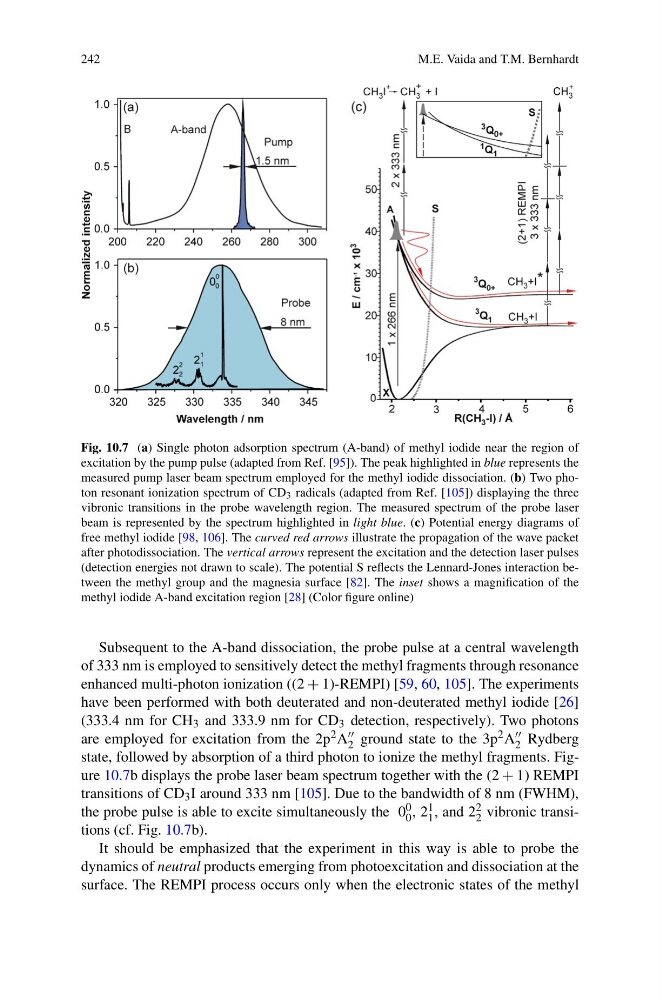
Fig. 10.7 (a) Single photon adsorption spectrum (A-band) of methyl iodide near the region of
excitation by the pump pulse (adapted from Ref. [95]). The peak highlighted in blue represents the
measured pump laser beam spectrum employed for the methyl iodide dissociation. (b) Two photon resonant ionization spectrum of CD 3 radicals (adapted from Ref. [105]) displaying the three
vibronic transitions in the probe wavelength region. The measured spectrum of the probe laser
beam is represented by the spectrum highlighted in light blue. (c) Potential energy diagrams of
free methyl iodide [98, 106]. The curved red arrows illustrate the propagation of the wave packet
after photodissociation. The vertical arrows represent the excitation and the detection laser pulses
(detection energies not drawn to scale). The potential S reflects the Lennard-Jones interaction between the methyl group and the magnesia surface [82]. The inset shows a magnification of the
methyl iodide A-band excitation region [28] (Color figure online)
Subsequent to the A-band dissociation, the probe pulse at a central wavelength
of 333 nm is employed to sensitively detect the methyl fragments through resonance
enhanced multi-photon ionization ((2 + 1)-REMPI) [59, 60, 105]. The experiments
have been performed with both deuterated and non-deuterated methyl iodide [26]
(333.4 nm for CH 3 and 333.9 nm for CD 3 detection, respectively). Two photons
are employed for excitation from the 2p 2 A
2 ground state to the 3p 2 A
2 Rydberg
state, followed by absorption of a third photon to ionize the methyl fragments. Figure 10.7b displays the probe laser beam spectrum together with the (2 + 1) REMPI
transitions of CD 3 I around 333 nm [105]. Due to the bandwidth of 8 nm (FWHM),
the probe pulse is able to excite simultaneously the 0 0
0 , 2 1
1 , and 2 2
2 vibronic transitions (cf. Fig. 10.7b).
It should be emphasized that the experiment in this way is able to probe the
dynamics of neutral products emerging from photoexcitation and dissociation at the
surface. The REMPI process occurs only when the electronic states of the methyl
M.E. Vaida and T.M. Bernhardt
Fig. 10.7 (a) Single photon adsorption spectrum (A-band) of methyl iodide near the region of
excitation by the pump pulse (adapted from Ref. [95]). The peak highlighted in blue represents the
measured pump laser beam spectrum employed for the methyl iodide dissociation. (b) Two photon resonant ionization spectrum of CD 3 radicals (adapted from Ref. [105]) displaying the three
vibronic transitions in the probe wavelength region. The measured spectrum of the probe laser
beam is represented by the spectrum highlighted in light blue. (c) Potential energy diagrams of
free methyl iodide [98, 106]. The curved red arrows illustrate the propagation of the wave packet
after photodissociation. The vertical arrows represent the excitation and the detection laser pulses
(detection energies not drawn to scale). The potential S reflects the Lennard-Jones interaction between the methyl group and the magnesia surface [82]. The inset shows a magnification of the
methyl iodide A-band excitation region [28] (Color figure online)
Subsequent to the A-band dissociation, the probe pulse at a central wavelength
of 333 nm is employed to sensitively detect the methyl fragments through resonance
enhanced multi-photon ionization ((2 + 1)-REMPI) [59, 60, 105]. The experiments
have been performed with both deuterated and non-deuterated methyl iodide [26]
(333.4 nm for CH 3 and 333.9 nm for CD 3 detection, respectively). Two photons
are employed for excitation from the 2p 2 A
2 ground state to the 3p 2 A
2 Rydberg
state, followed by absorption of a third photon to ionize the methyl fragments. Figure 10.7b displays the probe laser beam spectrum together with the (2 + 1) REMPI
transitions of CD 3 I around 333 nm [105]. Due to the bandwidth of 8 nm (FWHM),
the probe pulse is able to excite simultaneously the 0 0
0 , 2 1
1 , and 2 2
2 vibronic transitions (cf. Fig. 10.7b).
It should be emphasized that the experiment in this way is able to probe the
dynamics of neutral products emerging from photoexcitation and dissociation at the
surface. The REMPI process occurs only when the electronic states of the methyl