

10 Surface-Aligned Femtochemistry: Dynamics on Oxide Surfaces
235
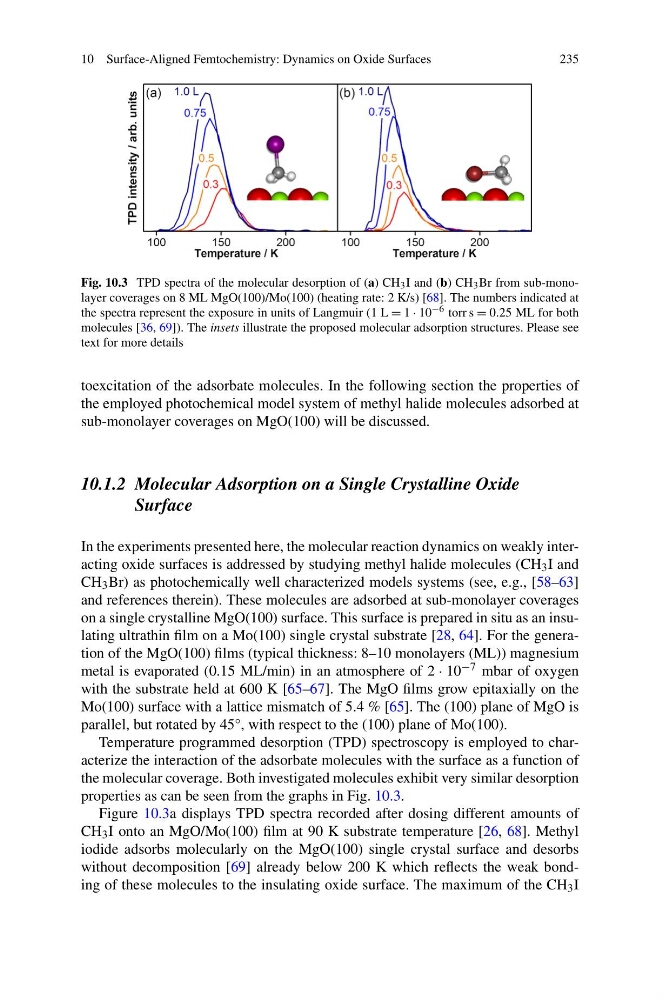
Fig. 10.3 TPD spectra of the molecular desorption of (a) CH 3 I and (b) CH 3 Br from sub-monolayer coverages on 8 ML MgO(100)/Mo(100) (heating rate: 2 K/s) [68]. The numbers indicated at
the spectra represent the exposure in units of Langmuir (1 L = 1 · 10 −6 torr s = 0.25 ML for both
molecules [36, 69]). The insets illustrate the proposed molecular adsorption structures. Please see
text for more details
toexcitation of the adsorbate molecules. In the following section the properties of
the employed photochemical model system of methyl halide molecules adsorbed at
sub-monolayer coverages on MgO(100) will be discussed.
10.1.2 Molecular Adsorption on a Single Crystalline Oxide
Surface
In the experiments presented here, the molecular reaction dynamics on weakly interacting oxide surfaces is addressed by studying methyl halide molecules (CH 3 I and
CH 3 Br) as photochemically well characterized models systems (see, e.g., [58–63]
and references therein). These molecules are adsorbed at sub-monolayer coverages
on a single crystalline MgO(100) surface. This surface is prepared in situ as an insulating ultrathin film on a Mo(100) single crystal substrate [28, 64]. For the generation of the MgO(100) films (typical thickness: 8–10 monolayers (ML)) magnesium
metal is evaporated (0.15 ML/min) in an atmosphere of 2 · 10 −7 mbar of oxygen
with the substrate held at 600 K [65–67]. The MgO films grow epitaxially on the
Mo(100) surface with a lattice mismatch of 5.4 % [65]. The (100) plane of MgO is
parallel, but rotated by 45°, with respect to the (100) plane of Mo(100).
Temperature programmed desorption (TPD) spectroscopy is employed to characterize the interaction of the adsorbate molecules with the surface as a function of
the molecular coverage. Both investigated molecules exhibit very similar desorption
properties as can be seen from the graphs in Fig. 10.3.
Figure 10.3a displays TPD spectra recorded after dosing different amounts of
CH 3 I onto an MgO/Mo(100) film at 90 K substrate temperature [26, 68]. Methyl
iodide adsorbs molecularly on the MgO(100) single crystal surface and desorbs
without decomposition [69] already below 200 K which reflects the weak bonding of these molecules to the insulating oxide surface. The maximum of the CH 3 I
235
Fig. 10.3 TPD spectra of the molecular desorption of (a) CH 3 I and (b) CH 3 Br from sub-monolayer coverages on 8 ML MgO(100)/Mo(100) (heating rate: 2 K/s) [68]. The numbers indicated at
the spectra represent the exposure in units of Langmuir (1 L = 1 · 10 −6 torr s = 0.25 ML for both
molecules [36, 69]). The insets illustrate the proposed molecular adsorption structures. Please see
text for more details
toexcitation of the adsorbate molecules. In the following section the properties of
the employed photochemical model system of methyl halide molecules adsorbed at
sub-monolayer coverages on MgO(100) will be discussed.
10.1.2 Molecular Adsorption on a Single Crystalline Oxide
Surface
In the experiments presented here, the molecular reaction dynamics on weakly interacting oxide surfaces is addressed by studying methyl halide molecules (CH 3 I and
CH 3 Br) as photochemically well characterized models systems (see, e.g., [58–63]
and references therein). These molecules are adsorbed at sub-monolayer coverages
on a single crystalline MgO(100) surface. This surface is prepared in situ as an insulating ultrathin film on a Mo(100) single crystal substrate [28, 64]. For the generation of the MgO(100) films (typical thickness: 8–10 monolayers (ML)) magnesium
metal is evaporated (0.15 ML/min) in an atmosphere of 2 · 10 −7 mbar of oxygen
with the substrate held at 600 K [65–67]. The MgO films grow epitaxially on the
Mo(100) surface with a lattice mismatch of 5.4 % [65]. The (100) plane of MgO is
parallel, but rotated by 45°, with respect to the (100) plane of Mo(100).
Temperature programmed desorption (TPD) spectroscopy is employed to characterize the interaction of the adsorbate molecules with the surface as a function of
the molecular coverage. Both investigated molecules exhibit very similar desorption
properties as can be seen from the graphs in Fig. 10.3.
Figure 10.3a displays TPD spectra recorded after dosing different amounts of
CH 3 I onto an MgO/Mo(100) film at 90 K substrate temperature [26, 68]. Methyl
iodide adsorbs molecularly on the MgO(100) single crystal surface and desorbs
without decomposition [69] already below 200 K which reflects the weak bonding of these molecules to the insulating oxide surface. The maximum of the CH 3 I