

234
M.E. Vaida and T.M. Bernhardt
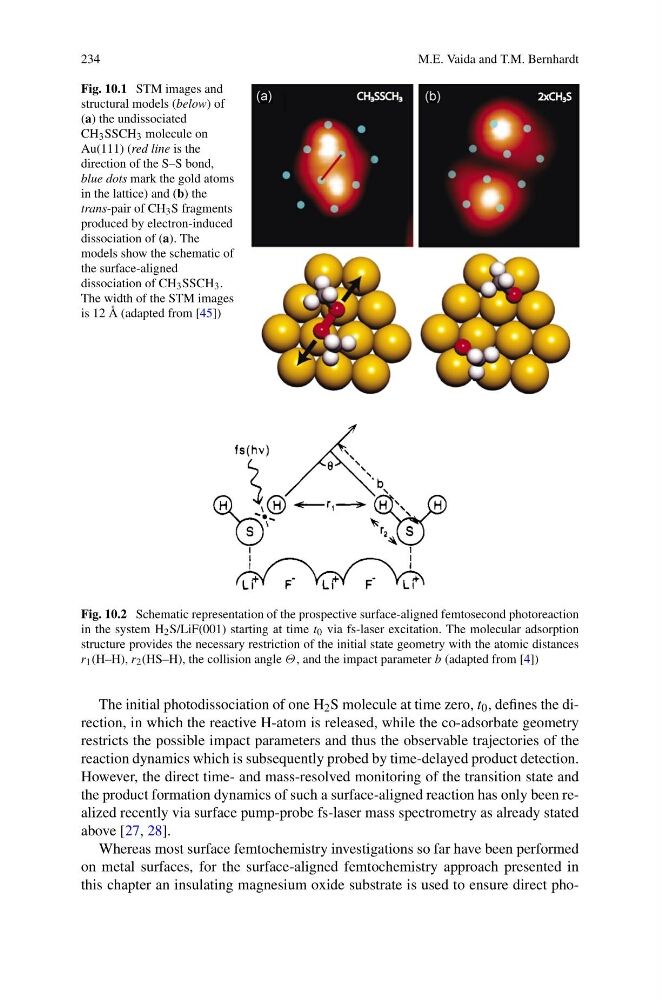
Fig. 10.1 STM images and
structural models (below) of
(a) the undissociated
CH 3 SSCH 3 molecule on
Au(111) (red line is the
direction of the S–S bond,
blue dots mark the gold atoms
in the lattice) and (b) the
trans-pair of CH 3 S fragments
produced by electron-induced
dissociation of (a). The
models show the schematic of
the surface-aligned
dissociation of CH 3 SSCH 3 .
The width of the STM images
is 12 Å (adapted from [45])
Fig. 10.2 Schematic representation of the prospective surface-aligned femtosecond photoreaction
in the system H 2 S/LiF(001) starting at time t 0 via fs-laser excitation. The molecular adsorption
structure provides the necessary restriction of the initial state geometry with the atomic distances
r 1 (H–H), r 2 (HS–H), the collision angle Θ, and the impact parameter b (adapted from [4])
The initial photodissociation of one H 2 S molecule at time zero, t 0 , defines the direction, in which the reactive H-atom is released, while the co-adsorbate geometry
restricts the possible impact parameters and thus the observable trajectories of the
reaction dynamics which is subsequently probed by time-delayed product detection.
However, the direct time- and mass-resolved monitoring of the transition state and
the product formation dynamics of such a surface-aligned reaction has only been realized recently via surface pump-probe fs-laser mass spectrometry as already stated
above [27, 28].
Whereas most surface femtochemistry investigations so far have been performed
on metal surfaces, for the surface-aligned femtochemistry approach presented in
this chapter an insulating magnesium oxide substrate is used to ensure direct pho-
M.E. Vaida and T.M. Bernhardt
Fig. 10.1 STM images and
structural models (below) of
(a) the undissociated
CH 3 SSCH 3 molecule on
Au(111) (red line is the
direction of the S–S bond,
blue dots mark the gold atoms
in the lattice) and (b) the
trans-pair of CH 3 S fragments
produced by electron-induced
dissociation of (a). The
models show the schematic of
the surface-aligned
dissociation of CH 3 SSCH 3 .
The width of the STM images
is 12 Å (adapted from [45])
Fig. 10.2 Schematic representation of the prospective surface-aligned femtosecond photoreaction
in the system H 2 S/LiF(001) starting at time t 0 via fs-laser excitation. The molecular adsorption
structure provides the necessary restriction of the initial state geometry with the atomic distances
r 1 (H–H), r 2 (HS–H), the collision angle Θ, and the impact parameter b (adapted from [4])
The initial photodissociation of one H 2 S molecule at time zero, t 0 , defines the direction, in which the reactive H-atom is released, while the co-adsorbate geometry
restricts the possible impact parameters and thus the observable trajectories of the
reaction dynamics which is subsequently probed by time-delayed product detection.
However, the direct time- and mass-resolved monitoring of the transition state and
the product formation dynamics of such a surface-aligned reaction has only been realized recently via surface pump-probe fs-laser mass spectrometry as already stated
above [27, 28].
Whereas most surface femtochemistry investigations so far have been performed
on metal surfaces, for the surface-aligned femtochemistry approach presented in
this chapter an insulating magnesium oxide substrate is used to ensure direct pho-