

190
M. Dantus and C.L. Kalcic
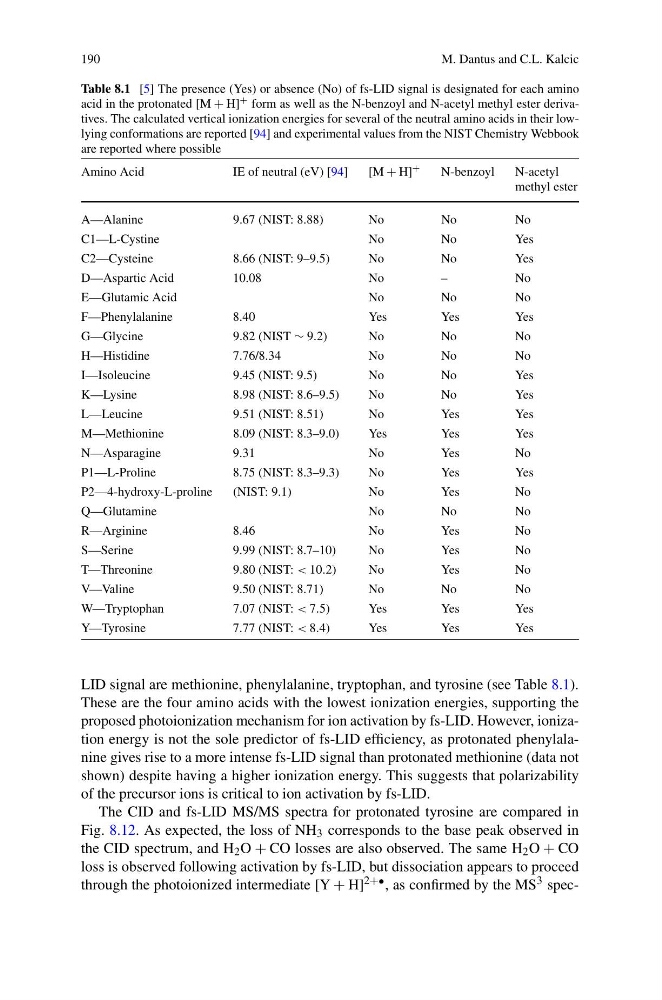
Table 8.1 [5] The presence (Yes) or absence (No) of fs-LID signal is designated for each amino
acid in the protonated [M + H] + form as well as the N-benzoyl and N-acetyl methyl ester derivatives. The calculated vertical ionization energies for several of the neutral amino acids in their lowlying conformations are reported [94] and experimental values from the NIST Chemistry Webbook
are reported where possible
Amino Acid
IE of neutral (eV) [94]
[M + H] +
N-benzoyl
N-acetyl
methyl ester
A—Alanine
9.67 (NIST: 8.88)
No
No
No
C1—L-Cystine
No
No
Yes
C2—Cysteine
8.66 (NIST: 9–9.5)
No
No
Yes
D—Aspartic Acid
10.08
No
–
No
E—Glutamic Acid
No
No
No
F—Phenylalanine
8.40
Yes
Yes
Yes
G—Glycine
9.82 (NIST ∼ 9.2)
No
No
No
H—Histidine
7.76/8.34
No
No
No
I—Isoleucine
9.45 (NIST: 9.5)
No
No
Yes
K—Lysine
8.98 (NIST: 8.6–9.5)
No
No
Yes
L—Leucine
9.51 (NIST: 8.51)
No
Yes
Yes
M—Methionine
8.09 (NIST: 8.3–9.0)
Yes
Yes
Yes
N—Asparagine
9.31
No
Yes
No
P1—L-Proline
8.75 (NIST: 8.3–9.3)
No
Yes
Yes
P2—4-hydroxy-L-proline
(NIST: 9.1)
No
Yes
No
Q—Glutamine
No
No
No
R—Arginine
8.46
No
Yes
No
S—Serine
9.99 (NIST: 8.7–10)
No
Yes
No
T—Threonine
9.80 (NIST: < 10.2)
No
Yes
No
V—Valine
9.50 (NIST: 8.71)
No
No
No
W—Tryptophan
7.07 (NIST: < 7.5)
Yes
Yes
Yes
Y—Tyrosine
7.77 (NIST: < 8.4)
Yes
Yes
Yes
LID signal are methionine, phenylalanine, tryptophan, and tyrosine (see Table 8.1).
These are the four amino acids with the lowest ionization energies, supporting the
proposed photoionization mechanism for ion activation by fs-LID. However, ionization energy is not the sole predictor of fs-LID efficiency, as protonated phenylalanine gives rise to a more intense fs-LID signal than protonated methionine (data not
shown) despite having a higher ionization energy. This suggests that polarizability
of the precursor ions is critical to ion activation by fs-LID.
The CID and fs-LID MS/MS spectra for protonated tyrosine are compared in
Fig. 8.12. As expected, the loss of NH 3 corresponds to the base peak observed in
the CID spectrum, and H 2 O + CO losses are also observed. The same H 2 O + CO
loss is observed following activation by fs-LID, but dissociation appears to proceed
through the photoionized intermediate [Y + H] 2+• , as confirmed by the MS 3 spec-
M. Dantus and C.L. Kalcic
Table 8.1 [5] The presence (Yes) or absence (No) of fs-LID signal is designated for each amino
acid in the protonated [M + H] + form as well as the N-benzoyl and N-acetyl methyl ester derivatives. The calculated vertical ionization energies for several of the neutral amino acids in their lowlying conformations are reported [94] and experimental values from the NIST Chemistry Webbook
are reported where possible
Amino Acid
IE of neutral (eV) [94]
[M + H] +
N-benzoyl
N-acetyl
methyl ester
A—Alanine
9.67 (NIST: 8.88)
No
No
No
C1—L-Cystine
No
No
Yes
C2—Cysteine
8.66 (NIST: 9–9.5)
No
No
Yes
D—Aspartic Acid
10.08
No
–
No
E—Glutamic Acid
No
No
No
F—Phenylalanine
8.40
Yes
Yes
Yes
G—Glycine
9.82 (NIST ∼ 9.2)
No
No
No
H—Histidine
7.76/8.34
No
No
No
I—Isoleucine
9.45 (NIST: 9.5)
No
No
Yes
K—Lysine
8.98 (NIST: 8.6–9.5)
No
No
Yes
L—Leucine
9.51 (NIST: 8.51)
No
Yes
Yes
M—Methionine
8.09 (NIST: 8.3–9.0)
Yes
Yes
Yes
N—Asparagine
9.31
No
Yes
No
P1—L-Proline
8.75 (NIST: 8.3–9.3)
No
Yes
Yes
P2—4-hydroxy-L-proline
(NIST: 9.1)
No
Yes
No
Q—Glutamine
No
No
No
R—Arginine
8.46
No
Yes
No
S—Serine
9.99 (NIST: 8.7–10)
No
Yes
No
T—Threonine
9.80 (NIST: < 10.2)
No
Yes
No
V—Valine
9.50 (NIST: 8.71)
No
No
No
W—Tryptophan
7.07 (NIST: < 7.5)
Yes
Yes
Yes
Y—Tyrosine
7.77 (NIST: < 8.4)
Yes
Yes
Yes
LID signal are methionine, phenylalanine, tryptophan, and tyrosine (see Table 8.1).
These are the four amino acids with the lowest ionization energies, supporting the
proposed photoionization mechanism for ion activation by fs-LID. However, ionization energy is not the sole predictor of fs-LID efficiency, as protonated phenylalanine gives rise to a more intense fs-LID signal than protonated methionine (data not
shown) despite having a higher ionization energy. This suggests that polarizability
of the precursor ions is critical to ion activation by fs-LID.
The CID and fs-LID MS/MS spectra for protonated tyrosine are compared in
Fig. 8.12. As expected, the loss of NH 3 corresponds to the base peak observed in
the CID spectrum, and H 2 O + CO losses are also observed. The same H 2 O + CO
loss is observed following activation by fs-LID, but dissociation appears to proceed
through the photoionized intermediate [Y + H] 2+• , as confirmed by the MS 3 spec-