

186
M. Dantus and C.L. Kalcic
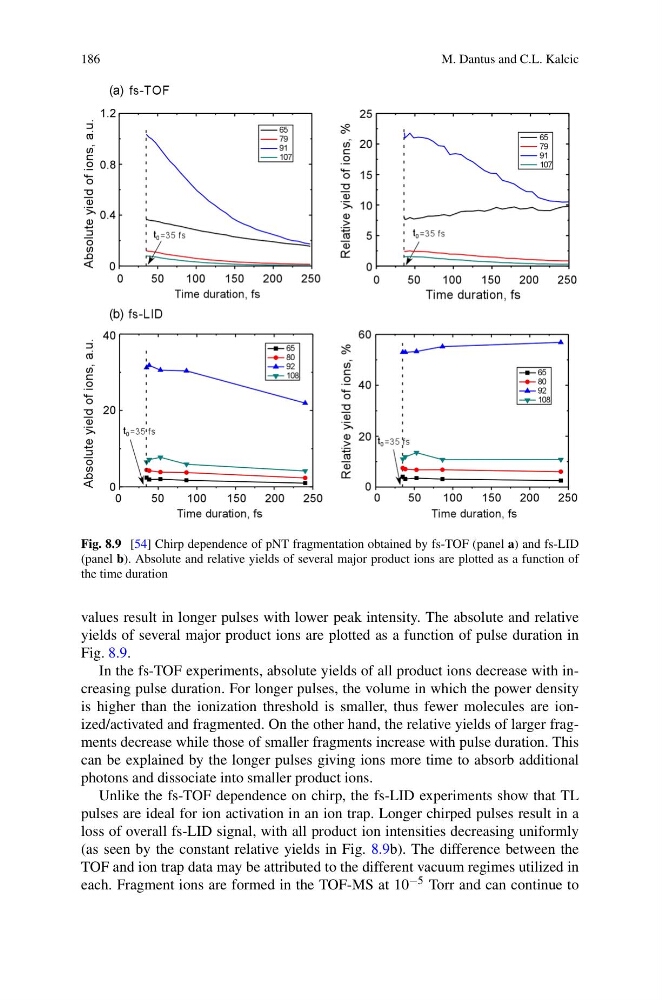
Fig. 8.9 [54] Chirp dependence of pNT fragmentation obtained by fs-TOF (panel a) and fs-LID
(panel b). Absolute and relative yields of several major product ions are plotted as a function of
the time duration
values result in longer pulses with lower peak intensity. The absolute and relative
yields of several major product ions are plotted as a function of pulse duration in
Fig. 8.9.
In the fs-TOF experiments, absolute yields of all product ions decrease with increasing pulse duration. For longer pulses, the volume in which the power density
is higher than the ionization threshold is smaller, thus fewer molecules are ionized/activated and fragmented. On the other hand, the relative yields of larger fragments decrease while those of smaller fragments increase with pulse duration. This
can be explained by the longer pulses giving ions more time to absorb additional
photons and dissociate into smaller product ions.
Unlike the fs-TOF dependence on chirp, the fs-LID experiments show that TL
pulses are ideal for ion activation in an ion trap. Longer chirped pulses result in a
loss of overall fs-LID signal, with all product ion intensities decreasing uniformly
(as seen by the constant relative yields in Fig. 8.9b). The difference between the
TOF and ion trap data may be attributed to the different vacuum regimes utilized in
each. Fragment ions are formed in the TOF-MS at 10 −5 Torr and can continue to
M. Dantus and C.L. Kalcic
Fig. 8.9 [54] Chirp dependence of pNT fragmentation obtained by fs-TOF (panel a) and fs-LID
(panel b). Absolute and relative yields of several major product ions are plotted as a function of
the time duration
values result in longer pulses with lower peak intensity. The absolute and relative
yields of several major product ions are plotted as a function of pulse duration in
Fig. 8.9.
In the fs-TOF experiments, absolute yields of all product ions decrease with increasing pulse duration. For longer pulses, the volume in which the power density
is higher than the ionization threshold is smaller, thus fewer molecules are ionized/activated and fragmented. On the other hand, the relative yields of larger fragments decrease while those of smaller fragments increase with pulse duration. This
can be explained by the longer pulses giving ions more time to absorb additional
photons and dissociate into smaller product ions.
Unlike the fs-TOF dependence on chirp, the fs-LID experiments show that TL
pulses are ideal for ion activation in an ion trap. Longer chirped pulses result in a
loss of overall fs-LID signal, with all product ion intensities decreasing uniformly
(as seen by the constant relative yields in Fig. 8.9b). The difference between the
TOF and ion trap data may be attributed to the different vacuum regimes utilized in
each. Fragment ions are formed in the TOF-MS at 10 −5 Torr and can continue to