

8 Ultrafast Ionization and Fragmentation: From Small Molecules
173
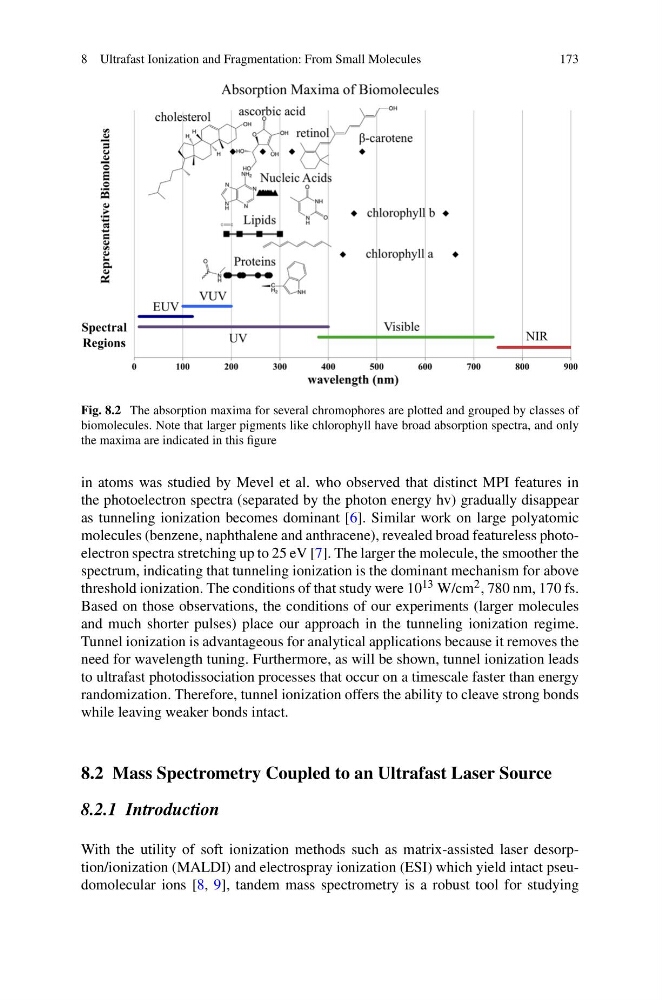
Fig. 8.2 The absorption maxima for several chromophores are plotted and grouped by classes of
biomolecules. Note that larger pigments like chlorophyll have broad absorption spectra, and only
the maxima are indicated in this figure
in atoms was studied by Mevel et al. who observed that distinct MPI features in
the photoelectron spectra (separated by the photon energy hv) gradually disappear
as tunneling ionization becomes dominant [6]. Similar work on large polyatomic
molecules (benzene, naphthalene and anthracene), revealed broad featureless photoelectron spectra stretching up to 25 eV [7]. The larger the molecule, the smoother the
spectrum, indicating that tunneling ionization is the dominant mechanism for above
threshold ionization. The conditions of that study were 10 13 W/cm 2 , 780 nm, 170 fs.
Based on those observations, the conditions of our experiments (larger molecules
and much shorter pulses) place our approach in the tunneling ionization regime.
Tunnel ionization is advantageous for analytical applications because it removes the
need for wavelength tuning. Furthermore, as will be shown, tunnel ionization leads
to ultrafast photodissociation processes that occur on a timescale faster than energy
randomization. Therefore, tunnel ionization offers the ability to cleave strong bonds
while leaving weaker bonds intact.
8.2 Mass Spectrometry Coupled to an Ultrafast Laser Source
8.2.1 Introduction
With the utility of soft ionization methods such as matrix-assisted laser desorption/ionization (MALDI) and electrospray ionization (ESI) which yield intact pseudomolecular ions [8, 9], tandem mass spectrometry is a robust tool for studying
173
Fig. 8.2 The absorption maxima for several chromophores are plotted and grouped by classes of
biomolecules. Note that larger pigments like chlorophyll have broad absorption spectra, and only
the maxima are indicated in this figure
in atoms was studied by Mevel et al. who observed that distinct MPI features in
the photoelectron spectra (separated by the photon energy hv) gradually disappear
as tunneling ionization becomes dominant [6]. Similar work on large polyatomic
molecules (benzene, naphthalene and anthracene), revealed broad featureless photoelectron spectra stretching up to 25 eV [7]. The larger the molecule, the smoother the
spectrum, indicating that tunneling ionization is the dominant mechanism for above
threshold ionization. The conditions of that study were 10 13 W/cm 2 , 780 nm, 170 fs.
Based on those observations, the conditions of our experiments (larger molecules
and much shorter pulses) place our approach in the tunneling ionization regime.
Tunnel ionization is advantageous for analytical applications because it removes the
need for wavelength tuning. Furthermore, as will be shown, tunnel ionization leads
to ultrafast photodissociation processes that occur on a timescale faster than energy
randomization. Therefore, tunnel ionization offers the ability to cleave strong bonds
while leaving weaker bonds intact.
8.2 Mass Spectrometry Coupled to an Ultrafast Laser Source
8.2.1 Introduction
With the utility of soft ionization methods such as matrix-assisted laser desorption/ionization (MALDI) and electrospray ionization (ESI) which yield intact pseudomolecular ions [8, 9], tandem mass spectrometry is a robust tool for studying