

172
M. Dantus and C.L. Kalcic
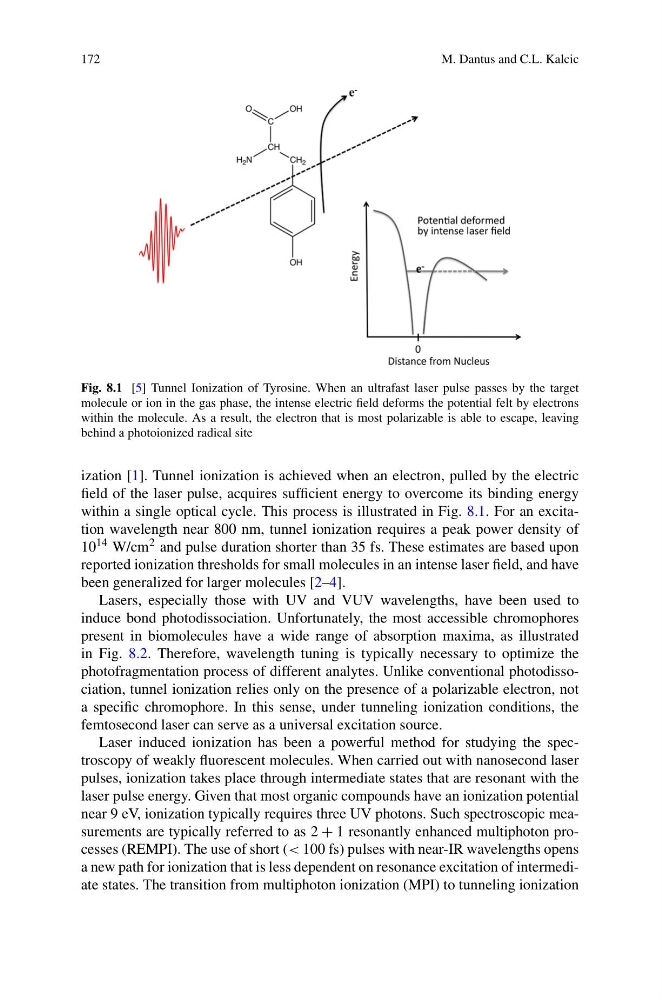
Fig. 8.1 [5] Tunnel Ionization of Tyrosine. When an ultrafast laser pulse passes by the target
molecule or ion in the gas phase, the intense electric field deforms the potential felt by electrons
within the molecule. As a result, the electron that is most polarizable is able to escape, leaving
behind a photoionized radical site
ization [1]. Tunnel ionization is achieved when an electron, pulled by the electric
field of the laser pulse, acquires sufficient energy to overcome its binding energy
within a single optical cycle. This process is illustrated in Fig. 8.1. For an excitation wavelength near 800 nm, tunnel ionization requires a peak power density of
10 14 W/cm 2 and pulse duration shorter than 35 fs. These estimates are based upon
reported ionization thresholds for small molecules in an intense laser field, and have
been generalized for larger molecules [2–4].
Lasers, especially those with UV and VUV wavelengths, have been used to
induce bond photodissociation. Unfortunately, the most accessible chromophores
present in biomolecules have a wide range of absorption maxima, as illustrated
in Fig. 8.2. Therefore, wavelength tuning is typically necessary to optimize the
photofragmentation process of different analytes. Unlike conventional photodissociation, tunnel ionization relies only on the presence of a polarizable electron, not
a specific chromophore. In this sense, under tunneling ionization conditions, the
femtosecond laser can serve as a universal excitation source.
Laser induced ionization has been a powerful method for studying the spectroscopy of weakly fluorescent molecules. When carried out with nanosecond laser
pulses, ionization takes place through intermediate states that are resonant with the
laser pulse energy. Given that most organic compounds have an ionization potential
near 9 eV, ionization typically requires three UV photons. Such spectroscopic measurements are typically referred to as 2 + 1 resonantly enhanced multiphoton processes (REMPI). The use of short (< 100 fs) pulses with near-IR wavelengths opens
a new path for ionization that is less dependent on resonance excitation of intermediate states. The transition from multiphoton ionization (MPI) to tunneling ionization
M. Dantus and C.L. Kalcic
Fig. 8.1 [5] Tunnel Ionization of Tyrosine. When an ultrafast laser pulse passes by the target
molecule or ion in the gas phase, the intense electric field deforms the potential felt by electrons
within the molecule. As a result, the electron that is most polarizable is able to escape, leaving
behind a photoionized radical site
ization [1]. Tunnel ionization is achieved when an electron, pulled by the electric
field of the laser pulse, acquires sufficient energy to overcome its binding energy
within a single optical cycle. This process is illustrated in Fig. 8.1. For an excitation wavelength near 800 nm, tunnel ionization requires a peak power density of
10 14 W/cm 2 and pulse duration shorter than 35 fs. These estimates are based upon
reported ionization thresholds for small molecules in an intense laser field, and have
been generalized for larger molecules [2–4].
Lasers, especially those with UV and VUV wavelengths, have been used to
induce bond photodissociation. Unfortunately, the most accessible chromophores
present in biomolecules have a wide range of absorption maxima, as illustrated
in Fig. 8.2. Therefore, wavelength tuning is typically necessary to optimize the
photofragmentation process of different analytes. Unlike conventional photodissociation, tunnel ionization relies only on the presence of a polarizable electron, not
a specific chromophore. In this sense, under tunneling ionization conditions, the
femtosecond laser can serve as a universal excitation source.
Laser induced ionization has been a powerful method for studying the spectroscopy of weakly fluorescent molecules. When carried out with nanosecond laser
pulses, ionization takes place through intermediate states that are resonant with the
laser pulse energy. Given that most organic compounds have an ionization potential
near 9 eV, ionization typically requires three UV photons. Such spectroscopic measurements are typically referred to as 2 + 1 resonantly enhanced multiphoton processes (REMPI). The use of short (< 100 fs) pulses with near-IR wavelengths opens
a new path for ionization that is less dependent on resonance excitation of intermediate states. The transition from multiphoton ionization (MPI) to tunneling ionization