

7 Ultrafast Laser-Induced Processes Described by Ab Initio Molecular
151
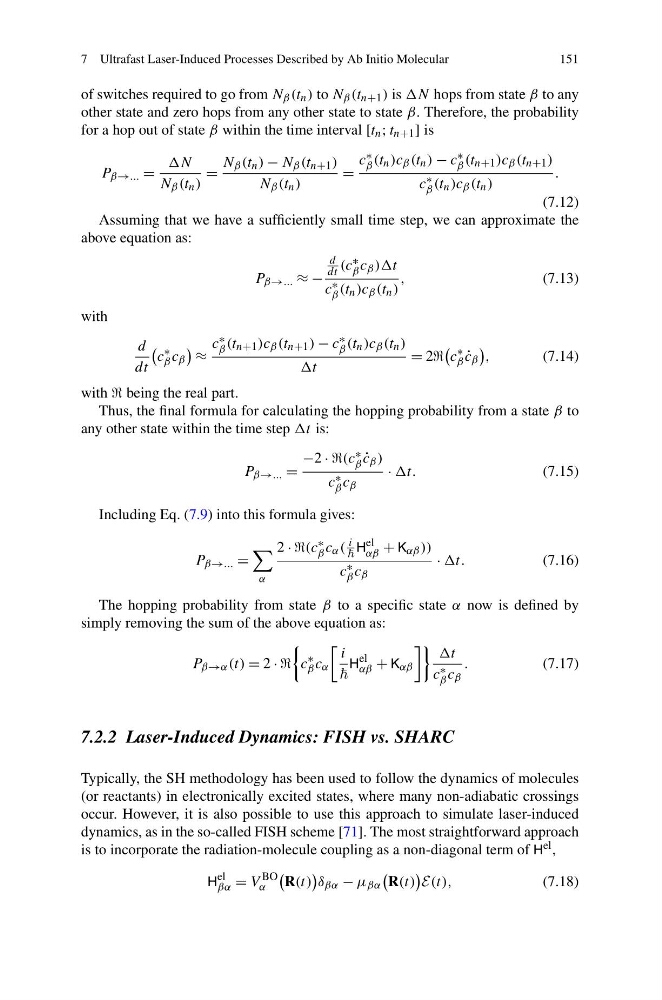
of switches required to go from N β (t n ) to N β (t n+1 ) is N hops from state β to any
other state and zero hops from any other state to state β. Therefore, the probability
for a hop out of state β within the time interval [t n ; t n+1 ] is
P β→... =
N
N β (t n )
=
N β (t n ) − N β (t n+1 )
N β (t n )
=
c ∗
β (t n )c β (t n ) − c ∗
β (t n+1 )c β (t n+1 )
c ∗
β (t n )c β (t n )
.
(7.12)
Assuming that we have a sufficiently small time step, we can approximate the
above equation as:
P β→... ≈ −
d
dt (c ∗
β c β ))t
c ∗
β (t n )c β (t n )
,
(7.13)
with
d
dt
c
∗
β c β
≈
c ∗
β (t n+1 )c β (t n+1 ) − c ∗
β (t n )c β (t n )
t
= 2
c
∗
β ˙
c β
,
(7.14)
with being the real part.
Thus, the final formula for calculating the hopping probability from a state β to
any other state within the time step t is:
P β→... =
−2 · ·(c ∗
β ˙
c β )
c ∗
β c β
· t.
(7.15)
Including Eq. (7.9) into this formula gives:
P β→... =
α
2 · ·(c ∗
β c α (
i
H el
αβ + K αβ ))
c ∗
β c β
· t.
(7.16)
The hopping probability from state β to a specific state α now is defined by
simply removing the sum of the above equation as:
P β→α (t) = 2 · ·
c
∗
β c α
i
H
el
αβ + K αβ
t
c ∗
β c β
.
(7.17)
7.2.2 Laser-Induced Dynamics: FISH vs. SHARC
Typically, the SH methodology has been used to follow the dynamics of molecules
(or reactants) in electronically excited states, where many non-adiabatic crossings
occur. However, it is also possible to use this approach to simulate laser-induced
dynamics, as in the so-called FISH scheme [71]. The most straightforward approach
is to incorporate the radiation-molecule coupling as a non-diagonal term of H el ,
H
el
βα = V
BO
α
R(t)
δ βα − μ βα
R(t)
E(t),
(7.18)
151
of switches required to go from N β (t n ) to N β (t n+1 ) is N hops from state β to any
other state and zero hops from any other state to state β. Therefore, the probability
for a hop out of state β within the time interval [t n ; t n+1 ] is
P β→... =
N
N β (t n )
=
N β (t n ) − N β (t n+1 )
N β (t n )
=
c ∗
β (t n )c β (t n ) − c ∗
β (t n+1 )c β (t n+1 )
c ∗
β (t n )c β (t n )
.
(7.12)
Assuming that we have a sufficiently small time step, we can approximate the
above equation as:
P β→... ≈ −
d
dt (c ∗
β c β ))t
c ∗
β (t n )c β (t n )
,
(7.13)
with
d
dt
c
∗
β c β
≈
c ∗
β (t n+1 )c β (t n+1 ) − c ∗
β (t n )c β (t n )
t
= 2
c
∗
β ˙
c β
,
(7.14)
with being the real part.
Thus, the final formula for calculating the hopping probability from a state β to
any other state within the time step t is:
P β→... =
−2 · ·(c ∗
β ˙
c β )
c ∗
β c β
· t.
(7.15)
Including Eq. (7.9) into this formula gives:
P β→... =
α
2 · ·(c ∗
β c α (
i
H el
αβ + K αβ ))
c ∗
β c β
· t.
(7.16)
The hopping probability from state β to a specific state α now is defined by
simply removing the sum of the above equation as:
P β→α (t) = 2 · ·
c
∗
β c α
i
H
el
αβ + K αβ
t
c ∗
β c β
.
(7.17)
7.2.2 Laser-Induced Dynamics: FISH vs. SHARC
Typically, the SH methodology has been used to follow the dynamics of molecules
(or reactants) in electronically excited states, where many non-adiabatic crossings
occur. However, it is also possible to use this approach to simulate laser-induced
dynamics, as in the so-called FISH scheme [71]. The most straightforward approach
is to incorporate the radiation-molecule coupling as a non-diagonal term of H el ,
H
el
βα = V
BO
α
R(t)
δ βα − μ βα
R(t)
E(t),
(7.18)