

132
G.M. Roberts and V.G. Stavros
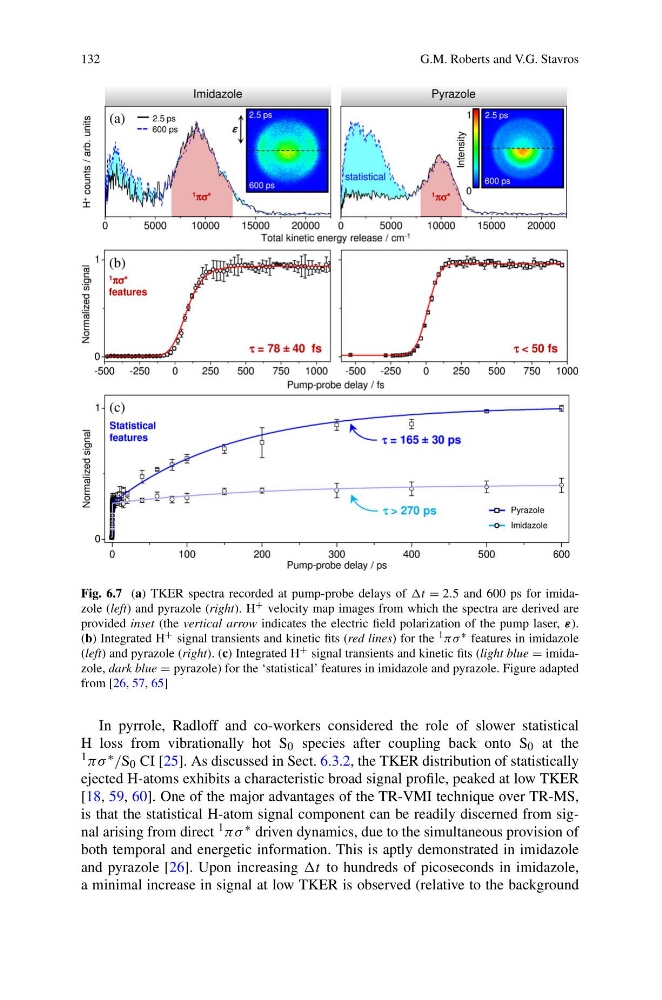
Fig. 6.7 (a) TKER spectra recorded at pump-probe delays of t = 2.5 and 600 ps for imidazole (left) and pyrazole (right). H + velocity map images from which the spectra are derived are
provided inset (the vertical arrow indicates the electric field polarization of the pump laser, ε).
(b) Integrated H + signal transients and kinetic fits (red lines) for the 1 πσ ∗ features in imidazole
(left) and pyrazole (right). (c) Integrated H + signal transients and kinetic fits (light blue = imidazole, dark blue = pyrazole) for the ‘statistical’ features in imidazole and pyrazole. Figure adapted
from [26, 57, 65]
In pyrrole, Radloff and co-workers considered the role of slower statistical
H loss from vibrationally hot S 0 species after coupling back onto S 0 at the
1 πσ ∗ /S 0 CI [25]. As discussed in Sect. 6.3.2, the TKER distribution of statistically
ejected H-atoms exhibits a characteristic broad signal profile, peaked at low TKER
[18, 59, 60]. One of the major advantages of the TR-VMI technique over TR-MS,
is that the statistical H-atom signal component can be readily discerned from signal arising from direct 1 πσ ∗ driven dynamics, due to the simultaneous provision of
both temporal and energetic information. This is aptly demonstrated in imidazole
and pyrazole [26]. Upon increasing t to hundreds of picoseconds in imidazole,
a minimal increase in signal at low TKER is observed (relative to the background
G.M. Roberts and V.G. Stavros
Fig. 6.7 (a) TKER spectra recorded at pump-probe delays of t = 2.5 and 600 ps for imidazole (left) and pyrazole (right). H + velocity map images from which the spectra are derived are
provided inset (the vertical arrow indicates the electric field polarization of the pump laser, ε).
(b) Integrated H + signal transients and kinetic fits (red lines) for the 1 πσ ∗ features in imidazole
(left) and pyrazole (right). (c) Integrated H + signal transients and kinetic fits (light blue = imidazole, dark blue = pyrazole) for the ‘statistical’ features in imidazole and pyrazole. Figure adapted
from [26, 57, 65]
In pyrrole, Radloff and co-workers considered the role of slower statistical
H loss from vibrationally hot S 0 species after coupling back onto S 0 at the
1 πσ ∗ /S 0 CI [25]. As discussed in Sect. 6.3.2, the TKER distribution of statistically
ejected H-atoms exhibits a characteristic broad signal profile, peaked at low TKER
[18, 59, 60]. One of the major advantages of the TR-VMI technique over TR-MS,
is that the statistical H-atom signal component can be readily discerned from signal arising from direct 1 πσ ∗ driven dynamics, due to the simultaneous provision of
both temporal and energetic information. This is aptly demonstrated in imidazole
and pyrazole [26]. Upon increasing t to hundreds of picoseconds in imidazole,
a minimal increase in signal at low TKER is observed (relative to the background