

122
G.M. Roberts and V.G. Stavros
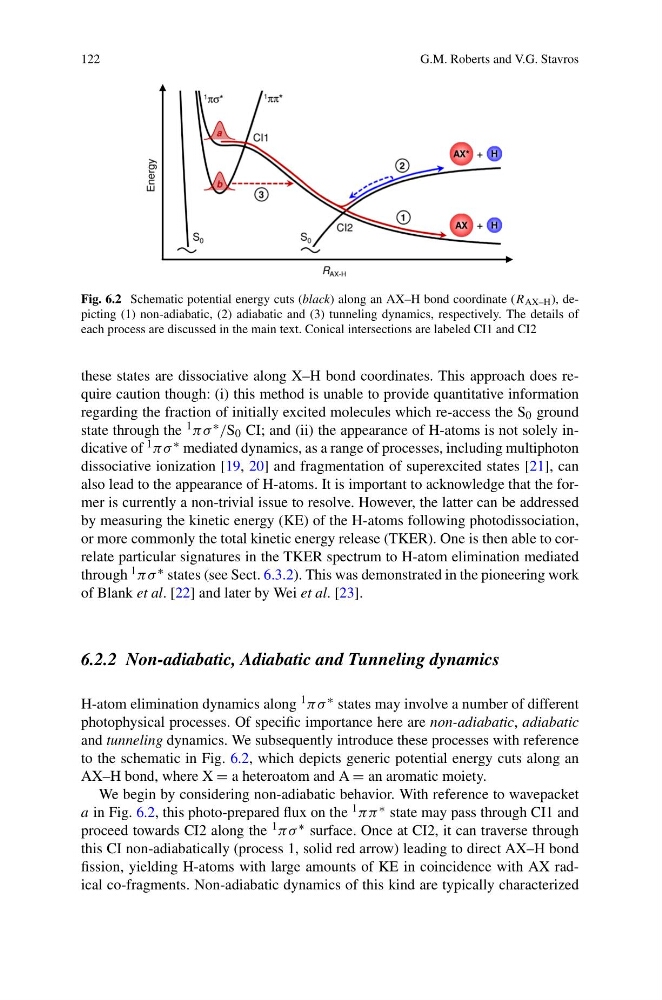
Fig. 6.2 Schematic potential energy cuts (black) along an AX–H bond coordinate (R AX–H ), depicting (1) non-adiabatic, (2) adiabatic and (3) tunneling dynamics, respectively. The details of
each process are discussed in the main text. Conical intersections are labeled CI1 and CI2
these states are dissociative along X–H bond coordinates. This approach does require caution though: (i) this method is unable to provide quantitative information
regarding the fraction of initially excited molecules which re-access the S 0 ground
state through the 1 πσ ∗ /S 0 CI; and (ii) the appearance of H-atoms is not solely indicative of 1 πσ ∗ mediated dynamics, as a range of processes, including multiphoton
dissociative ionization [19, 20] and fragmentation of superexcited states [21], can
also lead to the appearance of H-atoms. It is important to acknowledge that the former is currently a non-trivial issue to resolve. However, the latter can be addressed
by measuring the kinetic energy (KE) of the H-atoms following photodissociation,
or more commonly the total kinetic energy release (TKER). One is then able to correlate particular signatures in the TKER spectrum to H-atom elimination mediated
through 1 πσ ∗ states (see Sect. 6.3.2). This was demonstrated in the pioneering work
of Blank et al. [22] and later by Wei et al. [23].
6.2.2 Non-adiabatic, Adiabatic and Tunneling dynamics
H-atom elimination dynamics along 1 πσ ∗ states may involve a number of different
photophysical processes. Of specific importance here are non-adiabatic, adiabatic
and tunneling dynamics. We subsequently introduce these processes with reference
to the schematic in Fig. 6.2, which depicts generic potential energy cuts along an
AX–H bond, where X = a heteroatom and A = an aromatic moiety.
We begin by considering non-adiabatic behavior. With reference to wavepacket
a in Fig. 6.2, this photo-prepared flux on the 1 ππ ∗ state may pass through CI1 and
proceed towards CI2 along the 1 πσ ∗ surface. Once at CI2, it can traverse through
this CI non-adiabatically (process 1, solid red arrow) leading to direct AX–H bond
fission, yielding H-atoms with large amounts of KE in coincidence with AX radical co-fragments. Non-adiabatic dynamics of this kind are typically characterized
G.M. Roberts and V.G. Stavros
Fig. 6.2 Schematic potential energy cuts (black) along an AX–H bond coordinate (R AX–H ), depicting (1) non-adiabatic, (2) adiabatic and (3) tunneling dynamics, respectively. The details of
each process are discussed in the main text. Conical intersections are labeled CI1 and CI2
these states are dissociative along X–H bond coordinates. This approach does require caution though: (i) this method is unable to provide quantitative information
regarding the fraction of initially excited molecules which re-access the S 0 ground
state through the 1 πσ ∗ /S 0 CI; and (ii) the appearance of H-atoms is not solely indicative of 1 πσ ∗ mediated dynamics, as a range of processes, including multiphoton
dissociative ionization [19, 20] and fragmentation of superexcited states [21], can
also lead to the appearance of H-atoms. It is important to acknowledge that the former is currently a non-trivial issue to resolve. However, the latter can be addressed
by measuring the kinetic energy (KE) of the H-atoms following photodissociation,
or more commonly the total kinetic energy release (TKER). One is then able to correlate particular signatures in the TKER spectrum to H-atom elimination mediated
through 1 πσ ∗ states (see Sect. 6.3.2). This was demonstrated in the pioneering work
of Blank et al. [22] and later by Wei et al. [23].
6.2.2 Non-adiabatic, Adiabatic and Tunneling dynamics
H-atom elimination dynamics along 1 πσ ∗ states may involve a number of different
photophysical processes. Of specific importance here are non-adiabatic, adiabatic
and tunneling dynamics. We subsequently introduce these processes with reference
to the schematic in Fig. 6.2, which depicts generic potential energy cuts along an
AX–H bond, where X = a heteroatom and A = an aromatic moiety.
We begin by considering non-adiabatic behavior. With reference to wavepacket
a in Fig. 6.2, this photo-prepared flux on the 1 ππ ∗ state may pass through CI1 and
proceed towards CI2 along the 1 πσ ∗ surface. Once at CI2, it can traverse through
this CI non-adiabatically (process 1, solid red arrow) leading to direct AX–H bond
fission, yielding H-atoms with large amounts of KE in coincidence with AX radical co-fragments. Non-adiabatic dynamics of this kind are typically characterized