

6 Biomolecules, Photostability and 1 πσ ∗ States
121
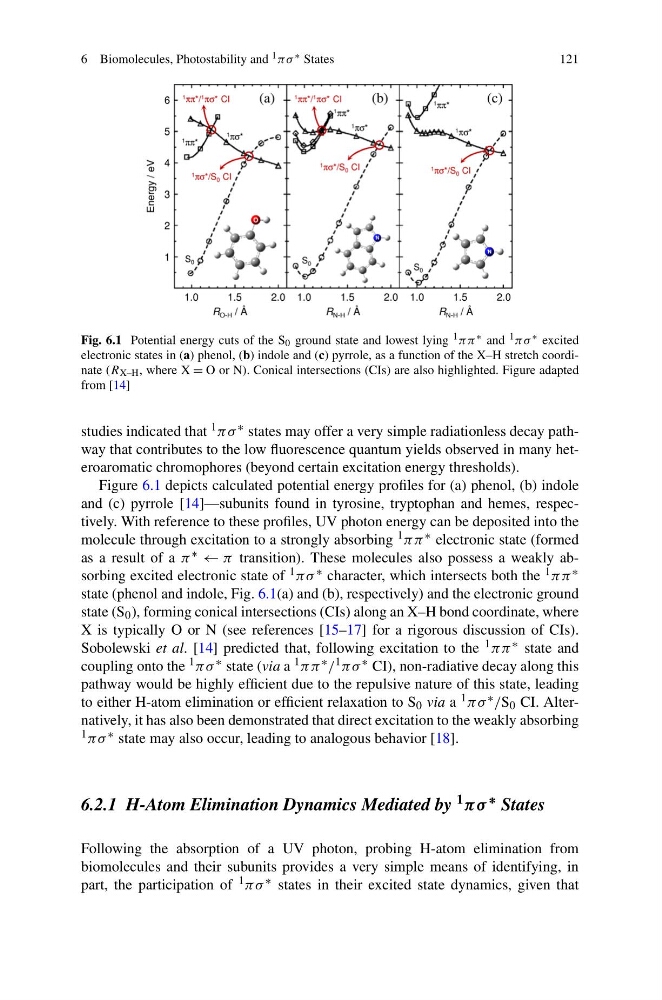
Fig. 6.1 Potential energy cuts of the S 0 ground state and lowest lying 1 ππ ∗ and 1 πσ ∗ excited
electronic states in (a) phenol, (b) indole and (c) pyrrole, as a function of the X–H stretch coordinate (R X–H , where X = O or N). Conical intersections (CIs) are also highlighted. Figure adapted
from [14]
studies indicated that 1 πσ ∗ states may offer a very simple radiationless decay pathway that contributes to the low fluorescence quantum yields observed in many heteroaromatic chromophores (beyond certain excitation energy thresholds).
Figure 6.1 depicts calculated potential energy profiles for (a) phenol, (b) indole
and (c) pyrrole [14]—subunits found in tyrosine, tryptophan and hemes, respectively. With reference to these profiles, UV photon energy can be deposited into the
molecule through excitation to a strongly absorbing 1 ππ ∗ electronic state (formed
as a result of a π ∗ ← π transition). These molecules also possess a weakly absorbing excited electronic state of 1 πσ ∗ character, which intersects both the 1 ππ ∗
state (phenol and indole, Fig. 6.1(a) and (b), respectively) and the electronic ground
state (S 0 ), forming conical intersections (CIs) along an X–H bond coordinate, where
X is typically O or N (see references [15–17] for a rigorous discussion of CIs).
Sobolewski et al. [14] predicted that, following excitation to the 1 ππ ∗ state and
coupling onto the 1 πσ ∗ state (via a 1 ππ ∗ / 1 πσ ∗ CI), non-radiative decay along this
pathway would be highly efficient due to the repulsive nature of this state, leading
to either H-atom elimination or efficient relaxation to S 0 via a 1 πσ ∗ /S 0 CI. Alternatively, it has also been demonstrated that direct excitation to the weakly absorbing
1 πσ ∗ state may also occur, leading to analogous behavior [18].
6.2.1 H-Atom Elimination Dynamics Mediated by 1 πσ ∗ States
Following the absorption of a UV photon, probing H-atom elimination from
biomolecules and their subunits provides a very simple means of identifying, in
part, the participation of 1 πσ ∗ states in their excited state dynamics, given that
121
Fig. 6.1 Potential energy cuts of the S 0 ground state and lowest lying 1 ππ ∗ and 1 πσ ∗ excited
electronic states in (a) phenol, (b) indole and (c) pyrrole, as a function of the X–H stretch coordinate (R X–H , where X = O or N). Conical intersections (CIs) are also highlighted. Figure adapted
from [14]
studies indicated that 1 πσ ∗ states may offer a very simple radiationless decay pathway that contributes to the low fluorescence quantum yields observed in many heteroaromatic chromophores (beyond certain excitation energy thresholds).
Figure 6.1 depicts calculated potential energy profiles for (a) phenol, (b) indole
and (c) pyrrole [14]—subunits found in tyrosine, tryptophan and hemes, respectively. With reference to these profiles, UV photon energy can be deposited into the
molecule through excitation to a strongly absorbing 1 ππ ∗ electronic state (formed
as a result of a π ∗ ← π transition). These molecules also possess a weakly absorbing excited electronic state of 1 πσ ∗ character, which intersects both the 1 ππ ∗
state (phenol and indole, Fig. 6.1(a) and (b), respectively) and the electronic ground
state (S 0 ), forming conical intersections (CIs) along an X–H bond coordinate, where
X is typically O or N (see references [15–17] for a rigorous discussion of CIs).
Sobolewski et al. [14] predicted that, following excitation to the 1 ππ ∗ state and
coupling onto the 1 πσ ∗ state (via a 1 ππ ∗ / 1 πσ ∗ CI), non-radiative decay along this
pathway would be highly efficient due to the repulsive nature of this state, leading
to either H-atom elimination or efficient relaxation to S 0 via a 1 πσ ∗ /S 0 CI. Alternatively, it has also been demonstrated that direct excitation to the weakly absorbing
1 πσ ∗ state may also occur, leading to analogous behavior [18].
6.2.1 H-Atom Elimination Dynamics Mediated by 1 πσ ∗ States
Following the absorption of a UV photon, probing H-atom elimination from
biomolecules and their subunits provides a very simple means of identifying, in
part, the participation of 1 πσ ∗ states in their excited state dynamics, given that