

4 Femtosecond Photodissociation Dynamics by Velocity Map Imaging
95
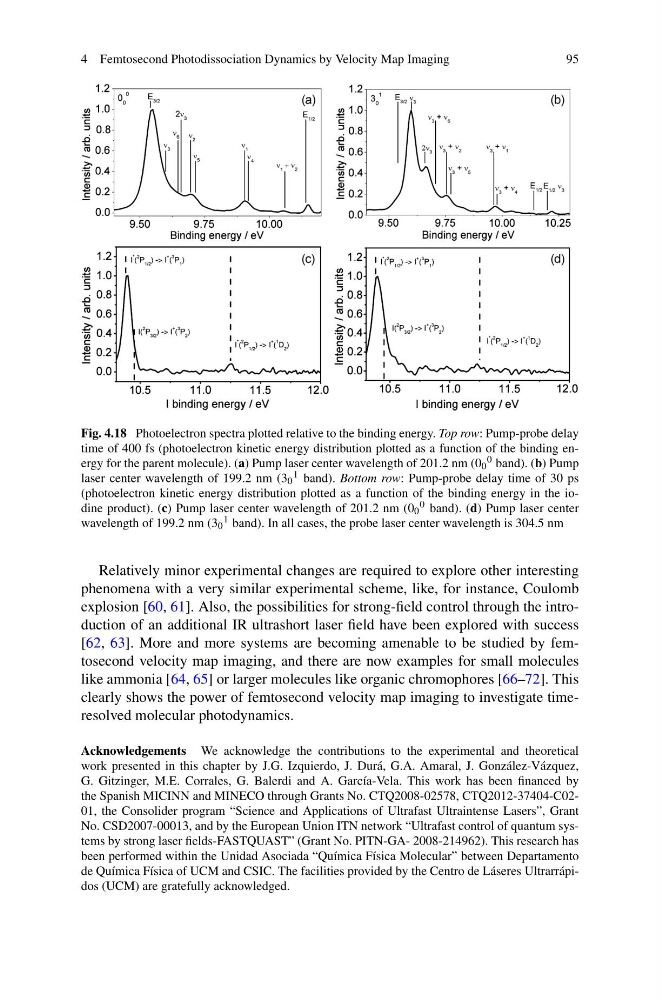
Fig. 4.18 Photoelectron spectra plotted relative to the binding energy. Top row: Pump-probe delay
time of 400 fs (photoelectron kinetic energy distribution plotted as a function of the binding energy for the parent molecule). (a) Pump laser center wavelength of 201.2 nm (0 0
0 band). (b) Pump
laser center wavelength of 199.2 nm (3 0
1 band). Bottom row: Pump-probe delay time of 30 ps
(photoelectron kinetic energy distribution plotted as a function of the binding energy in the iodine product). (c) Pump laser center wavelength of 201.2 nm (0 0
0 band). (d) Pump laser center
wavelength of 199.2 nm (3 0
1 band). In all cases, the probe laser center wavelength is 304.5 nm
Relatively minor experimental changes are required to explore other interesting
phenomena with a very similar experimental scheme, like, for instance, Coulomb
explosion [60, 61]. Also, the possibilities for strong-field control through the introduction of an additional IR ultrashort laser field have been explored with success
[62, 63]. More and more systems are becoming amenable to be studied by femtosecond velocity map imaging, and there are now examples for small molecules
like ammonia [64, 65] or larger molecules like organic chromophores [66–72]. This
clearly shows the power of femtosecond velocity map imaging to investigate timeresolved molecular photodynamics.
Acknowledgements We acknowledge the contributions to the experimental and theoretical
work presented in this chapter by J.G. Izquierdo, J. Durá, G.A. Amaral, J. González-Vázquez,
G. Gitzinger, M.E. Corrales, G. Balerdi and A. García-Vela. This work has been financed by
the Spanish MICINN and MINECO through Grants No. CTQ2008-02578, CTQ2012-37404-C0201, the Consolider program “Science and Applications of Ultrafast Ultraintense Lasers”, Grant
No. CSD2007-00013, and by the European Union ITN network “Ultrafast control of quantum systems by strong laser fields-FASTQUAST” (Grant No. PITN-GA- 2008-214962). This research has
been performed within the Unidad Asociada “Química Física Molecular” between Departamento
de Química Física of UCM and CSIC. The facilities provided by the Centro de Láseres Ultrarrápidos (UCM) are gratefully acknowledged.
95
Fig. 4.18 Photoelectron spectra plotted relative to the binding energy. Top row: Pump-probe delay
time of 400 fs (photoelectron kinetic energy distribution plotted as a function of the binding energy for the parent molecule). (a) Pump laser center wavelength of 201.2 nm (0 0
0 band). (b) Pump
laser center wavelength of 199.2 nm (3 0
1 band). Bottom row: Pump-probe delay time of 30 ps
(photoelectron kinetic energy distribution plotted as a function of the binding energy in the iodine product). (c) Pump laser center wavelength of 201.2 nm (0 0
0 band). (d) Pump laser center
wavelength of 199.2 nm (3 0
1 band). In all cases, the probe laser center wavelength is 304.5 nm
Relatively minor experimental changes are required to explore other interesting
phenomena with a very similar experimental scheme, like, for instance, Coulomb
explosion [60, 61]. Also, the possibilities for strong-field control through the introduction of an additional IR ultrashort laser field have been explored with success
[62, 63]. More and more systems are becoming amenable to be studied by femtosecond velocity map imaging, and there are now examples for small molecules
like ammonia [64, 65] or larger molecules like organic chromophores [66–72]. This
clearly shows the power of femtosecond velocity map imaging to investigate timeresolved molecular photodynamics.
Acknowledgements We acknowledge the contributions to the experimental and theoretical
work presented in this chapter by J.G. Izquierdo, J. Durá, G.A. Amaral, J. González-Vázquez,
G. Gitzinger, M.E. Corrales, G. Balerdi and A. García-Vela. This work has been financed by
the Spanish MICINN and MINECO through Grants No. CTQ2008-02578, CTQ2012-37404-C0201, the Consolider program “Science and Applications of Ultrafast Ultraintense Lasers”, Grant
No. CSD2007-00013, and by the European Union ITN network “Ultrafast control of quantum systems by strong laser fields-FASTQUAST” (Grant No. PITN-GA- 2008-214962). This research has
been performed within the Unidad Asociada “Química Física Molecular” between Departamento
de Química Física of UCM and CSIC. The facilities provided by the Centro de Láseres Ultrarrápidos (UCM) are gratefully acknowledged.