

94
R. de Nalda et al.
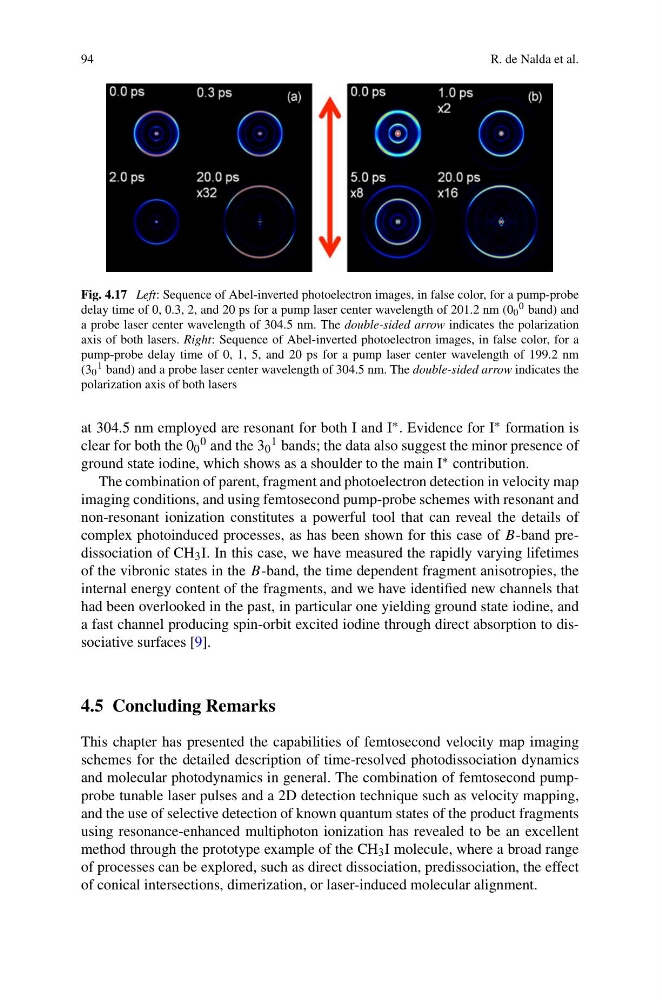
Fig. 4.17 Left: Sequence of Abel-inverted photoelectron images, in false color, for a pump-probe
delay time of 0, 0.3, 2, and 20 ps for a pump laser center wavelength of 201.2 nm (0 0
0 band) and
a probe laser center wavelength of 304.5 nm. The double-sided arrow indicates the polarization
axis of both lasers. Right: Sequence of Abel-inverted photoelectron images, in false color, for a
pump-probe delay time of 0, 1, 5, and 20 ps for a pump laser center wavelength of 199.2 nm
(3 0
1 band) and a probe laser center wavelength of 304.5 nm. The double-sided arrow indicates the
polarization axis of both lasers
at 304.5 nm employed are resonant for both I and I ∗ . Evidence for I ∗ formation is
clear for both the 0 0
0 and the 3 0
1 bands; the data also suggest the minor presence of
ground state iodine, which shows as a shoulder to the main I ∗ contribution.
The combination of parent, fragment and photoelectron detection in velocity map
imaging conditions, and using femtosecond pump-probe schemes with resonant and
non-resonant ionization constitutes a powerful tool that can reveal the details of
complex photoinduced processes, as has been shown for this case of B-band predissociation of CH 3 I. In this case, we have measured the rapidly varying lifetimes
of the vibronic states in the B-band, the time dependent fragment anisotropies, the
internal energy content of the fragments, and we have identified new channels that
had been overlooked in the past, in particular one yielding ground state iodine, and
a fast channel producing spin-orbit excited iodine through direct absorption to dissociative surfaces [9].
4.5 Concluding Remarks
This chapter has presented the capabilities of femtosecond velocity map imaging
schemes for the detailed description of time-resolved photodissociation dynamics
and molecular photodynamics in general. The combination of femtosecond pumpprobe tunable laser pulses and a 2D detection technique such as velocity mapping,
and the use of selective detection of known quantum states of the product fragments
using resonance-enhanced multiphoton ionization has revealed to be an excellent
method through the prototype example of the CH 3 I molecule, where a broad range
of processes can be explored, such as direct dissociation, predissociation, the effect
of conical intersections, dimerization, or laser-induced molecular alignment.
R. de Nalda et al.
Fig. 4.17 Left: Sequence of Abel-inverted photoelectron images, in false color, for a pump-probe
delay time of 0, 0.3, 2, and 20 ps for a pump laser center wavelength of 201.2 nm (0 0
0 band) and
a probe laser center wavelength of 304.5 nm. The double-sided arrow indicates the polarization
axis of both lasers. Right: Sequence of Abel-inverted photoelectron images, in false color, for a
pump-probe delay time of 0, 1, 5, and 20 ps for a pump laser center wavelength of 199.2 nm
(3 0
1 band) and a probe laser center wavelength of 304.5 nm. The double-sided arrow indicates the
polarization axis of both lasers
at 304.5 nm employed are resonant for both I and I ∗ . Evidence for I ∗ formation is
clear for both the 0 0
0 and the 3 0
1 bands; the data also suggest the minor presence of
ground state iodine, which shows as a shoulder to the main I ∗ contribution.
The combination of parent, fragment and photoelectron detection in velocity map
imaging conditions, and using femtosecond pump-probe schemes with resonant and
non-resonant ionization constitutes a powerful tool that can reveal the details of
complex photoinduced processes, as has been shown for this case of B-band predissociation of CH 3 I. In this case, we have measured the rapidly varying lifetimes
of the vibronic states in the B-band, the time dependent fragment anisotropies, the
internal energy content of the fragments, and we have identified new channels that
had been overlooked in the past, in particular one yielding ground state iodine, and
a fast channel producing spin-orbit excited iodine through direct absorption to dissociative surfaces [9].
4.5 Concluding Remarks
This chapter has presented the capabilities of femtosecond velocity map imaging
schemes for the detailed description of time-resolved photodissociation dynamics
and molecular photodynamics in general. The combination of femtosecond pumpprobe tunable laser pulses and a 2D detection technique such as velocity mapping,
and the use of selective detection of known quantum states of the product fragments
using resonance-enhanced multiphoton ionization has revealed to be an excellent
method through the prototype example of the CH 3 I molecule, where a broad range
of processes can be explored, such as direct dissociation, predissociation, the effect
of conical intersections, dimerization, or laser-induced molecular alignment.