

3.3 The Two-State Model: Rabi Oscillations
85
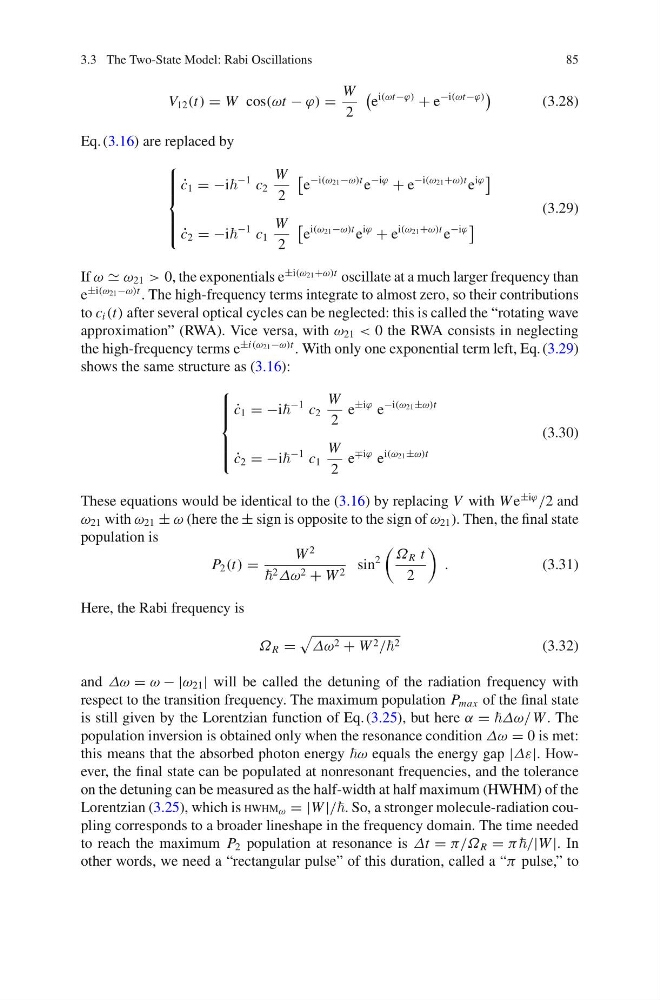
V 12 (t) = W cos(ωt − ϕ) =
W
2
e
i(ωt−ϕ)
+ e
−i(ωt−ϕ)
(3.28)
Eq. (3.16) are replaced by
⎧
⎪ ⎪ ⎪ ⎨
⎪ ⎪ ⎪ ⎩
˙
c 1 = −i
−1 c 2
W
2
e
−i(ω 21 −ω)t e
−iϕ
+ e
−i(ω 21 +ω)t e
iϕ
˙
c 2 = −i
−1 c 1
W
2
e
i(ω 21 −ω)t e
iϕ
+ e
i(ω 21 +ω)t e
−iϕ
(3.29)
If ω ω 21 > 0, the exponentials e
±i(ω 21 +ω)t oscillate at a much larger frequency than
e
±i(ω 21 −ω)t . The high-frequency terms integrate to almost zero, so their contributions
to c i (t) after several optical cycles can be neglected: this is called the “rotating wave
approximation” (RWA). Vice versa, with ω 21 < 0 the RWA consists in neglecting
the high-frequency terms e
±i(ω 21 −ω)t . With only one exponential term left, Eq. (3.29)
shows the same structure as (3.16):
⎧
⎪ ⎪ ⎪ ⎨
⎪ ⎪ ⎪ ⎩
˙
c 1 = −i
−1 c 2
W
2
e
±iϕ e
−i(ω 21 ±ω)t
˙
c 2 = −i
−1 c 1
W
2
e
∓iϕ e
i(ω 21 ±ω)t
(3.30)
These equations would be identical to the (3.16) by replacing V with W e
±iϕ
/2 and
ω 21 with ω 21 ± ω (here the ± sign is opposite to the sign of ω 21 ). Then, the final state
population is
P 2 (t) =
W
2
2 Δω 2 + W 2 sin
2
Ω R t
2
.
(3.31)
Here, the Rabi frequency is
Ω R =
Δω 2 + W 2 / 2
(3.32)
and Δω = ω − |ω 21 | will be called the detuning of the radiation frequency with
respect to the transition frequency. The maximum population P max of the final state
is still given by the Lorentzian function of Eq. (3.25), but here α = Δω/W . The
population inversion is obtained only when the resonance condition Δω = 0 is met:
this means that the absorbed photon energy ω equals the energy gap |Δε|. However, the final state can be populated at nonresonant frequencies, and the tolerance
on the detuning can be measured as the half-width at half maximum (HWHM) of the
Lorentzian (3.25), which is HWHM ω = |W |/. So, a stronger molecule-radiation coupling corresponds to a broader lineshape in the frequency domain. The time needed
to reach the maximum P 2 population at resonance is Δt = π/Ω R = π /|W |. In
other words, we need a “rectangular pulse” of this duration, called a “π pulse,” to
85
V 12 (t) = W cos(ωt − ϕ) =
W
2
e
i(ωt−ϕ)
+ e
−i(ωt−ϕ)
(3.28)
Eq. (3.16) are replaced by
⎧
⎪ ⎪ ⎪ ⎨
⎪ ⎪ ⎪ ⎩
˙
c 1 = −i
−1 c 2
W
2
e
−i(ω 21 −ω)t e
−iϕ
+ e
−i(ω 21 +ω)t e
iϕ
˙
c 2 = −i
−1 c 1
W
2
e
i(ω 21 −ω)t e
iϕ
+ e
i(ω 21 +ω)t e
−iϕ
(3.29)
If ω ω 21 > 0, the exponentials e
±i(ω 21 +ω)t oscillate at a much larger frequency than
e
±i(ω 21 −ω)t . The high-frequency terms integrate to almost zero, so their contributions
to c i (t) after several optical cycles can be neglected: this is called the “rotating wave
approximation” (RWA). Vice versa, with ω 21 < 0 the RWA consists in neglecting
the high-frequency terms e
±i(ω 21 −ω)t . With only one exponential term left, Eq. (3.29)
shows the same structure as (3.16):
⎧
⎪ ⎪ ⎪ ⎨
⎪ ⎪ ⎪ ⎩
˙
c 1 = −i
−1 c 2
W
2
e
±iϕ e
−i(ω 21 ±ω)t
˙
c 2 = −i
−1 c 1
W
2
e
∓iϕ e
i(ω 21 ±ω)t
(3.30)
These equations would be identical to the (3.16) by replacing V with W e
±iϕ
/2 and
ω 21 with ω 21 ± ω (here the ± sign is opposite to the sign of ω 21 ). Then, the final state
population is
P 2 (t) =
W
2
2 Δω 2 + W 2 sin
2
Ω R t
2
.
(3.31)
Here, the Rabi frequency is
Ω R =
Δω 2 + W 2 / 2
(3.32)
and Δω = ω − |ω 21 | will be called the detuning of the radiation frequency with
respect to the transition frequency. The maximum population P max of the final state
is still given by the Lorentzian function of Eq. (3.25), but here α = Δω/W . The
population inversion is obtained only when the resonance condition Δω = 0 is met:
this means that the absorbed photon energy ω equals the energy gap |Δε|. However, the final state can be populated at nonresonant frequencies, and the tolerance
on the detuning can be measured as the half-width at half maximum (HWHM) of the
Lorentzian (3.25), which is HWHM ω = |W |/. So, a stronger molecule-radiation coupling corresponds to a broader lineshape in the frequency domain. The time needed
to reach the maximum P 2 population at resonance is Δt = π/Ω R = π /|W |. In
other words, we need a “rectangular pulse” of this duration, called a “π pulse,” to