

82
3 Electronic Excitation and Decay
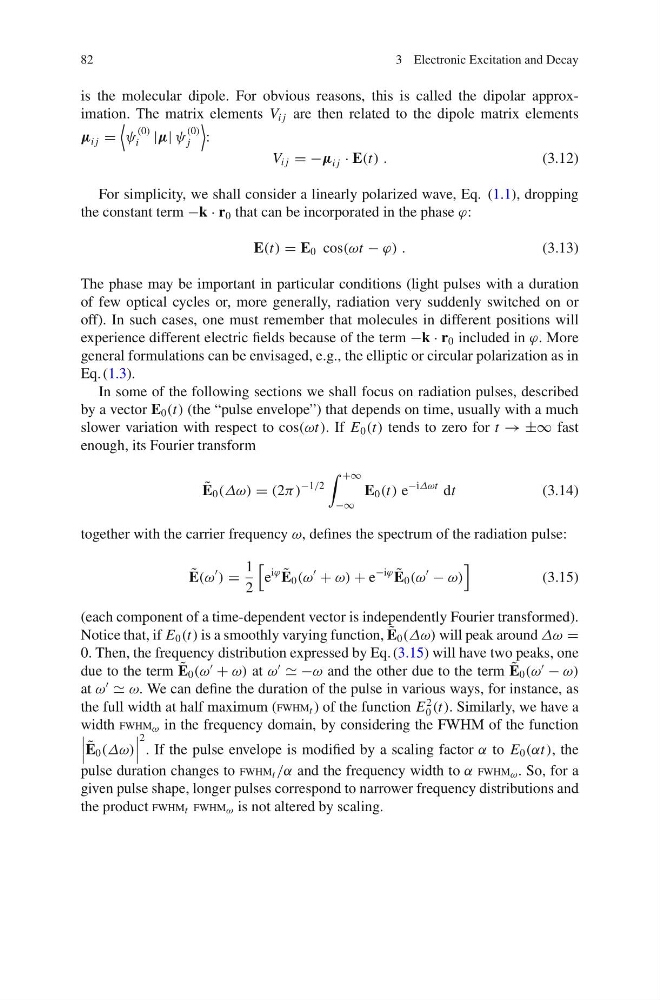
is the molecular dipole. For obvious reasons, this is called the dipolar approximation. The matrix elements V i j are then related to the dipole matrix elements
µ i j =
ψ
(0)
i |µ| ψ
(0)
j
:
V i j = −µ i j · E(t) .
(3.12)
For simplicity, we shall consider a linearly polarized wave, Eq. (1.1), dropping
the constant term −k · r 0 that can be incorporated in the phase ϕ:
E(t) = E 0 cos(ωt − ϕ) .
(3.13)
The phase may be important in particular conditions (light pulses with a duration
of few optical cycles or, more generally, radiation very suddenly switched on or
off). In such cases, one must remember that molecules in different positions will
experience different electric fields because of the term −k · r 0 included in ϕ. More
general formulations can be envisaged, e.g., the elliptic or circular polarization as in
Eq. (1.3).
In some of the following sections we shall focus on radiation pulses, described
by a vector E 0 (t) (the “pulse envelope”) that depends on time, usually with a much
slower variation with respect to cos(ωt). If E 0 (t) tends to zero for t → ±∞ fast
enough, its Fourier transform
˜
E 0 (Δω) = (2π)
−1/2
+∞
−∞
E 0 (t) e
−iΔωt dt
(3.14)
together with the carrier frequency ω, defines the spectrum of the radiation pulse:
˜
E(ω
) =
1
2
e
iϕ ˜
E 0 (ω
+ ω) + e
−iϕ ˜
E 0 (ω
− ω)
(3.15)
(each component of a time-dependent vector is independently Fourier transformed).
Notice that, if E 0 (t) is a smoothly varying function, ˜
E 0 (Δω) will peak around Δω =
0. Then, the frequency distribution expressed by Eq. (3.15) will have two peaks, one
due to the term ˜
E 0 (ω
+ ω) at ω
−ω and the other due to the term ˜
E 0 (ω
− ω)
at ω
ω. We can define the duration of the pulse in various ways, for instance, as
the full width at half maximum (FWHM t ) of the function E
2
0 (t). Similarly, we have a
width FWHM ω in the frequency domain, by considering the FWHM of the function
˜
E 0 (Δω)
2
. If the pulse envelope is modified by a scaling factor α to E 0 (αt), the
pulse duration changes to FWHM t /α and the frequency width to α FWHM ω . So, for a
given pulse shape, longer pulses correspond to narrower frequency distributions and
the product FWHM t FWHM ω is not altered by scaling.
3 Electronic Excitation and Decay
is the molecular dipole. For obvious reasons, this is called the dipolar approximation. The matrix elements V i j are then related to the dipole matrix elements
µ i j =
ψ
(0)
i |µ| ψ
(0)
j
:
V i j = −µ i j · E(t) .
(3.12)
For simplicity, we shall consider a linearly polarized wave, Eq. (1.1), dropping
the constant term −k · r 0 that can be incorporated in the phase ϕ:
E(t) = E 0 cos(ωt − ϕ) .
(3.13)
The phase may be important in particular conditions (light pulses with a duration
of few optical cycles or, more generally, radiation very suddenly switched on or
off). In such cases, one must remember that molecules in different positions will
experience different electric fields because of the term −k · r 0 included in ϕ. More
general formulations can be envisaged, e.g., the elliptic or circular polarization as in
Eq. (1.3).
In some of the following sections we shall focus on radiation pulses, described
by a vector E 0 (t) (the “pulse envelope”) that depends on time, usually with a much
slower variation with respect to cos(ωt). If E 0 (t) tends to zero for t → ±∞ fast
enough, its Fourier transform
˜
E 0 (Δω) = (2π)
−1/2
+∞
−∞
E 0 (t) e
−iΔωt dt
(3.14)
together with the carrier frequency ω, defines the spectrum of the radiation pulse:
˜
E(ω
) =
1
2
e
iϕ ˜
E 0 (ω
+ ω) + e
−iϕ ˜
E 0 (ω
− ω)
(3.15)
(each component of a time-dependent vector is independently Fourier transformed).
Notice that, if E 0 (t) is a smoothly varying function, ˜
E 0 (Δω) will peak around Δω =
0. Then, the frequency distribution expressed by Eq. (3.15) will have two peaks, one
due to the term ˜
E 0 (ω
+ ω) at ω
−ω and the other due to the term ˜
E 0 (ω
− ω)
at ω
ω. We can define the duration of the pulse in various ways, for instance, as
the full width at half maximum (FWHM t ) of the function E
2
0 (t). Similarly, we have a
width FWHM ω in the frequency domain, by considering the FWHM of the function
˜
E 0 (Δω)
2
. If the pulse envelope is modified by a scaling factor α to E 0 (αt), the
pulse duration changes to FWHM t /α and the frequency width to α FWHM ω . So, for a
given pulse shape, longer pulses correspond to narrower frequency distributions and
the product FWHM t FWHM ω is not altered by scaling.