

2.6 Electronic States of Polyatomics and Photoreactivity
63
λ
λ
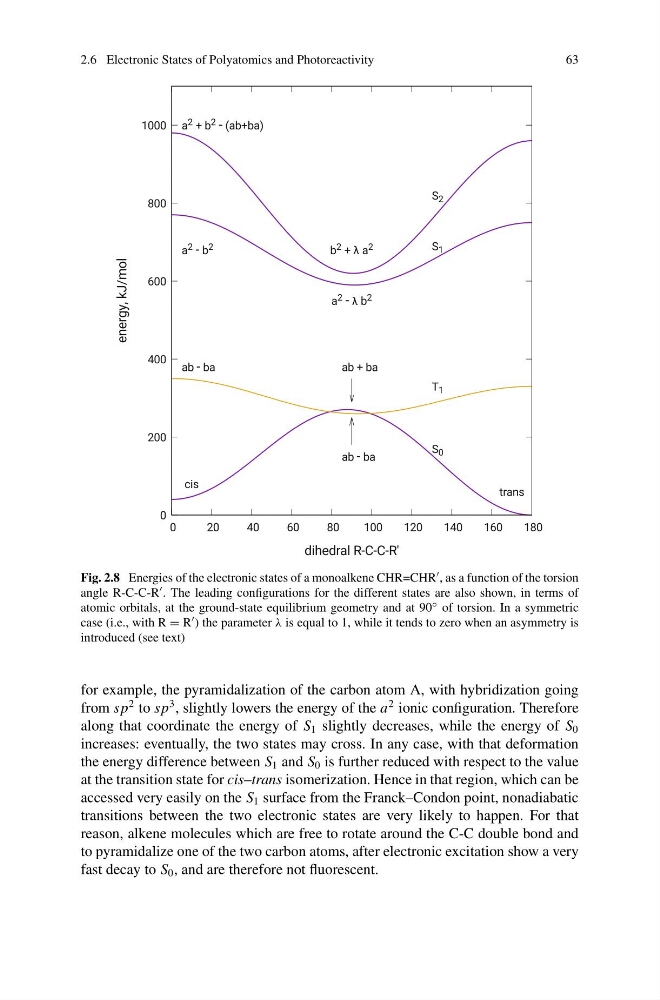
Fig. 2.8 Energies of the electronic states of a monoalkene CHR=CHR , as a function of the torsion
angle R-C-C-R . The leading configurations for the different states are also shown, in terms of
atomic orbitals, at the ground-state equilibrium geometry and at 90 ◦ of torsion. In a symmetric
case (i.e., with R = R ) the parameter λ is equal to 1, while it tends to zero when an asymmetry is
introduced (see text)
for example, the pyramidalization of the carbon atom A, with hybridization going
from sp
2 to sp
3 , slightly lowers the energy of the a
2 ionic configuration. Therefore
along that coordinate the energy of S 1 slightly decreases, while the energy of S 0
increases: eventually, the two states may cross. In any case, with that deformation
the energy difference between S 1 and S 0 is further reduced with respect to the value
at the transition state for cis–trans isomerization. Hence in that region, which can be
accessed very easily on the S 1 surface from the Franck–Condon point, nonadiabatic
transitions between the two electronic states are very likely to happen. For that
reason, alkene molecules which are free to rotate around the C-C double bond and
to pyramidalize one of the two carbon atoms, after electronic excitation show a very
fast decay to S 0 , and are therefore not fluorescent.
63
λ
λ
Fig. 2.8 Energies of the electronic states of a monoalkene CHR=CHR , as a function of the torsion
angle R-C-C-R . The leading configurations for the different states are also shown, in terms of
atomic orbitals, at the ground-state equilibrium geometry and at 90 ◦ of torsion. In a symmetric
case (i.e., with R = R ) the parameter λ is equal to 1, while it tends to zero when an asymmetry is
introduced (see text)
for example, the pyramidalization of the carbon atom A, with hybridization going
from sp
2 to sp
3 , slightly lowers the energy of the a
2 ionic configuration. Therefore
along that coordinate the energy of S 1 slightly decreases, while the energy of S 0
increases: eventually, the two states may cross. In any case, with that deformation
the energy difference between S 1 and S 0 is further reduced with respect to the value
at the transition state for cis–trans isomerization. Hence in that region, which can be
accessed very easily on the S 1 surface from the Franck–Condon point, nonadiabatic
transitions between the two electronic states are very likely to happen. For that
reason, alkene molecules which are free to rotate around the C-C double bond and
to pyramidalize one of the two carbon atoms, after electronic excitation show a very
fast decay to S 0 , and are therefore not fluorescent.