

62
2 Molecular States
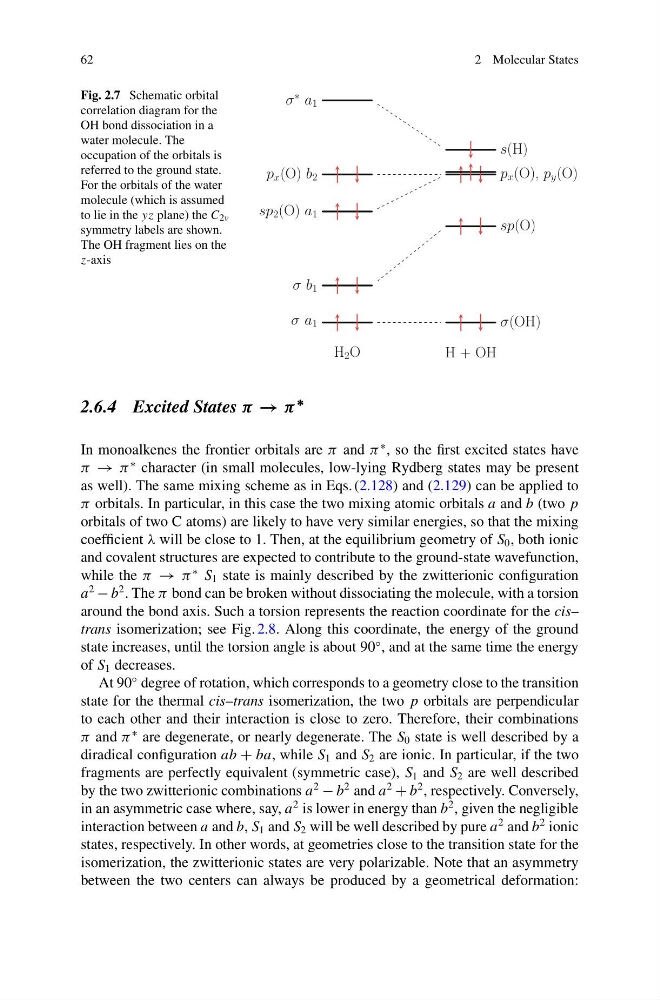
Fig. 2.7 Schematic orbital
correlation diagram for the
OH bond dissociation in a
water molecule. The
occupation of the orbitals is
referred to the ground state.
For the orbitals of the water
molecule (which is assumed
to lie in the yz plane) the C 2v
symmetry labels are shown.
The OH fragment lies on the
z-axis
σ a 1
σ b 1
sp 2 (O) a 1
p x (O) b 2
σ
∗
a 1
σ(OH)
sp(O)
p x (O), p y (O)
s(H)
H 2 O
H + OH
2.6.4 Excited States π → π ∗
In monoalkenes the frontier orbitals are π and π
∗ , so the first excited states have
π → π
∗ character (in small molecules, low-lying Rydberg states may be present
as well). The same mixing scheme as in Eqs. (2.128) and (2.129) can be applied to
π orbitals. In particular, in this case the two mixing atomic orbitals a and b (two p
orbitals of two C atoms) are likely to have very similar energies, so that the mixing
coefficient λ will be close to 1. Then, at the equilibrium geometry of S 0 , both ionic
and covalent structures are expected to contribute to the ground-state wavefunction,
while the π → π
∗ S 1 state is mainly described by the zwitterionic configuration
a
2
− b
2 . The π bond can be broken without dissociating the molecule, with a torsion
around the bond axis. Such a torsion represents the reaction coordinate for the cis–
trans isomerization; see Fig. 2.8. Along this coordinate, the energy of the ground
state increases, until the torsion angle is about 90
◦ , and at the same time the energy
of S 1 decreases.
At 90
◦ degree of rotation, which corresponds to a geometry close to the transition
state for the thermal cis–trans isomerization, the two p orbitals are perpendicular
to each other and their interaction is close to zero. Therefore, their combinations
π and π
∗ are degenerate, or nearly degenerate. The S 0 state is well described by a
diradical configuration ab + ba, while S 1 and S 2 are ionic. In particular, if the two
fragments are perfectly equivalent (symmetric case), S 1 and S 2 are well described
by the two zwitterionic combinations a
2
− b
2 and a
2
+ b
2 , respectively. Conversely,
in an asymmetric case where, say, a
2 is lower in energy than b
2 , given the negligible
interaction between a and b, S 1 and S 2 will be well described by pure a
2 and b
2 ionic
states, respectively. In other words, at geometries close to the transition state for the
isomerization, the zwitterionic states are very polarizable. Note that an asymmetry
between the two centers can always be produced by a geometrical deformation:
2 Molecular States
Fig. 2.7 Schematic orbital
correlation diagram for the
OH bond dissociation in a
water molecule. The
occupation of the orbitals is
referred to the ground state.
For the orbitals of the water
molecule (which is assumed
to lie in the yz plane) the C 2v
symmetry labels are shown.
The OH fragment lies on the
z-axis
σ a 1
σ b 1
sp 2 (O) a 1
p x (O) b 2
σ
∗
a 1
σ(OH)
sp(O)
p x (O), p y (O)
s(H)
H 2 O
H + OH
2.6.4 Excited States π → π ∗
In monoalkenes the frontier orbitals are π and π
∗ , so the first excited states have
π → π
∗ character (in small molecules, low-lying Rydberg states may be present
as well). The same mixing scheme as in Eqs. (2.128) and (2.129) can be applied to
π orbitals. In particular, in this case the two mixing atomic orbitals a and b (two p
orbitals of two C atoms) are likely to have very similar energies, so that the mixing
coefficient λ will be close to 1. Then, at the equilibrium geometry of S 0 , both ionic
and covalent structures are expected to contribute to the ground-state wavefunction,
while the π → π
∗ S 1 state is mainly described by the zwitterionic configuration
a
2
− b
2 . The π bond can be broken without dissociating the molecule, with a torsion
around the bond axis. Such a torsion represents the reaction coordinate for the cis–
trans isomerization; see Fig. 2.8. Along this coordinate, the energy of the ground
state increases, until the torsion angle is about 90
◦ , and at the same time the energy
of S 1 decreases.
At 90
◦ degree of rotation, which corresponds to a geometry close to the transition
state for the thermal cis–trans isomerization, the two p orbitals are perpendicular
to each other and their interaction is close to zero. Therefore, their combinations
π and π
∗ are degenerate, or nearly degenerate. The S 0 state is well described by a
diradical configuration ab + ba, while S 1 and S 2 are ionic. In particular, if the two
fragments are perfectly equivalent (symmetric case), S 1 and S 2 are well described
by the two zwitterionic combinations a
2
− b
2 and a
2
+ b
2 , respectively. Conversely,
in an asymmetric case where, say, a
2 is lower in energy than b
2 , given the negligible
interaction between a and b, S 1 and S 2 will be well described by pure a
2 and b
2 ionic
states, respectively. In other words, at geometries close to the transition state for the
isomerization, the zwitterionic states are very polarizable. Note that an asymmetry
between the two centers can always be produced by a geometrical deformation: