

2.2 Molecular Dynamics and the Separation of Variables
35
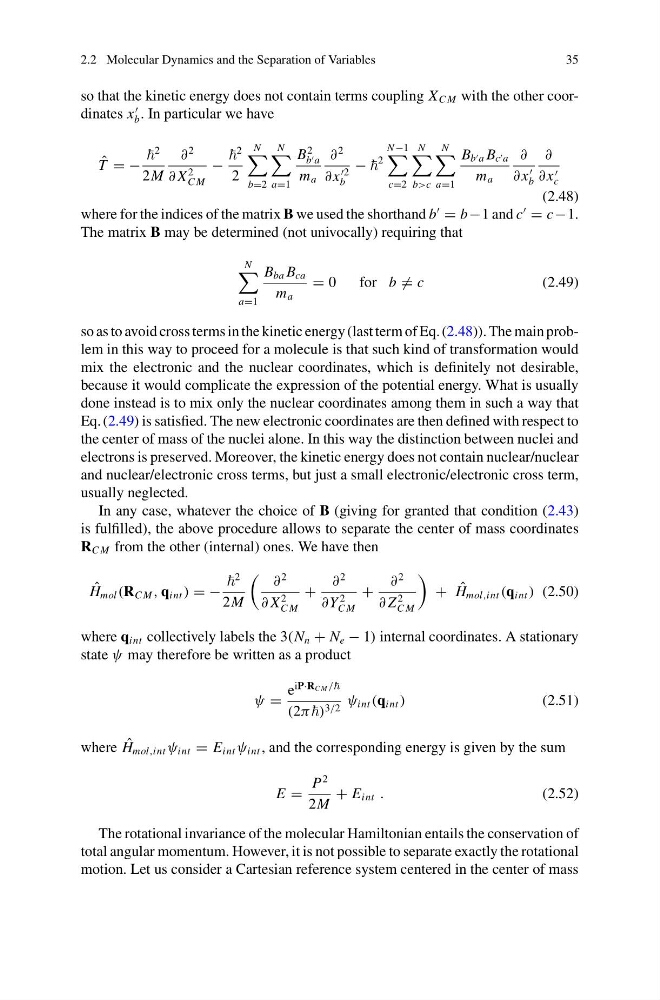
so that the kinetic energy does not contain terms coupling X C M with the other coordinates x
b . In particular we have
ˆ
T = −
2
2M
∂
2
∂ X
2
C M
−
2
2
N
b=2
N
a=1
B
2
b a
m a
∂
2
∂ x
2
b
−
2
N −1
c=2
N
b>c
N
a=1
B b a B c a
m a
∂
∂ x
b
∂
∂ x
c
(2.48)
where for the indices of the matrix B we used the shorthand b
= b−1 and c
= c−1.
The matrix B may be determined (not univocally) requiring that
N
a=1
B ba B ca
m a
= 0
for b = c
(2.49)
so as to avoid cross terms in the kinetic energy (last term of Eq. (2.48)). The main problem in this way to proceed for a molecule is that such kind of transformation would
mix the electronic and the nuclear coordinates, which is definitely not desirable,
because it would complicate the expression of the potential energy. What is usually
done instead is to mix only the nuclear coordinates among them in such a way that
Eq. (2.49) is satisfied. The new electronic coordinates are then defined with respect to
the center of mass of the nuclei alone. In this way the distinction between nuclei and
electrons is preserved. Moreover, the kinetic energy does not contain nuclear/nuclear
and nuclear/electronic cross terms, but just a small electronic/electronic cross term,
usually neglected.
In any case, whatever the choice of B (giving for granted that condition (2.43)
is fulfilled), the above procedure allows to separate the center of mass coordinates
R C M from the other (internal) ones. We have then
ˆ
H mol (R C M , q int ) = −
2
2M
∂
2
∂ X
2
C M
+
∂
2
∂Y
2
C M
+
∂
2
∂ Z
2
C M
+ ˆ
H mol,int (q int ) (2.50)
where q int collectively labels the 3(N n + N e − 1) internal coordinates. A stationary
state ψ may therefore be written as a product
ψ =
e
iP·R C M /
(2π ) 3/2 ψ int (q int )
(2.51)
where ˆ
H mol,int ψ int = E int ψ int , and the corresponding energy is given by the sum
E =
P
2
2M
+ E int .
(2.52)
The rotational invariance of the molecular Hamiltonian entails the conservation of
total angular momentum. However, it is not possible to separate exactly the rotational
motion. Let us consider a Cartesian reference system centered in the center of mass
35
so that the kinetic energy does not contain terms coupling X C M with the other coordinates x
b . In particular we have
ˆ
T = −
2
2M
∂
2
∂ X
2
C M
−
2
2
N
b=2
N
a=1
B
2
b a
m a
∂
2
∂ x
2
b
−
2
N −1
c=2
N
b>c
N
a=1
B b a B c a
m a
∂
∂ x
b
∂
∂ x
c
(2.48)
where for the indices of the matrix B we used the shorthand b
= b−1 and c
= c−1.
The matrix B may be determined (not univocally) requiring that
N
a=1
B ba B ca
m a
= 0
for b = c
(2.49)
so as to avoid cross terms in the kinetic energy (last term of Eq. (2.48)). The main problem in this way to proceed for a molecule is that such kind of transformation would
mix the electronic and the nuclear coordinates, which is definitely not desirable,
because it would complicate the expression of the potential energy. What is usually
done instead is to mix only the nuclear coordinates among them in such a way that
Eq. (2.49) is satisfied. The new electronic coordinates are then defined with respect to
the center of mass of the nuclei alone. In this way the distinction between nuclei and
electrons is preserved. Moreover, the kinetic energy does not contain nuclear/nuclear
and nuclear/electronic cross terms, but just a small electronic/electronic cross term,
usually neglected.
In any case, whatever the choice of B (giving for granted that condition (2.43)
is fulfilled), the above procedure allows to separate the center of mass coordinates
R C M from the other (internal) ones. We have then
ˆ
H mol (R C M , q int ) = −
2
2M
∂
2
∂ X
2
C M
+
∂
2
∂Y
2
C M
+
∂
2
∂ Z
2
C M
+ ˆ
H mol,int (q int ) (2.50)
where q int collectively labels the 3(N n + N e − 1) internal coordinates. A stationary
state ψ may therefore be written as a product
ψ =
e
iP·R C M /
(2π ) 3/2 ψ int (q int )
(2.51)
where ˆ
H mol,int ψ int = E int ψ int , and the corresponding energy is given by the sum
E =
P
2
2M
+ E int .
(2.52)
The rotational invariance of the molecular Hamiltonian entails the conservation of
total angular momentum. However, it is not possible to separate exactly the rotational
motion. Let us consider a Cartesian reference system centered in the center of mass