

34
2 Molecular States
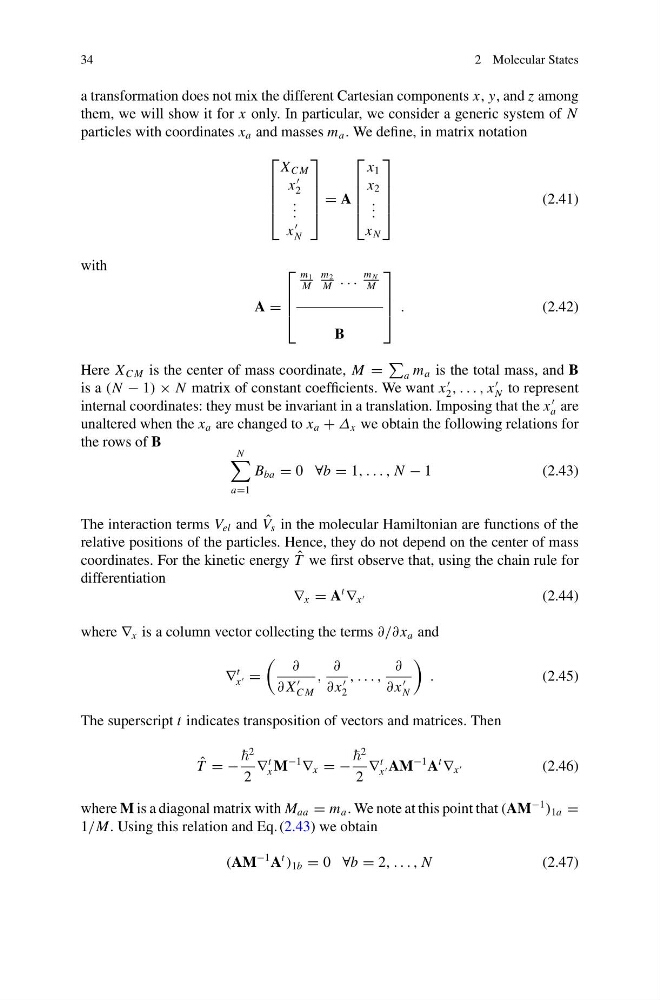
a transformation does not mix the different Cartesian components x, y, and z among
them, we will show it for x only. In particular, we consider a generic system of N
particles with coordinates x a and masses m a . We define, in matrix notation
⎡
⎢
⎢
⎢
⎣
X C M
x
2
. . .
x
N
⎤
⎥
⎥
⎥
⎦
= A
⎡
⎢
⎢
⎢
⎣
x 1
x 2
. . .
x N
⎤
⎥
⎥
⎥
⎦
(2.41)
with
A =
⎡
⎢
⎢
⎣
m 1
M
m 2
M
. . .
m N
M
B
⎤
⎥
⎥
⎦ .
(2.42)
Here X C M is the center of mass coordinate, M =
a m a is the total mass, and B
is a (N − 1) × N matrix of constant coefficients. We want x
2 , . . . , x
N to represent
internal coordinates: they must be invariant in a translation. Imposing that the x
a are
unaltered when the x a are changed to x a + Δ x we obtain the following relations for
the rows of B
N
a=1
B ba = 0 ∀b = 1, . . . , N − 1
(2.43)
The interaction terms V el and ˆ
V s in the molecular Hamiltonian are functions of the
relative positions of the particles. Hence, they do not depend on the center of mass
coordinates. For the kinetic energy ˆ
T we first observe that, using the chain rule for
differentiation
∇ x = A
t
∇ x
(2.44)
where ∇ x is a column vector collecting the terms ∂/∂ x a and
∇
t
x =
∂
∂ X
C M
,
∂
∂ x
2
, . . . ,
∂
∂ x
N
.
(2.45)
The superscript t indicates transposition of vectors and matrices. Then
ˆ
T = −
2
2
∇
t
x M
−1
∇ x = −
2
2
∇
t
x AM
−1 A
t
∇ x
(2.46)
where M is a diagonal matrix with M aa = m a . We note at this point that (AM
−1
) 1a =
1/M. Using this relation and Eq. (2.43) we obtain
(AM
−1 A
t
) 1b = 0 ∀b = 2, . . . , N
(2.47)
2 Molecular States
a transformation does not mix the different Cartesian components x, y, and z among
them, we will show it for x only. In particular, we consider a generic system of N
particles with coordinates x a and masses m a . We define, in matrix notation
⎡
⎢
⎢
⎢
⎣
X C M
x
2
. . .
x
N
⎤
⎥
⎥
⎥
⎦
= A
⎡
⎢
⎢
⎢
⎣
x 1
x 2
. . .
x N
⎤
⎥
⎥
⎥
⎦
(2.41)
with
A =
⎡
⎢
⎢
⎣
m 1
M
m 2
M
. . .
m N
M
B
⎤
⎥
⎥
⎦ .
(2.42)
Here X C M is the center of mass coordinate, M =
a m a is the total mass, and B
is a (N − 1) × N matrix of constant coefficients. We want x
2 , . . . , x
N to represent
internal coordinates: they must be invariant in a translation. Imposing that the x
a are
unaltered when the x a are changed to x a + Δ x we obtain the following relations for
the rows of B
N
a=1
B ba = 0 ∀b = 1, . . . , N − 1
(2.43)
The interaction terms V el and ˆ
V s in the molecular Hamiltonian are functions of the
relative positions of the particles. Hence, they do not depend on the center of mass
coordinates. For the kinetic energy ˆ
T we first observe that, using the chain rule for
differentiation
∇ x = A
t
∇ x
(2.44)
where ∇ x is a column vector collecting the terms ∂/∂ x a and
∇
t
x =
∂
∂ X
C M
,
∂
∂ x
2
, . . . ,
∂
∂ x
N
.
(2.45)
The superscript t indicates transposition of vectors and matrices. Then
ˆ
T = −
2
2
∇
t
x M
−1
∇ x = −
2
2
∇
t
x AM
−1 A
t
∇ x
(2.46)
where M is a diagonal matrix with M aa = m a . We note at this point that (AM
−1
) 1a =
1/M. Using this relation and Eq. (2.43) we obtain
(AM
−1 A
t
) 1b = 0 ∀b = 2, . . . , N
(2.47)