

2.1 The Time-Dependent Schrödinger Equation
31
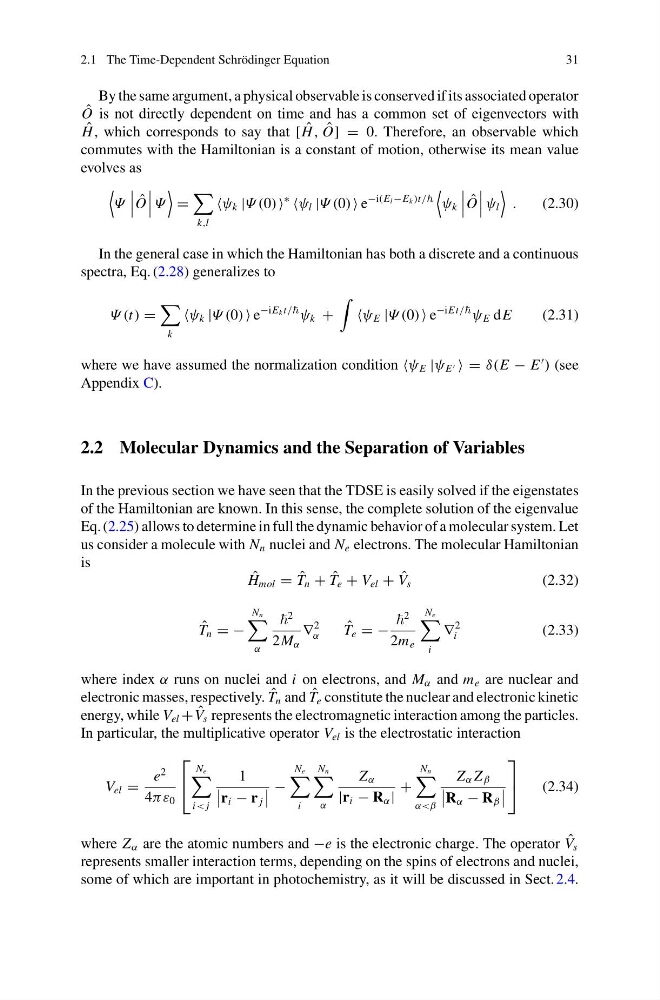
By the same argument, a physical observable is conserved if its associated operator
ˆ
O is not directly dependent on time and has a common set of eigenvectors with
ˆ
H , which corresponds to say that [ ˆ
H , ˆ
O] = 0. Therefore, an observable which
commutes with the Hamiltonian is a constant of motion, otherwise its mean value
evolves as
Ψ
ˆ
O
Ψ
=
k,l
ψ k |Ψ (0)
∗
ψ l |Ψ (0) e
−i(E l −E k )t/
ψ k
ˆ
O
ψ l
.
(2.30)
In the general case in which the Hamiltonian has both a discrete and a continuous
spectra, Eq. (2.28) generalizes to
Ψ (t) =
k
ψ k |Ψ (0) e
−iE k t/
ψ k +
ψ E |Ψ (0) e
−iEt/
ψ E dE
(2.31)
where we have assumed the normalization condition ψ E |ψ E = δ(E − E
) (see
Appendix C).
2.2 Molecular Dynamics and the Separation of Variables
In the previous section we have seen that the TDSE is easily solved if the eigenstates
of the Hamiltonian are known. In this sense, the complete solution of the eigenvalue
Eq. (2.25) allows to determine in full the dynamic behavior of a molecular system. Let
us consider a molecule with N n nuclei and N e electrons. The molecular Hamiltonian
is
ˆ
H mol = ˆ
T n + ˆ
T e + V el + ˆ
V s
(2.32)
ˆ
T n = −
N n
α
2
2M α
∇
2
α
ˆ
T e = −
2
2m e
N e
i
∇
2
i
(2.33)
where index α runs on nuclei and i on electrons, and M α and m e are nuclear and
electronic masses, respectively. ˆ
T n and ˆ
T e constitute the nuclear and electronic kinetic
energy, while V el + ˆ
V s represents the electromagnetic interaction among the particles.
In particular, the multiplicative operator V el is the electrostatic interaction
V el =
e
2
4πε 0
⎡
⎣
N e
i< j
1
r i − r j
−
N e
i
N n
α
Z α
|r i − R α |
+
N n
α<β
Z α Z β
R α − R β
⎤
⎦
(2.34)
where Z α are the atomic numbers and −e is the electronic charge. The operator ˆ
V s
represents smaller interaction terms, depending on the spins of electrons and nuclei,
some of which are important in photochemistry, as it will be discussed in Sect. 2.4.
31
By the same argument, a physical observable is conserved if its associated operator
ˆ
O is not directly dependent on time and has a common set of eigenvectors with
ˆ
H , which corresponds to say that [ ˆ
H , ˆ
O] = 0. Therefore, an observable which
commutes with the Hamiltonian is a constant of motion, otherwise its mean value
evolves as
Ψ
ˆ
O
Ψ
=
k,l
ψ k |Ψ (0)
∗
ψ l |Ψ (0) e
−i(E l −E k )t/
ψ k
ˆ
O
ψ l
.
(2.30)
In the general case in which the Hamiltonian has both a discrete and a continuous
spectra, Eq. (2.28) generalizes to
Ψ (t) =
k
ψ k |Ψ (0) e
−iE k t/
ψ k +
ψ E |Ψ (0) e
−iEt/
ψ E dE
(2.31)
where we have assumed the normalization condition ψ E |ψ E = δ(E − E
) (see
Appendix C).
2.2 Molecular Dynamics and the Separation of Variables
In the previous section we have seen that the TDSE is easily solved if the eigenstates
of the Hamiltonian are known. In this sense, the complete solution of the eigenvalue
Eq. (2.25) allows to determine in full the dynamic behavior of a molecular system. Let
us consider a molecule with N n nuclei and N e electrons. The molecular Hamiltonian
is
ˆ
H mol = ˆ
T n + ˆ
T e + V el + ˆ
V s
(2.32)
ˆ
T n = −
N n
α
2
2M α
∇
2
α
ˆ
T e = −
2
2m e
N e
i
∇
2
i
(2.33)
where index α runs on nuclei and i on electrons, and M α and m e are nuclear and
electronic masses, respectively. ˆ
T n and ˆ
T e constitute the nuclear and electronic kinetic
energy, while V el + ˆ
V s represents the electromagnetic interaction among the particles.
In particular, the multiplicative operator V el is the electrostatic interaction
V el =
e
2
4πε 0
⎡
⎣
N e
i< j
1
r i − r j
−
N e
i
N n
α
Z α
|r i − R α |
+
N n
α<β
Z α Z β
R α − R β
⎤
⎦
(2.34)
where Z α are the atomic numbers and −e is the electronic charge. The operator ˆ
V s
represents smaller interaction terms, depending on the spins of electrons and nuclei,
some of which are important in photochemistry, as it will be discussed in Sect. 2.4.