

28
2 Molecular States
φ i
φ j
= δ i j .
(2.12)
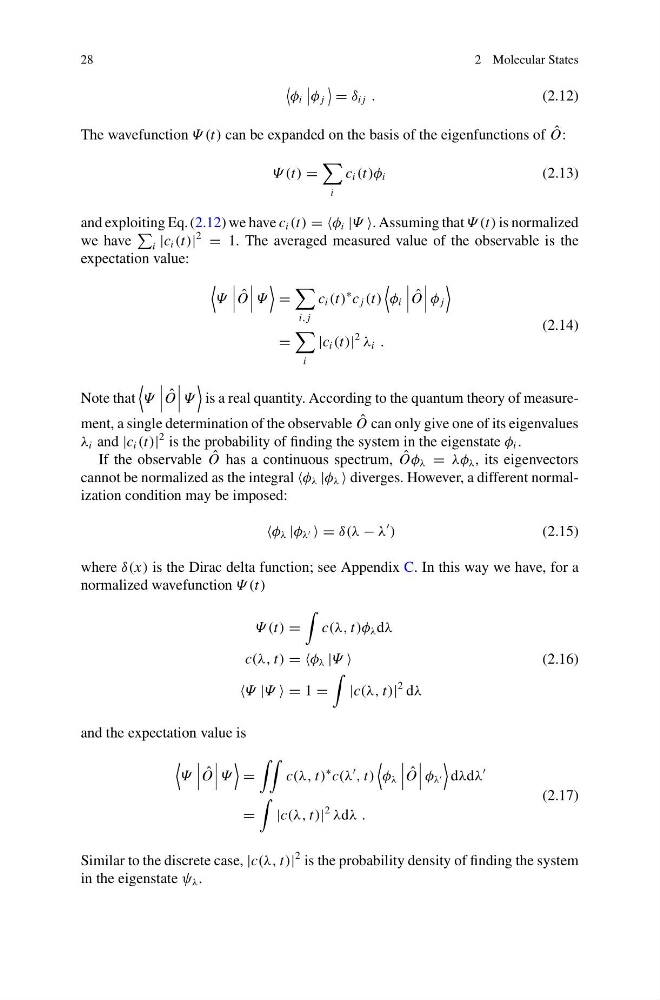
The wavefunction Ψ (t) can be expanded on the basis of the eigenfunctions of ˆ
O:
Ψ (t) =
i
c i (t)φ i
(2.13)
and exploiting Eq. (2.12) we have c i (t) = φ i |Ψ . Assuming that Ψ (t) is normalized
we have
i |c i (t)|
2
= 1. The averaged measured value of the observable is the
expectation value:
Ψ
ˆ
O
Ψ
=
i, j
c i (t)
∗ c j (t)
φ i
ˆ
O
φ j
=
i
|c i (t)|
2
λ i .
(2.14)
Note that
Ψ
ˆ
O
Ψ
is a real quantity. According to the quantum theory of measurement, a single determination of the observable ˆ
O can only give one of its eigenvalues
λ i and |c i (t)|
2 is the probability of finding the system in the eigenstate φ i .
If the observable ˆ
O has a continuous spectrum, ˆ
Oφ λ = λφ λ , its eigenvectors
cannot be normalized as the integral φ λ |φ λ diverges. However, a different normalization condition may be imposed:
φ λ |φ λ = δ(λ − λ
)
(2.15)
where δ(x) is the Dirac delta function; see Appendix C. In this way we have, for a
normalized wavefunction Ψ (t)
Ψ (t) =
c(λ, t)φ λ dλ
c(λ, t) = φ λ |Ψ
Ψ |Ψ = 1 =
|c(λ, t)|
2 dλ
(2.16)
and the expectation value is
Ψ
ˆ
O
Ψ
=
c(λ, t)
∗ c(λ
, t)
φ λ
ˆ
O
φ λ
dλdλ
=
|c(λ, t)|
2
λdλ .
(2.17)
Similar to the discrete case, |c(λ, t)|
2 is the probability density of finding the system
in the eigenstate ψ λ .
2 Molecular States
φ i
φ j
= δ i j .
(2.12)
The wavefunction Ψ (t) can be expanded on the basis of the eigenfunctions of ˆ
O:
Ψ (t) =
i
c i (t)φ i
(2.13)
and exploiting Eq. (2.12) we have c i (t) = φ i |Ψ . Assuming that Ψ (t) is normalized
we have
i |c i (t)|
2
= 1. The averaged measured value of the observable is the
expectation value:
Ψ
ˆ
O
Ψ
=
i, j
c i (t)
∗ c j (t)
φ i
ˆ
O
φ j
=
i
|c i (t)|
2
λ i .
(2.14)
Note that
Ψ
ˆ
O
Ψ
is a real quantity. According to the quantum theory of measurement, a single determination of the observable ˆ
O can only give one of its eigenvalues
λ i and |c i (t)|
2 is the probability of finding the system in the eigenstate φ i .
If the observable ˆ
O has a continuous spectrum, ˆ
Oφ λ = λφ λ , its eigenvectors
cannot be normalized as the integral φ λ |φ λ diverges. However, a different normalization condition may be imposed:
φ λ |φ λ = δ(λ − λ
)
(2.15)
where δ(x) is the Dirac delta function; see Appendix C. In this way we have, for a
normalized wavefunction Ψ (t)
Ψ (t) =
c(λ, t)φ λ dλ
c(λ, t) = φ λ |Ψ
Ψ |Ψ = 1 =
|c(λ, t)|
2 dλ
(2.16)
and the expectation value is
Ψ
ˆ
O
Ψ
=
c(λ, t)
∗ c(λ
, t)
φ λ
ˆ
O
φ λ
dλdλ
=
|c(λ, t)|
2
λdλ .
(2.17)
Similar to the discrete case, |c(λ, t)|
2 is the probability density of finding the system
in the eigenstate ψ λ .