

1.6 Photochemical Kinetics
17
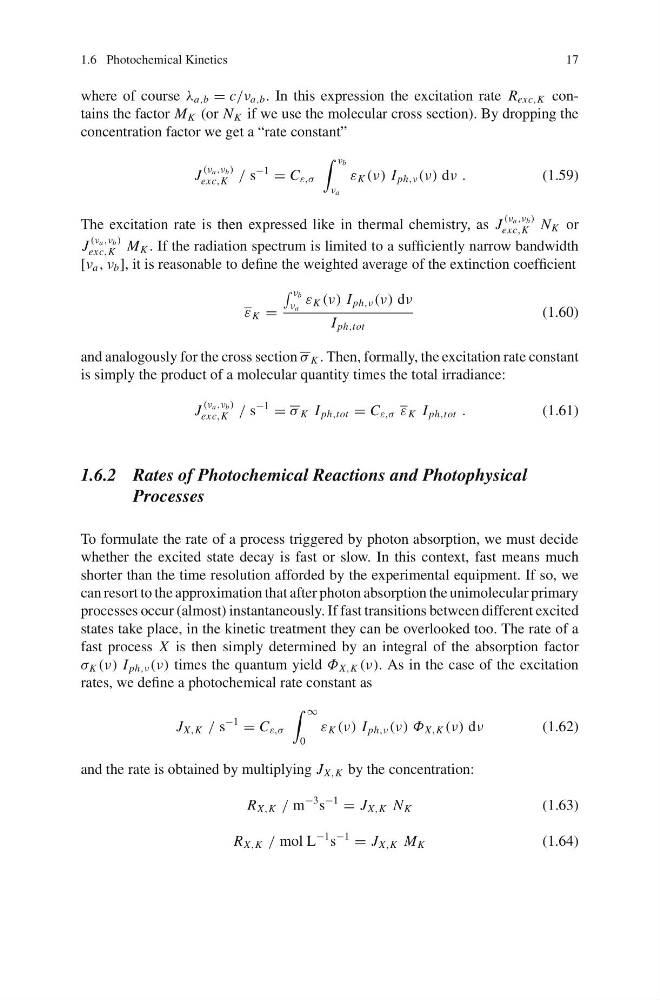
where of course λ a,b = c/ν a,b . In this expression the excitation rate R exc,K contains the factor M K (or N K if we use the molecular cross section). By dropping the
concentration factor we get a “rate constant”
J
(ν a ,ν b )
exc,K / s
−1
= C ε,σ
ν b
ν a
ε K (ν) I ph,ν (ν) dν .
(1.59)
The excitation rate is then expressed like in thermal chemistry, as J
(ν a ,ν b )
exc,K N K or
J
(ν a ,ν b )
exc,K M K . If the radiation spectrum is limited to a sufficiently narrow bandwidth
[ν a , ν b ], it is reasonable to define the weighted average of the extinction coefficient
ε K =
ν b
ν a
ε K (ν) I ph,ν (ν) dν
I ph,tot
(1.60)
and analogously for the cross section σ K . Then, formally, the excitation rate constant
is simply the product of a molecular quantity times the total irradiance:
J
(ν a ,ν b )
exc,K / s
−1
= σ K I ph,tot = C ε,σ ε K I ph,tot .
(1.61)
1.6.2 Rates of Photochemical Reactions and Photophysical
Processes
To formulate the rate of a process triggered by photon absorption, we must decide
whether the excited state decay is fast or slow. In this context, fast means much
shorter than the time resolution afforded by the experimental equipment. If so, we
can resort to the approximation that after photon absorption the unimolecular primary
processes occur (almost) instantaneously. If fast transitions between different excited
states take place, in the kinetic treatment they can be overlooked too. The rate of a
fast process X is then simply determined by an integral of the absorption factor
σ K (ν) I ph,ν (ν) times the quantum yield Φ X,K (ν). As in the case of the excitation
rates, we define a photochemical rate constant as
J X,K / s
−1
= C ε,σ
∞
0
ε K (ν) I ph,ν (ν) Φ X,K (ν) dν
(1.62)
and the rate is obtained by multiplying J X,K by the concentration:
R X,K / m
−3 s
−1
= J X,K N K
(1.63)
R X,K / mol L
−1 s
−1
= J X,K M K
(1.64)
17
where of course λ a,b = c/ν a,b . In this expression the excitation rate R exc,K contains the factor M K (or N K if we use the molecular cross section). By dropping the
concentration factor we get a “rate constant”
J
(ν a ,ν b )
exc,K / s
−1
= C ε,σ
ν b
ν a
ε K (ν) I ph,ν (ν) dν .
(1.59)
The excitation rate is then expressed like in thermal chemistry, as J
(ν a ,ν b )
exc,K N K or
J
(ν a ,ν b )
exc,K M K . If the radiation spectrum is limited to a sufficiently narrow bandwidth
[ν a , ν b ], it is reasonable to define the weighted average of the extinction coefficient
ε K =
ν b
ν a
ε K (ν) I ph,ν (ν) dν
I ph,tot
(1.60)
and analogously for the cross section σ K . Then, formally, the excitation rate constant
is simply the product of a molecular quantity times the total irradiance:
J
(ν a ,ν b )
exc,K / s
−1
= σ K I ph,tot = C ε,σ ε K I ph,tot .
(1.61)
1.6.2 Rates of Photochemical Reactions and Photophysical
Processes
To formulate the rate of a process triggered by photon absorption, we must decide
whether the excited state decay is fast or slow. In this context, fast means much
shorter than the time resolution afforded by the experimental equipment. If so, we
can resort to the approximation that after photon absorption the unimolecular primary
processes occur (almost) instantaneously. If fast transitions between different excited
states take place, in the kinetic treatment they can be overlooked too. The rate of a
fast process X is then simply determined by an integral of the absorption factor
σ K (ν) I ph,ν (ν) times the quantum yield Φ X,K (ν). As in the case of the excitation
rates, we define a photochemical rate constant as
J X,K / s
−1
= C ε,σ
∞
0
ε K (ν) I ph,ν (ν) Φ X,K (ν) dν
(1.62)
and the rate is obtained by multiplying J X,K by the concentration:
R X,K / m
−3 s
−1
= J X,K N K
(1.63)
R X,K / mol L
−1 s
−1
= J X,K M K
(1.64)