

16
1 Introduction to Photochemistry
I ν (ν, l) = I ν (ν, 0) 10
−M ε(ν) l
.
(1.50)
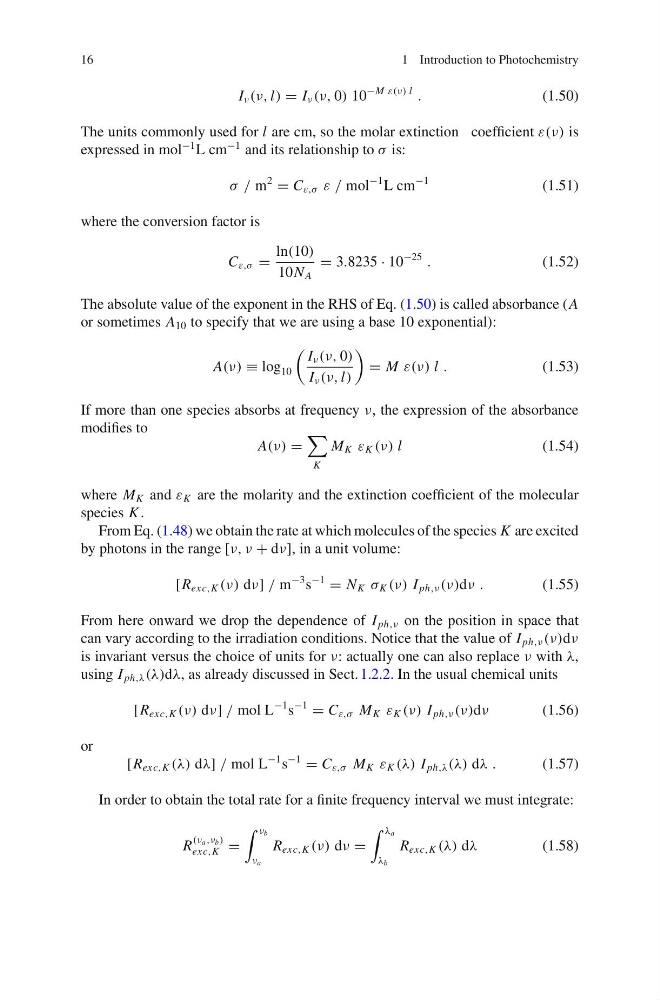
The units commonly used for l are cm, so the molar extinction coefficient ε(ν) is
expressed in mol
−1 L cm
−1 and its relationship to σ is:
σ / m
2
= C ε,σ ε / mol
−1 L cm
−1
(1.51)
where the conversion factor is
C ε,σ =
ln(10)
10N A
= 3.8235 · 10
−25
.
(1.52)
The absolute value of the exponent in the RHS of Eq. (1.50) is called absorbance (A
or sometimes A 10 to specify that we are using a base 10 exponential):
A(ν) ≡ log 10
I ν (ν, 0)
I ν (ν, l)
= M ε(ν) l .
(1.53)
If more than one species absorbs at frequency ν, the expression of the absorbance
modifies to
A(ν) =
K
M K ε K (ν) l
(1.54)
where M K and ε K are the molarity and the extinction coefficient of the molecular
species K .
From Eq. (1.48) we obtain the rate at which molecules of the species K are excited
by photons in the range [ν, ν + dν], in a unit volume:
[R exc,K (ν) dν] / m
−3 s
−1
= N K σ K (ν) I ph,ν (ν)dν .
(1.55)
From here onward we drop the dependence of I ph,ν on the position in space that
can vary according to the irradiation conditions. Notice that the value of I ph,ν (ν)dν
is invariant versus the choice of units for ν: actually one can also replace ν with λ,
using I ph,λ (λ)dλ, as already discussed in Sect. 1.2.2. In the usual chemical units
[R exc,K (ν) dν] / mol L
−1 s
−1
= C ε,σ M K ε K (ν) I ph,ν (ν)dν
(1.56)
or
[R exc,K (λ) dλ] / mol L
−1 s
−1
= C ε,σ M K ε K (λ) I ph,λ (λ) dλ .
(1.57)
In order to obtain the total rate for a finite frequency interval we must integrate:
R
(ν a ,ν b )
exc,K =
ν b
ν a
R exc,K (ν) dν =
λ a
λ b
R exc,K (λ) dλ
(1.58)
1 Introduction to Photochemistry
I ν (ν, l) = I ν (ν, 0) 10
−M ε(ν) l
.
(1.50)
The units commonly used for l are cm, so the molar extinction coefficient ε(ν) is
expressed in mol
−1 L cm
−1 and its relationship to σ is:
σ / m
2
= C ε,σ ε / mol
−1 L cm
−1
(1.51)
where the conversion factor is
C ε,σ =
ln(10)
10N A
= 3.8235 · 10
−25
.
(1.52)
The absolute value of the exponent in the RHS of Eq. (1.50) is called absorbance (A
or sometimes A 10 to specify that we are using a base 10 exponential):
A(ν) ≡ log 10
I ν (ν, 0)
I ν (ν, l)
= M ε(ν) l .
(1.53)
If more than one species absorbs at frequency ν, the expression of the absorbance
modifies to
A(ν) =
K
M K ε K (ν) l
(1.54)
where M K and ε K are the molarity and the extinction coefficient of the molecular
species K .
From Eq. (1.48) we obtain the rate at which molecules of the species K are excited
by photons in the range [ν, ν + dν], in a unit volume:
[R exc,K (ν) dν] / m
−3 s
−1
= N K σ K (ν) I ph,ν (ν)dν .
(1.55)
From here onward we drop the dependence of I ph,ν on the position in space that
can vary according to the irradiation conditions. Notice that the value of I ph,ν (ν)dν
is invariant versus the choice of units for ν: actually one can also replace ν with λ,
using I ph,λ (λ)dλ, as already discussed in Sect. 1.2.2. In the usual chemical units
[R exc,K (ν) dν] / mol L
−1 s
−1
= C ε,σ M K ε K (ν) I ph,ν (ν)dν
(1.56)
or
[R exc,K (λ) dλ] / mol L
−1 s
−1
= C ε,σ M K ε K (λ) I ph,λ (λ) dλ .
(1.57)
In order to obtain the total rate for a finite frequency interval we must integrate:
R
(ν a ,ν b )
exc,K =
ν b
ν a
R exc,K (ν) dν =
λ a
λ b
R exc,K (λ) dλ
(1.58)