

246
Solutions
μ
2
lk (Q) μ
2
lk (0) + 2μ lk (0) ·
r
∂μ lk
∂ Q r
Q=0
Q r +
r,s
∂μ lk
∂ Q r
Q=0
·
∂μ lk
∂ Q s
Q=0
Q r Q s .
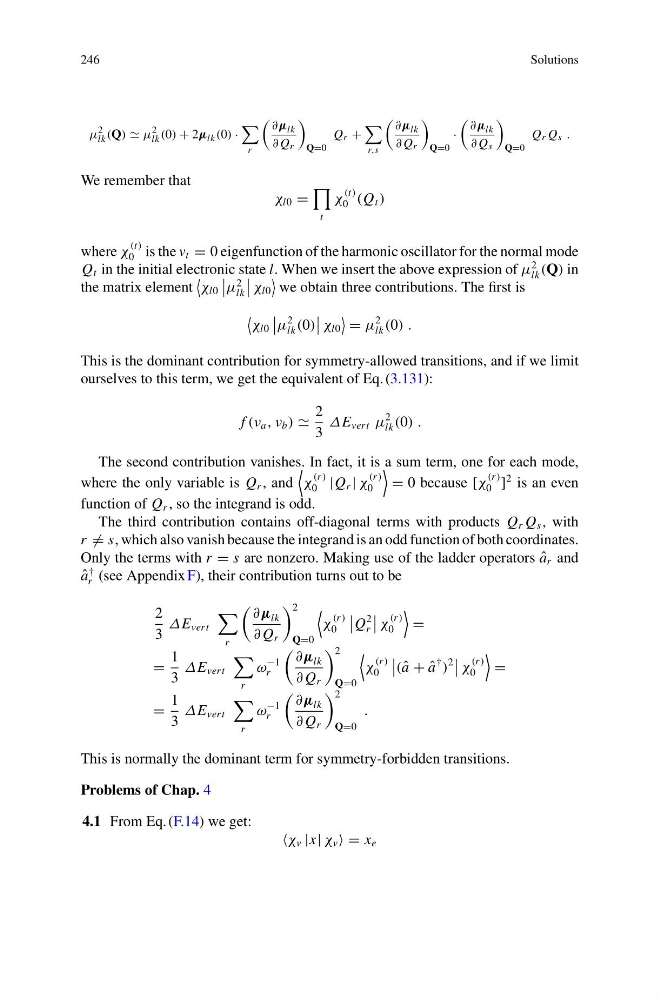
We remember that
χ l0 =
t
χ
(t)
0 (Q t )
where χ
(t)
0 is the v t = 0 eigenfunction of the harmonic oscillator for the normal mode
Q t in the initial electronic state l. When we insert the above expression of μ
2
lk (Q) in
the matrix element
χ l0
μ
2
lk
χ l0
we obtain three contributions. The first is
χ l0
μ
2
lk (0)
χ l0
= μ
2
lk (0) .
This is the dominant contribution for symmetry-allowed transitions, and if we limit
ourselves to this term, we get the equivalent of Eq. (3.131):
f (ν a , ν b )
2
3
ΔE vert μ
2
lk (0) .
The second contribution vanishes. In fact, it is a sum term, one for each mode,
where the only variable is Q r , and
χ
(r )
0 |Q r | χ
(r )
0
= 0 because [χ
(r )
0 ]
2 is an even
function of Q r , so the integrand is odd.
The third contribution contains off-diagonal terms with products Q r Q s , with
r = s, which also vanish because the integrand is an odd function of both coordinates.
Only the terms with r = s are nonzero. Making use of the ladder operators ˆ
a r and
ˆ
a
†
r (see Appendix F), their contribution turns out to be
2
3
ΔE vert
r
∂μ lk
∂ Q r
2
Q=0
χ
(r )
0
Q
2
r
χ
(r )
0
=
=
1
3
ΔE vert
r
ω
−1
r
∂μ lk
∂ Q r
2
Q=0
χ
(r )
0
( ˆ
a + ˆ
a
†
)
2
χ
(r )
0
=
=
1
3
ΔE vert
r
ω
−1
r
∂μ lk
∂ Q r
2
Q=0
.
This is normally the dominant term for symmetry-forbidden transitions.
Problems of Chap. 4
4.1 From Eq. (F.14) we get:
χ v |x| χ v = x e
Solutions
μ
2
lk (Q) μ
2
lk (0) + 2μ lk (0) ·
r
∂μ lk
∂ Q r
Q=0
Q r +
r,s
∂μ lk
∂ Q r
Q=0
·
∂μ lk
∂ Q s
Q=0
Q r Q s .
We remember that
χ l0 =
t
χ
(t)
0 (Q t )
where χ
(t)
0 is the v t = 0 eigenfunction of the harmonic oscillator for the normal mode
Q t in the initial electronic state l. When we insert the above expression of μ
2
lk (Q) in
the matrix element
χ l0
μ
2
lk
χ l0
we obtain three contributions. The first is
χ l0
μ
2
lk (0)
χ l0
= μ
2
lk (0) .
This is the dominant contribution for symmetry-allowed transitions, and if we limit
ourselves to this term, we get the equivalent of Eq. (3.131):
f (ν a , ν b )
2
3
ΔE vert μ
2
lk (0) .
The second contribution vanishes. In fact, it is a sum term, one for each mode,
where the only variable is Q r , and
χ
(r )
0 |Q r | χ
(r )
0
= 0 because [χ
(r )
0 ]
2 is an even
function of Q r , so the integrand is odd.
The third contribution contains off-diagonal terms with products Q r Q s , with
r = s, which also vanish because the integrand is an odd function of both coordinates.
Only the terms with r = s are nonzero. Making use of the ladder operators ˆ
a r and
ˆ
a
†
r (see Appendix F), their contribution turns out to be
2
3
ΔE vert
r
∂μ lk
∂ Q r
2
Q=0
χ
(r )
0
Q
2
r
χ
(r )
0
=
=
1
3
ΔE vert
r
ω
−1
r
∂μ lk
∂ Q r
2
Q=0
χ
(r )
0
( ˆ
a + ˆ
a
†
)
2
χ
(r )
0
=
=
1
3
ΔE vert
r
ω
−1
r
∂μ lk
∂ Q r
2
Q=0
.
This is normally the dominant term for symmetry-forbidden transitions.
Problems of Chap. 4
4.1 From Eq. (F.14) we get:
χ v |x| χ v = x e