

Solutions
245
˜
A(ω) = (2π)
−1/2
+∞
−∞
dt
∞
E min
|c(E)|
2 e
iEt/ e
−iωt dE =
= (2π)
1/2
∞
E min
|c(E)|
2
δ(E/ − ω) dE = (2π)
1/2
|c(ω)|
2
= (2π)
1/2 S(ω) .
Equation (3.85) is therefore satisfied and, of course the same is true for Eq. (3.86):
˜
S(t) = (2π)
−1/2
+∞
−∞
|c(ω)|
2 e
−iωt dω =
= (2π)
−1/2
+∞
−∞
|c(E)|
2 e
−iEt/ dE = (2π)
−1/2 A(−t) .
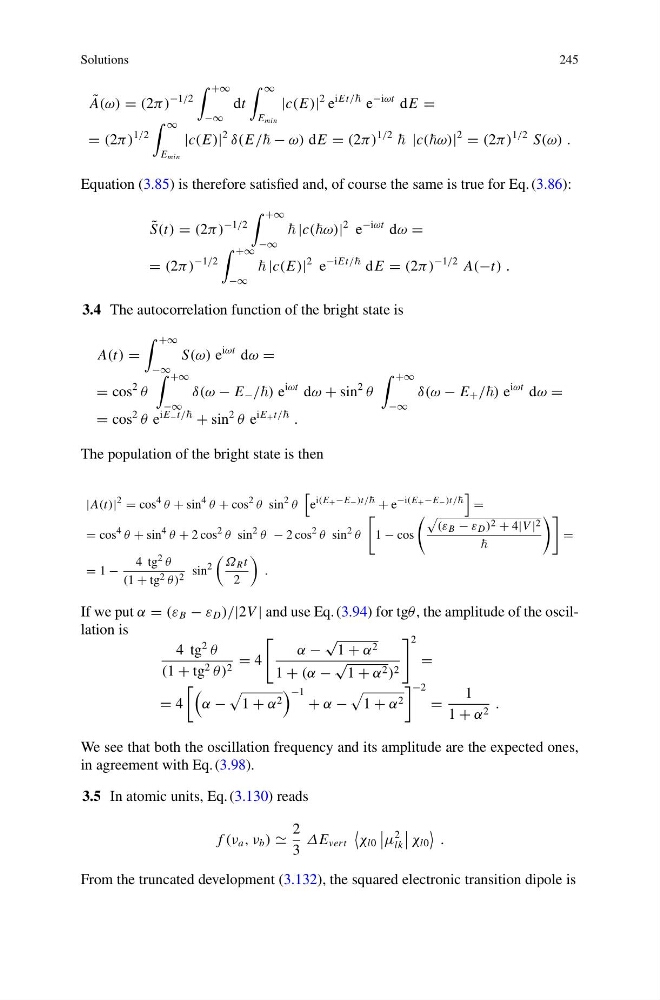
3.4 The autocorrelation function of the bright state is
A(t) =
+∞
−∞
S(ω) e
iωt dω =
= cos
2
θ
+∞
−∞
δ(ω − E − /) e
iωt dω + sin
2
θ
+∞
−∞
δ(ω − E + /) e
iωt dω =
= cos
2
θ e
iE − t/
+ sin
2
θ e
iE + t/
.
The population of the bright state is then
|A(t)|
2 = cos
4 θ + sin
4 θ + cos
2 θ sin
2 θ
e
i(E+−E−)t/ + e
−i(E+−E−)t/
=
= cos
4 θ + sin
4 θ + 2 cos
2 θ sin
2 θ − 2 cos
2 θ sin
2 θ
1 − cos
(ε B − ε D ) 2 + 4|V | 2
=
= 1 −
4 tg 2 θ
(1 + tg 2 θ) 2 sin
2
Ω R t
2
.
If we put α = (ε B − ε D )/|2V | and use Eq. (3.94) for tgθ , the amplitude of the oscillation is
4 tg
2
θ
(1 + tg 2 θ) 2 = 4
α −
√
1 + α 2
1 + (α −
√
1 + α 2 ) 2
2
=
= 4
α −
1 + α 2
−1 + α −
1 + α 2
−2
=
1
1 + α 2 .
We see that both the oscillation frequency and its amplitude are the expected ones,
in agreement with Eq. (3.98).
3.5 In atomic units, Eq. (3.130) reads
f (ν a , ν b )
2
3
ΔE vert
χ l0
μ
2
lk
χ l0
.
From the truncated development (3.132), the squared electronic transition dipole is
245
˜
A(ω) = (2π)
−1/2
+∞
−∞
dt
∞
E min
|c(E)|
2 e
iEt/ e
−iωt dE =
= (2π)
1/2
∞
E min
|c(E)|
2
δ(E/ − ω) dE = (2π)
1/2
|c(ω)|
2
= (2π)
1/2 S(ω) .
Equation (3.85) is therefore satisfied and, of course the same is true for Eq. (3.86):
˜
S(t) = (2π)
−1/2
+∞
−∞
|c(ω)|
2 e
−iωt dω =
= (2π)
−1/2
+∞
−∞
|c(E)|
2 e
−iEt/ dE = (2π)
−1/2 A(−t) .
3.4 The autocorrelation function of the bright state is
A(t) =
+∞
−∞
S(ω) e
iωt dω =
= cos
2
θ
+∞
−∞
δ(ω − E − /) e
iωt dω + sin
2
θ
+∞
−∞
δ(ω − E + /) e
iωt dω =
= cos
2
θ e
iE − t/
+ sin
2
θ e
iE + t/
.
The population of the bright state is then
|A(t)|
2 = cos
4 θ + sin
4 θ + cos
2 θ sin
2 θ
e
i(E+−E−)t/ + e
−i(E+−E−)t/
=
= cos
4 θ + sin
4 θ + 2 cos
2 θ sin
2 θ − 2 cos
2 θ sin
2 θ
1 − cos
(ε B − ε D ) 2 + 4|V | 2
=
= 1 −
4 tg 2 θ
(1 + tg 2 θ) 2 sin
2
Ω R t
2
.
If we put α = (ε B − ε D )/|2V | and use Eq. (3.94) for tgθ , the amplitude of the oscillation is
4 tg
2
θ
(1 + tg 2 θ) 2 = 4
α −
√
1 + α 2
1 + (α −
√
1 + α 2 ) 2
2
=
= 4
α −
1 + α 2
−1 + α −
1 + α 2
−2
=
1
1 + α 2 .
We see that both the oscillation frequency and its amplitude are the expected ones,
in agreement with Eq. (3.98).
3.5 In atomic units, Eq. (3.130) reads
f (ν a , ν b )
2
3
ΔE vert
χ l0
μ
2
lk
χ l0
.
From the truncated development (3.132), the squared electronic transition dipole is