

Solutions
243
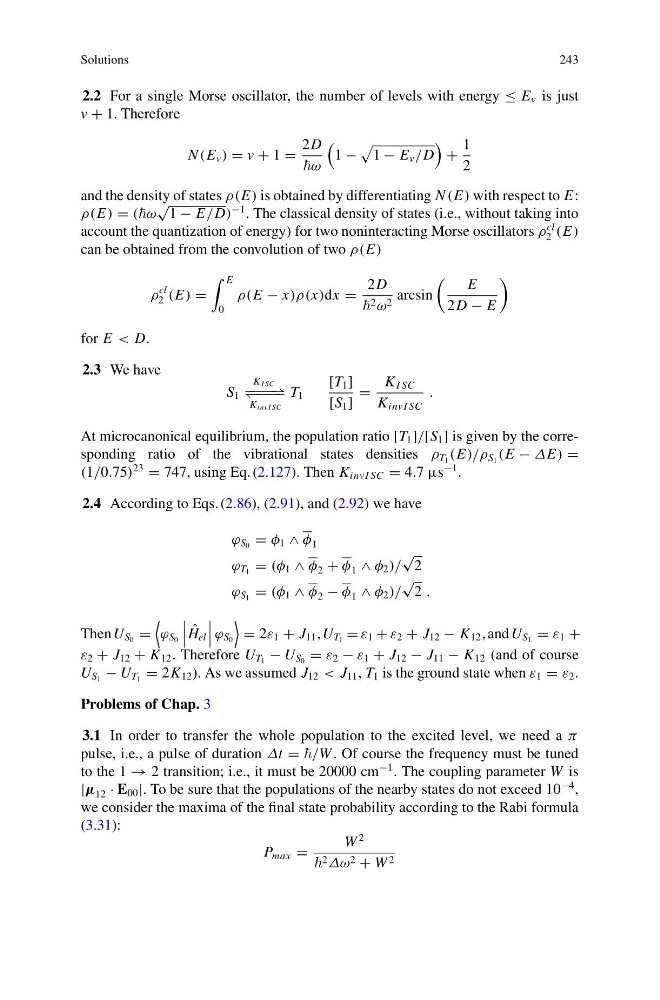
2.2 For a single Morse oscillator, the number of levels with energy ≤ E v is just
v + 1. Therefore
N (E v ) = v + 1 =
2D
ω
1 −
1 − E v /D
+
1
2
and the density of states ρ(E) is obtained by differentiating N (E) with respect to E:
ρ(E) = (ω
√
1 − E/D)
−1 . The classical density of states (i.e., without taking into
account the quantization of energy) for two noninteracting Morse oscillators ρ
cl
2 (E)
can be obtained from the convolution of two ρ(E)
ρ
cl
2 (E) =
E
0
ρ(E − x)ρ(x)dx =
2D
2 ω 2 arcsin
E
2D − E
for E < D.
2.3 We have
S 1
K I SC
− −−−
−−− −
K invI SC
T 1
[T 1 ]
[S 1 ]
=
K I SC
K invI SC
.
At microcanonical equilibrium, the population ratio [T 1 ]/[S 1 ] is given by the corresponding ratio of the vibrational states densities ρ T 1 (E)/ρ S 1 (E − ΔE) =
(1/0.75)
23
= 747, using Eq. (2.127). Then K invI SC = 4.7 µs
−1 .
2.4 According to Eqs. (2.86), (2.91), and (2.92) we have
ϕ S 0 = φ 1 ∧ φ 1
ϕ T 1 = (φ 1 ∧ φ 2 + φ 1 ∧ φ 2 )/
√
2
ϕ S 1 = (φ 1 ∧ φ 2 − φ 1 ∧ φ 2 )/
√
2 .
Then U S 0 =
ϕ S 0
ˆ
H el
ϕ S 0
= 2ε 1 + J 11 , U T 1 = ε 1 + ε 2 + J 12 − K 12 , and U S 1 = ε 1 +
ε 2 + J 12 + K 12 . Therefore U T 1 − U S 0 = ε 2 − ε 1 + J 12 − J 11 − K 12 (and of course
U S 1 − U T 1 = 2K 12 ). As we assumed J 12 < J 11 , T 1 is the ground state when ε 1 = ε 2 .
Problems of Chap. 3
3.1 In order to transfer the whole population to the excited level, we need a π
pulse, i.e., a pulse of duration Δt = /W . Of course the frequency must be tuned
to the 1 → 2 transition; i.e., it must be 20000 cm
−1 . The coupling parameter W is
|μ 12 · E 00 |. To be sure that the populations of the nearby states do not exceed 10
−4 ,
we consider the maxima of the final state probability according to the Rabi formula
(3.31):
P max =
W
2
2 Δω 2 + W 2
243
2.2 For a single Morse oscillator, the number of levels with energy ≤ E v is just
v + 1. Therefore
N (E v ) = v + 1 =
2D
ω
1 −
1 − E v /D
+
1
2
and the density of states ρ(E) is obtained by differentiating N (E) with respect to E:
ρ(E) = (ω
√
1 − E/D)
−1 . The classical density of states (i.e., without taking into
account the quantization of energy) for two noninteracting Morse oscillators ρ
cl
2 (E)
can be obtained from the convolution of two ρ(E)
ρ
cl
2 (E) =
E
0
ρ(E − x)ρ(x)dx =
2D
2 ω 2 arcsin
E
2D − E
for E < D.
2.3 We have
S 1
K I SC
− −−−
−−− −
K invI SC
T 1
[T 1 ]
[S 1 ]
=
K I SC
K invI SC
.
At microcanonical equilibrium, the population ratio [T 1 ]/[S 1 ] is given by the corresponding ratio of the vibrational states densities ρ T 1 (E)/ρ S 1 (E − ΔE) =
(1/0.75)
23
= 747, using Eq. (2.127). Then K invI SC = 4.7 µs
−1 .
2.4 According to Eqs. (2.86), (2.91), and (2.92) we have
ϕ S 0 = φ 1 ∧ φ 1
ϕ T 1 = (φ 1 ∧ φ 2 + φ 1 ∧ φ 2 )/
√
2
ϕ S 1 = (φ 1 ∧ φ 2 − φ 1 ∧ φ 2 )/
√
2 .
Then U S 0 =
ϕ S 0
ˆ
H el
ϕ S 0
= 2ε 1 + J 11 , U T 1 = ε 1 + ε 2 + J 12 − K 12 , and U S 1 = ε 1 +
ε 2 + J 12 + K 12 . Therefore U T 1 − U S 0 = ε 2 − ε 1 + J 12 − J 11 − K 12 (and of course
U S 1 − U T 1 = 2K 12 ). As we assumed J 12 < J 11 , T 1 is the ground state when ε 1 = ε 2 .
Problems of Chap. 3
3.1 In order to transfer the whole population to the excited level, we need a π
pulse, i.e., a pulse of duration Δt = /W . Of course the frequency must be tuned
to the 1 → 2 transition; i.e., it must be 20000 cm
−1 . The coupling parameter W is
|μ 12 · E 00 |. To be sure that the populations of the nearby states do not exceed 10
−4 ,
we consider the maxima of the final state probability according to the Rabi formula
(3.31):
P max =
W
2
2 Δω 2 + W 2