

242
Solutions
that it coincides with its lifetime. Since the triplet quantum yield of benzophenone is
practically 1, its phosphorescence quantum yield is the emission rate τ
−1
P times the
triplet lifetime: Φ P = τ T 1 /τ P = 0.0063/0.007 = 0.90.
For naphthalene we have similarly: τ T 1 = 2.4 · 10
−6 s = 2.4 μs and τ S 1 = (1/2 +
1 + 1/2)
−1
= 0.5 μs. The triplet quantum yield is (1/2)/((1/2 + 1 + 1/2) = 0.25,
so Φ P = 0.25 τ T 1 /τ P = 0.0017. The fluorescence quantum yield is τ S 1 /τ F = 0.5.
1.6 In the experiment of Fig. 1.5, at 150 s we have practically the asymptotic concentrations. If we increase the thermal rate constants to K
A→B = 1.8 · K A→B and
K
B→A = 1.5 · K B→A , the asymptote is approached even faster, so a fortiori at 150 s
we have
[B]
[A]
[B] ∞
[A] ∞
=
J A→B
K
B→A
+
K
A→B
K
B→A
The last equality stems from Eq. (1.75). Now, with the old rate constants we had
[B] ∞ /[A] ∞ = 3.44 (data read from Fig. 1.5). At thermal equilibrium, [B]/[A] =
K A→B /K B→A = 0.111 (data taken again from Fig. 1.5), so J A→B /K B→A = 3.44 −
0.11 = 3.33. With the new rate constants, K
A→B /K
B→A = 0.111 · 1.8/1.5 = 0.133
and J A→B /K
B→A = 3.33/1.5 = 2.22. Then, [B] ∞ /[A] ∞ = 2.22 + 0.13 = 2.35 and
the fraction of B is 0.70.
Problems of Chap. 2
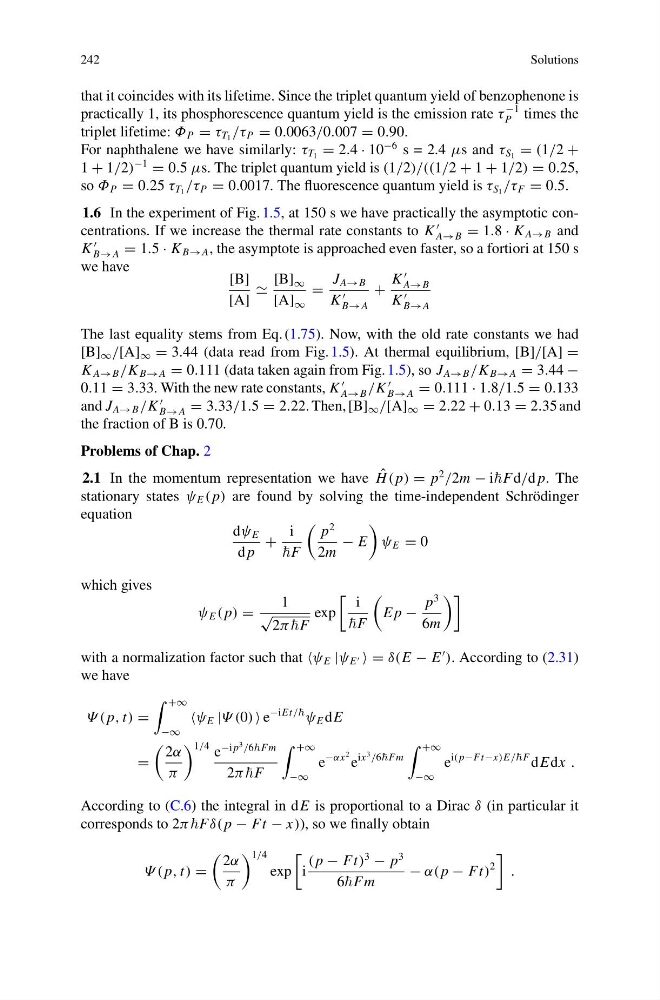
2.1 In the momentum representation we have ˆ
H ( p) = p
2
/2m − iFd/d p. The
stationary states ψ E ( p) are found by solving the time-independent Schrödinger
equation
dψ E
d p
+
i
F
p
2
2m
− E
ψ E = 0
which gives
ψ E ( p) =
1
√
2π F
exp
i
F
E p −
p
3
6m
with a normalization factor such that ψ E |ψ E = δ(E − E
). According to (2.31)
we have
Ψ (p, t) =
+∞
−∞
ψ E |Ψ (0) e
−iEt/
ψ E dE
=
2α
π
1/4 e
−i p
3 /6Fm
2π F
+∞
−∞
e
−αx
2 e
ix
3 /6Fm
+∞
−∞
e
i( p−Ft−x)E/F dEdx .
According to (C.6) the integral in dE is proportional to a Dirac δ (in particular it
corresponds to 2π Fδ( p − Ft − x)), so we finally obtain
Ψ (p, t) =
2α
π
1/4
exp
i
( p − Ft)
3
− p
3
6Fm
− α( p − Ft)
2
.
Solutions
that it coincides with its lifetime. Since the triplet quantum yield of benzophenone is
practically 1, its phosphorescence quantum yield is the emission rate τ
−1
P times the
triplet lifetime: Φ P = τ T 1 /τ P = 0.0063/0.007 = 0.90.
For naphthalene we have similarly: τ T 1 = 2.4 · 10
−6 s = 2.4 μs and τ S 1 = (1/2 +
1 + 1/2)
−1
= 0.5 μs. The triplet quantum yield is (1/2)/((1/2 + 1 + 1/2) = 0.25,
so Φ P = 0.25 τ T 1 /τ P = 0.0017. The fluorescence quantum yield is τ S 1 /τ F = 0.5.
1.6 In the experiment of Fig. 1.5, at 150 s we have practically the asymptotic concentrations. If we increase the thermal rate constants to K
A→B = 1.8 · K A→B and
K
B→A = 1.5 · K B→A , the asymptote is approached even faster, so a fortiori at 150 s
we have
[B]
[A]
[B] ∞
[A] ∞
=
J A→B
K
B→A
+
K
A→B
K
B→A
The last equality stems from Eq. (1.75). Now, with the old rate constants we had
[B] ∞ /[A] ∞ = 3.44 (data read from Fig. 1.5). At thermal equilibrium, [B]/[A] =
K A→B /K B→A = 0.111 (data taken again from Fig. 1.5), so J A→B /K B→A = 3.44 −
0.11 = 3.33. With the new rate constants, K
A→B /K
B→A = 0.111 · 1.8/1.5 = 0.133
and J A→B /K
B→A = 3.33/1.5 = 2.22. Then, [B] ∞ /[A] ∞ = 2.22 + 0.13 = 2.35 and
the fraction of B is 0.70.
Problems of Chap. 2
2.1 In the momentum representation we have ˆ
H ( p) = p
2
/2m − iFd/d p. The
stationary states ψ E ( p) are found by solving the time-independent Schrödinger
equation
dψ E
d p
+
i
F
p
2
2m
− E
ψ E = 0
which gives
ψ E ( p) =
1
√
2π F
exp
i
F
E p −
p
3
6m
with a normalization factor such that ψ E |ψ E = δ(E − E
). According to (2.31)
we have
Ψ (p, t) =
+∞
−∞
ψ E |Ψ (0) e
−iEt/
ψ E dE
=
2α
π
1/4 e
−i p
3 /6Fm
2π F
+∞
−∞
e
−αx
2 e
ix
3 /6Fm
+∞
−∞
e
i( p−Ft−x)E/F dEdx .
According to (C.6) the integral in dE is proportional to a Dirac δ (in particular it
corresponds to 2π Fδ( p − Ft − x)), so we finally obtain
Ψ (p, t) =
2α
π
1/4
exp
i
( p − Ft)
3
− p
3
6Fm
− α( p − Ft)
2
.