

1.4 An Overview of Photochemical and Photophysical Processes
11
ISC = intersystem crossing
IC = internal conversion
P = phosphorescence
F = fluorescence
A = photon absorption
P
F
ISC
ISC
IC
IC
A
T 1
S 1
S 2
S 0
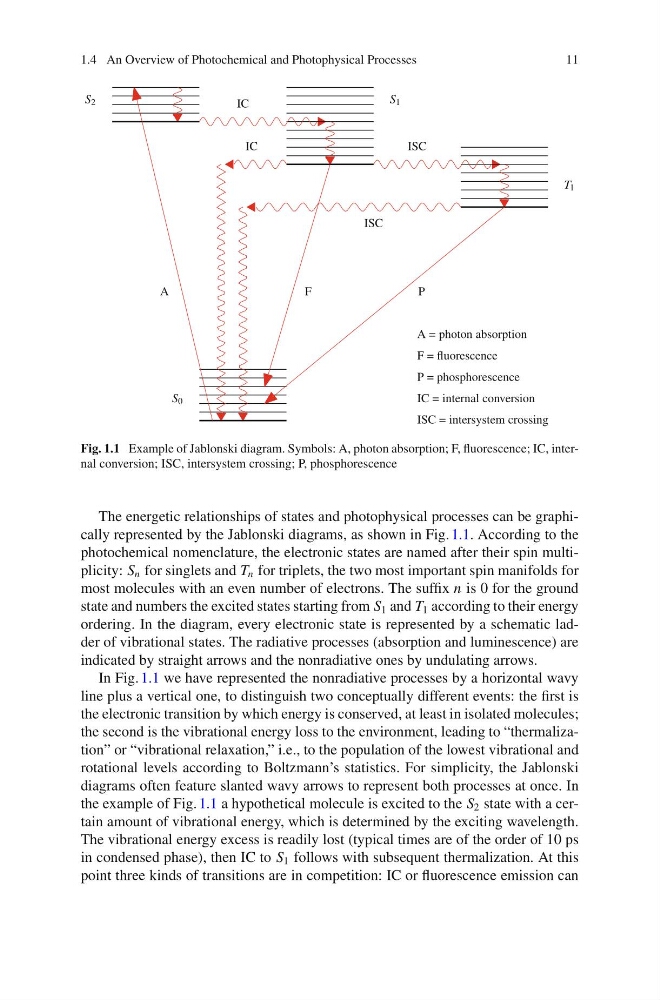
Fig. 1.1 Example of Jablonski diagram. Symbols: A, photon absorption; F, fluorescence; IC, internal conversion; ISC, intersystem crossing; P, phosphorescence
The energetic relationships of states and photophysical processes can be graphically represented by the Jablonski diagrams, as shown in Fig. 1.1. According to the
photochemical nomenclature, the electronic states are named after their spin multiplicity: S n for singlets and T n for triplets, the two most important spin manifolds for
most molecules with an even number of electrons. The suffix n is 0 for the ground
state and numbers the excited states starting from S 1 and T 1 according to their energy
ordering. In the diagram, every electronic state is represented by a schematic ladder of vibrational states. The radiative processes (absorption and luminescence) are
indicated by straight arrows and the nonradiative ones by undulating arrows.
In Fig. 1.1 we have represented the nonradiative processes by a horizontal wavy
line plus a vertical one, to distinguish two conceptually different events: the first is
the electronic transition by which energy is conserved, at least in isolated molecules;
the second is the vibrational energy loss to the environment, leading to “thermalization” or “vibrational relaxation,” i.e., to the population of the lowest vibrational and
rotational levels according to Boltzmann’s statistics. For simplicity, the Jablonski
diagrams often feature slanted wavy arrows to represent both processes at once. In
the example of Fig. 1.1 a hypothetical molecule is excited to the S 2 state with a certain amount of vibrational energy, which is determined by the exciting wavelength.
The vibrational energy excess is readily lost (typical times are of the order of 10 ps
in condensed phase), then IC to S 1 follows with subsequent thermalization. At this
point three kinds of transitions are in competition: IC or fluorescence emission can
11
ISC = intersystem crossing
IC = internal conversion
P = phosphorescence
F = fluorescence
A = photon absorption
P
F
ISC
ISC
IC
IC
A
T 1
S 1
S 2
S 0
Fig. 1.1 Example of Jablonski diagram. Symbols: A, photon absorption; F, fluorescence; IC, internal conversion; ISC, intersystem crossing; P, phosphorescence
The energetic relationships of states and photophysical processes can be graphically represented by the Jablonski diagrams, as shown in Fig. 1.1. According to the
photochemical nomenclature, the electronic states are named after their spin multiplicity: S n for singlets and T n for triplets, the two most important spin manifolds for
most molecules with an even number of electrons. The suffix n is 0 for the ground
state and numbers the excited states starting from S 1 and T 1 according to their energy
ordering. In the diagram, every electronic state is represented by a schematic ladder of vibrational states. The radiative processes (absorption and luminescence) are
indicated by straight arrows and the nonradiative ones by undulating arrows.
In Fig. 1.1 we have represented the nonradiative processes by a horizontal wavy
line plus a vertical one, to distinguish two conceptually different events: the first is
the electronic transition by which energy is conserved, at least in isolated molecules;
the second is the vibrational energy loss to the environment, leading to “thermalization” or “vibrational relaxation,” i.e., to the population of the lowest vibrational and
rotational levels according to Boltzmann’s statistics. For simplicity, the Jablonski
diagrams often feature slanted wavy arrows to represent both processes at once. In
the example of Fig. 1.1 a hypothetical molecule is excited to the S 2 state with a certain amount of vibrational energy, which is determined by the exciting wavelength.
The vibrational energy excess is readily lost (typical times are of the order of 10 ps
in condensed phase), then IC to S 1 follows with subsequent thermalization. At this
point three kinds of transitions are in competition: IC or fluorescence emission can