

10
1 Introduction to Photochemistry
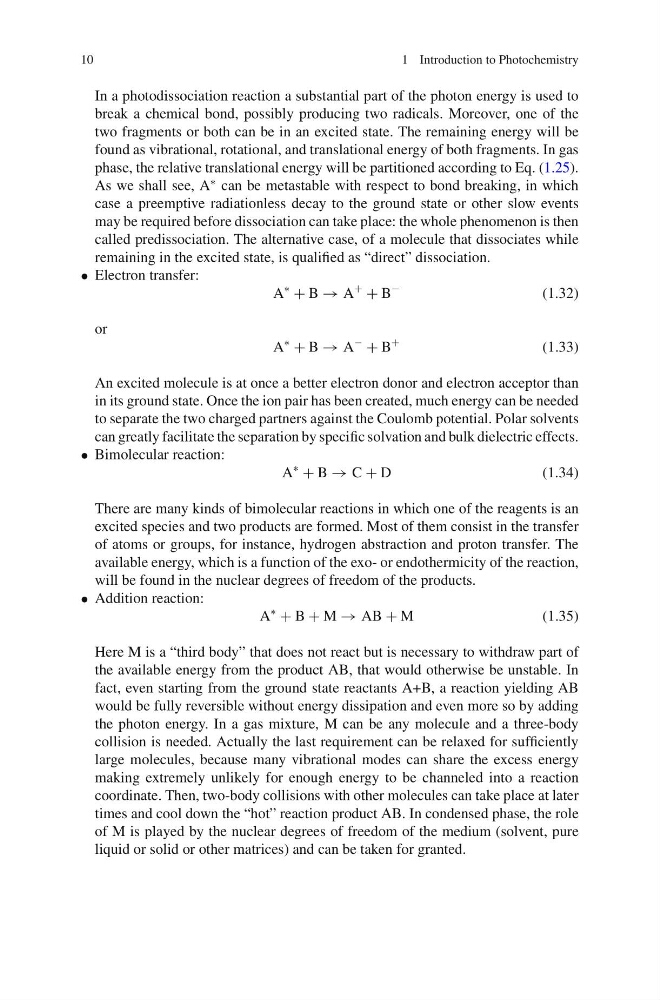
In a photodissociation reaction a substantial part of the photon energy is used to
break a chemical bond, possibly producing two radicals. Moreover, one of the
two fragments or both can be in an excited state. The remaining energy will be
found as vibrational, rotational, and translational energy of both fragments. In gas
phase, the relative translational energy will be partitioned according to Eq. (1.25).
As we shall see, A
∗ can be metastable with respect to bond breaking, in which
case a preemptive radiationless decay to the ground state or other slow events
may be required before dissociation can take place: the whole phenomenon is then
called predissociation. The alternative case, of a molecule that dissociates while
remaining in the excited state, is qualified as “direct” dissociation.
• Electron transfer:
A
∗
+ B → A
+
+ B
−
(1.32)
or
A
∗
+ B → A
−
+ B
+
(1.33)
An excited molecule is at once a better electron donor and electron acceptor than
in its ground state. Once the ion pair has been created, much energy can be needed
to separate the two charged partners against the Coulomb potential. Polar solvents
can greatly facilitate the separation by specific solvation and bulk dielectric effects.
• Bimolecular reaction:
A
∗
+ B → C + D
(1.34)
There are many kinds of bimolecular reactions in which one of the reagents is an
excited species and two products are formed. Most of them consist in the transfer
of atoms or groups, for instance, hydrogen abstraction and proton transfer. The
available energy, which is a function of the exo- or endothermicity of the reaction,
will be found in the nuclear degrees of freedom of the products.
• Addition reaction:
A
∗
+ B + M → AB + M
(1.35)
Here M is a “third body” that does not react but is necessary to withdraw part of
the available energy from the product AB, that would otherwise be unstable. In
fact, even starting from the ground state reactants A+B, a reaction yielding AB
would be fully reversible without energy dissipation and even more so by adding
the photon energy. In a gas mixture, M can be any molecule and a three-body
collision is needed. Actually the last requirement can be relaxed for sufficiently
large molecules, because many vibrational modes can share the excess energy
making extremely unlikely for enough energy to be channeled into a reaction
coordinate. Then, two-body collisions with other molecules can take place at later
times and cool down the “hot” reaction product AB. In condensed phase, the role
of M is played by the nuclear degrees of freedom of the medium (solvent, pure
liquid or solid or other matrices) and can be taken for granted.
1 Introduction to Photochemistry
In a photodissociation reaction a substantial part of the photon energy is used to
break a chemical bond, possibly producing two radicals. Moreover, one of the
two fragments or both can be in an excited state. The remaining energy will be
found as vibrational, rotational, and translational energy of both fragments. In gas
phase, the relative translational energy will be partitioned according to Eq. (1.25).
As we shall see, A
∗ can be metastable with respect to bond breaking, in which
case a preemptive radiationless decay to the ground state or other slow events
may be required before dissociation can take place: the whole phenomenon is then
called predissociation. The alternative case, of a molecule that dissociates while
remaining in the excited state, is qualified as “direct” dissociation.
• Electron transfer:
A
∗
+ B → A
+
+ B
−
(1.32)
or
A
∗
+ B → A
−
+ B
+
(1.33)
An excited molecule is at once a better electron donor and electron acceptor than
in its ground state. Once the ion pair has been created, much energy can be needed
to separate the two charged partners against the Coulomb potential. Polar solvents
can greatly facilitate the separation by specific solvation and bulk dielectric effects.
• Bimolecular reaction:
A
∗
+ B → C + D
(1.34)
There are many kinds of bimolecular reactions in which one of the reagents is an
excited species and two products are formed. Most of them consist in the transfer
of atoms or groups, for instance, hydrogen abstraction and proton transfer. The
available energy, which is a function of the exo- or endothermicity of the reaction,
will be found in the nuclear degrees of freedom of the products.
• Addition reaction:
A
∗
+ B + M → AB + M
(1.35)
Here M is a “third body” that does not react but is necessary to withdraw part of
the available energy from the product AB, that would otherwise be unstable. In
fact, even starting from the ground state reactants A+B, a reaction yielding AB
would be fully reversible without energy dissipation and even more so by adding
the photon energy. In a gas mixture, M can be any molecule and a three-body
collision is needed. Actually the last requirement can be relaxed for sufficiently
large molecules, because many vibrational modes can share the excess energy
making extremely unlikely for enough energy to be channeled into a reaction
coordinate. Then, two-body collisions with other molecules can take place at later
times and cool down the “hot” reaction product AB. In condensed phase, the role
of M is played by the nuclear degrees of freedom of the medium (solvent, pure
liquid or solid or other matrices) and can be taken for granted.