

6.4 Localized Excitations and Energy Transfer Mechanisms
195
ρ X,K K (r 1 ) = n X
s 1 ...s n X
Ψ X,K (x 1 . . . x n X ) Ψ X,K (x 1 . . . x n X ) dr
3
2 . . . dr
3
n X
(6.50)
is the transition density matrix for the K and K
states. The sum over the spins
s 1 . . . s n X makes it a spinless density matrix. ρ Y,L L (r 2 ) is defined similarly. We see
that the
K , L
ˆ
H el
K
, L
coupling is formally the Coulomb interaction between
two charge distributions, so it is potentially long range.
If the distance between X and Y is larger than the dimensions of the chromophores,
we can apply a multipole expansion to evaluate the (6.49) integral (see for instance
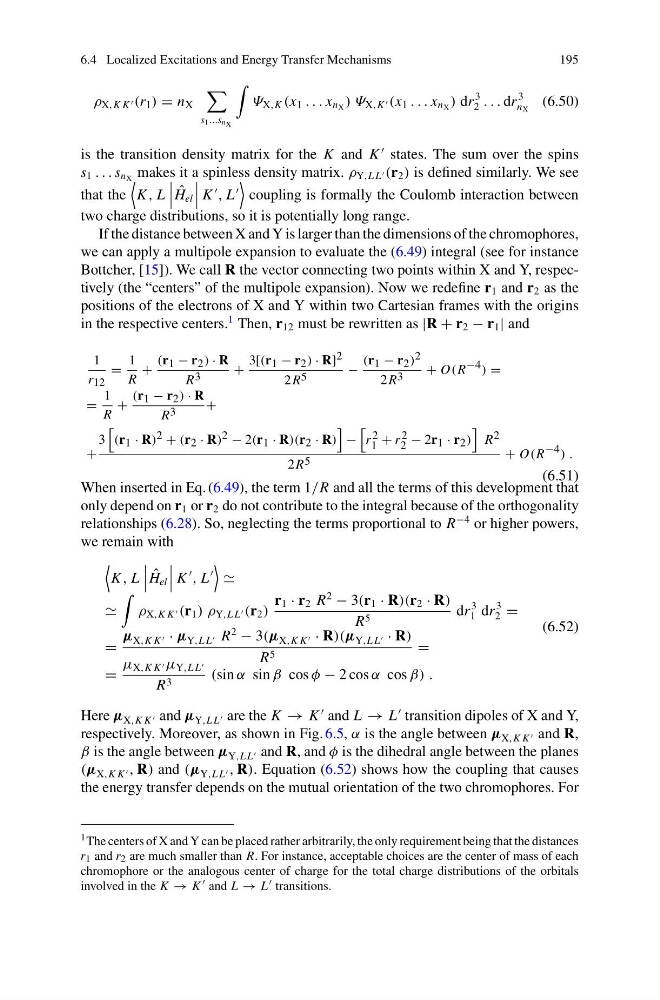
Bottcher, [15]). We call R the vector connecting two points within X and Y, respectively (the “centers” of the multipole expansion). Now we redefine r 1 and r 2 as the
positions of the electrons of X and Y within two Cartesian frames with the origins
in the respective centers.
1 Then, r 12 must be rewritten as |R + r 2 − r 1 | and
1
r 12
=
1
R
+
(r 1 − r 2 ) · R
R 3
+
3[(r 1 − r 2 ) · R] 2
2R 5
−
(r 1 − r 2 ) 2
2R 3
+ O(R −4 ) =
=
1
R
+
(r 1 − r 2 ) · R
R 3
+
+
3
(r 1 · R) 2 + (r 2 · R) 2 − 2(r 1 · R)(r 2 · R)
−
r 2
1 + r 2
2 − 2r 1 · r 2 )
R 2
2R 5
+ O(R −4 ) .
(6.51)
When inserted in Eq. (6.49), the term 1/R and all the terms of this development that
only depend on r 1 or r 2 do not contribute to the integral because of the orthogonality
relationships (6.28). So, neglecting the terms proportional to R
−4 or higher powers,
we remain with
K , L
ˆ
H el
K
, L
ρ X,K K (r 1 ) ρ Y,L L (r 2 )
r 1 · r 2 R
2
− 3(r 1 · R)(r 2 · R)
R 5
dr
3
1 dr
3
2 =
=
µ X,K K · µ Y,L L R
2
− 3(µ X,K K · R)(µ Y,L L · R)
R 5
=
=
μ X,K K μ Y,L L
R 3
(sin α sin β cos φ − 2 cos α cos β) .
(6.52)
Here µ X,K K and µ Y,L L are the K → K
and L → L
transition dipoles of X and Y,
respectively. Moreover, as shown in Fig. 6.5, α is the angle between µ X,K K and R,
β is the angle between µ Y,L L and R, and φ is the dihedral angle between the planes
(µ X,K K , R) and (µ Y,L L , R). Equation (6.52) shows how the coupling that causes
the energy transfer depends on the mutual orientation of the two chromophores. For
1 The centers of X and Y can be placed rather arbitrarily, the only requirement being that the distances
r 1 and r 2 are much smaller than R. For instance, acceptable choices are the center of mass of each
chromophore or the analogous center of charge for the total charge distributions of the orbitals
involved in the K → K and L → L transitions.
195
ρ X,K K (r 1 ) = n X
s 1 ...s n X
Ψ X,K (x 1 . . . x n X ) Ψ X,K (x 1 . . . x n X ) dr
3
2 . . . dr
3
n X
(6.50)
is the transition density matrix for the K and K
states. The sum over the spins
s 1 . . . s n X makes it a spinless density matrix. ρ Y,L L (r 2 ) is defined similarly. We see
that the
K , L
ˆ
H el
K
, L
coupling is formally the Coulomb interaction between
two charge distributions, so it is potentially long range.
If the distance between X and Y is larger than the dimensions of the chromophores,
we can apply a multipole expansion to evaluate the (6.49) integral (see for instance
Bottcher, [15]). We call R the vector connecting two points within X and Y, respectively (the “centers” of the multipole expansion). Now we redefine r 1 and r 2 as the
positions of the electrons of X and Y within two Cartesian frames with the origins
in the respective centers.
1 Then, r 12 must be rewritten as |R + r 2 − r 1 | and
1
r 12
=
1
R
+
(r 1 − r 2 ) · R
R 3
+
3[(r 1 − r 2 ) · R] 2
2R 5
−
(r 1 − r 2 ) 2
2R 3
+ O(R −4 ) =
=
1
R
+
(r 1 − r 2 ) · R
R 3
+
+
3
(r 1 · R) 2 + (r 2 · R) 2 − 2(r 1 · R)(r 2 · R)
−
r 2
1 + r 2
2 − 2r 1 · r 2 )
R 2
2R 5
+ O(R −4 ) .
(6.51)
When inserted in Eq. (6.49), the term 1/R and all the terms of this development that
only depend on r 1 or r 2 do not contribute to the integral because of the orthogonality
relationships (6.28). So, neglecting the terms proportional to R
−4 or higher powers,
we remain with
K , L
ˆ
H el
K
, L
ρ X,K K (r 1 ) ρ Y,L L (r 2 )
r 1 · r 2 R
2
− 3(r 1 · R)(r 2 · R)
R 5
dr
3
1 dr
3
2 =
=
µ X,K K · µ Y,L L R
2
− 3(µ X,K K · R)(µ Y,L L · R)
R 5
=
=
μ X,K K μ Y,L L
R 3
(sin α sin β cos φ − 2 cos α cos β) .
(6.52)
Here µ X,K K and µ Y,L L are the K → K
and L → L
transition dipoles of X and Y,
respectively. Moreover, as shown in Fig. 6.5, α is the angle between µ X,K K and R,
β is the angle between µ Y,L L and R, and φ is the dihedral angle between the planes
(µ X,K K , R) and (µ Y,L L , R). Equation (6.52) shows how the coupling that causes
the energy transfer depends on the mutual orientation of the two chromophores. For
1 The centers of X and Y can be placed rather arbitrarily, the only requirement being that the distances
r 1 and r 2 are much smaller than R. For instance, acceptable choices are the center of mass of each
chromophore or the analogous center of charge for the total charge distributions of the orbitals
involved in the K → K and L → L transitions.