

186
6 Charge and Energy Transfer Processes
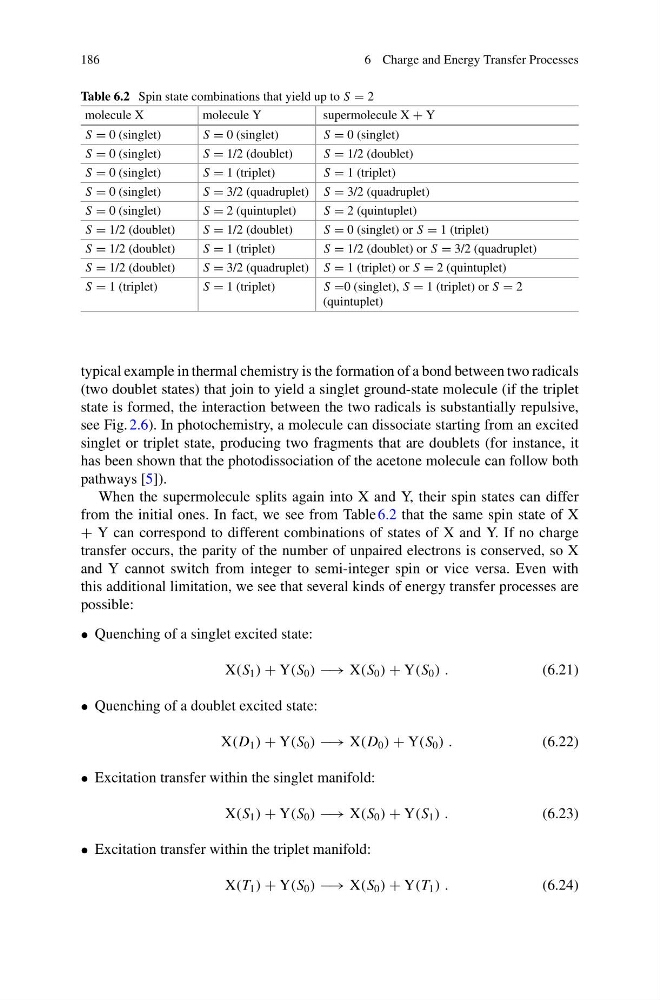
Table 6.2 Spin state combinations that yield up to S = 2
molecule X
molecule Y
supermolecule X + Y
S = 0 (singlet)
S = 0 (singlet)
S = 0 (singlet)
S = 0 (singlet)
S = 1/2 (doublet)
S = 1/2 (doublet)
S = 0 (singlet)
S = 1 (triplet)
S = 1 (triplet)
S = 0 (singlet)
S = 3/2 (quadruplet) S = 3/2 (quadruplet)
S = 0 (singlet)
S = 2 (quintuplet)
S = 2 (quintuplet)
S = 1/2 (doublet)
S = 1/2 (doublet)
S = 0 (singlet) or S = 1 (triplet)
S = 1/2 (doublet)
S = 1 (triplet)
S = 1/2 (doublet) or S = 3/2 (quadruplet)
S = 1/2 (doublet)
S = 3/2 (quadruplet) S = 1 (triplet) or S = 2 (quintuplet)
S = 1 (triplet)
S = 1 (triplet)
S =0 (singlet), S = 1 (triplet) or S = 2
(quintuplet)
typical example in thermal chemistry is the formation of a bond between two radicals
(two doublet states) that join to yield a singlet ground-state molecule (if the triplet
state is formed, the interaction between the two radicals is substantially repulsive,
see Fig. 2.6). In photochemistry, a molecule can dissociate starting from an excited
singlet or triplet state, producing two fragments that are doublets (for instance, it
has been shown that the photodissociation of the acetone molecule can follow both
pathways [5]).
When the supermolecule splits again into X and Y, their spin states can differ
from the initial ones. In fact, we see from Table 6.2 that the same spin state of X
+ Y can correspond to different combinations of states of X and Y. If no charge
transfer occurs, the parity of the number of unpaired electrons is conserved, so X
and Y cannot switch from integer to semi-integer spin or vice versa. Even with
this additional limitation, we see that several kinds of energy transfer processes are
possible:
• Quenching of a singlet excited state:
X(S 1 ) + Y(S 0 ) −→ X(S 0 ) + Y(S 0 ) .
(6.21)
• Quenching of a doublet excited state:
X(D 1 ) + Y(S 0 ) −→ X(D 0 ) + Y(S 0 ) .
(6.22)
• Excitation transfer within the singlet manifold:
X(S 1 ) + Y(S 0 ) −→ X(S 0 ) + Y(S 1 ) .
(6.23)
• Excitation transfer within the triplet manifold:
X(T 1 ) + Y(S 0 ) −→ X(S 0 ) + Y(T 1 ) .
(6.24)
6 Charge and Energy Transfer Processes
Table 6.2 Spin state combinations that yield up to S = 2
molecule X
molecule Y
supermolecule X + Y
S = 0 (singlet)
S = 0 (singlet)
S = 0 (singlet)
S = 0 (singlet)
S = 1/2 (doublet)
S = 1/2 (doublet)
S = 0 (singlet)
S = 1 (triplet)
S = 1 (triplet)
S = 0 (singlet)
S = 3/2 (quadruplet) S = 3/2 (quadruplet)
S = 0 (singlet)
S = 2 (quintuplet)
S = 2 (quintuplet)
S = 1/2 (doublet)
S = 1/2 (doublet)
S = 0 (singlet) or S = 1 (triplet)
S = 1/2 (doublet)
S = 1 (triplet)
S = 1/2 (doublet) or S = 3/2 (quadruplet)
S = 1/2 (doublet)
S = 3/2 (quadruplet) S = 1 (triplet) or S = 2 (quintuplet)
S = 1 (triplet)
S = 1 (triplet)
S =0 (singlet), S = 1 (triplet) or S = 2
(quintuplet)
typical example in thermal chemistry is the formation of a bond between two radicals
(two doublet states) that join to yield a singlet ground-state molecule (if the triplet
state is formed, the interaction between the two radicals is substantially repulsive,
see Fig. 2.6). In photochemistry, a molecule can dissociate starting from an excited
singlet or triplet state, producing two fragments that are doublets (for instance, it
has been shown that the photodissociation of the acetone molecule can follow both
pathways [5]).
When the supermolecule splits again into X and Y, their spin states can differ
from the initial ones. In fact, we see from Table 6.2 that the same spin state of X
+ Y can correspond to different combinations of states of X and Y. If no charge
transfer occurs, the parity of the number of unpaired electrons is conserved, so X
and Y cannot switch from integer to semi-integer spin or vice versa. Even with
this additional limitation, we see that several kinds of energy transfer processes are
possible:
• Quenching of a singlet excited state:
X(S 1 ) + Y(S 0 ) −→ X(S 0 ) + Y(S 0 ) .
(6.21)
• Quenching of a doublet excited state:
X(D 1 ) + Y(S 0 ) −→ X(D 0 ) + Y(S 0 ) .
(6.22)
• Excitation transfer within the singlet manifold:
X(S 1 ) + Y(S 0 ) −→ X(S 0 ) + Y(S 1 ) .
(6.23)
• Excitation transfer within the triplet manifold:
X(T 1 ) + Y(S 0 ) −→ X(S 0 ) + Y(T 1 ) .
(6.24)