

6.3 Electronic Energy Transfers
185
X+Y ∗
X ∗ +Y
X+Y
electronic excitation transfer
X ∗ +Y
X+Y
quenching
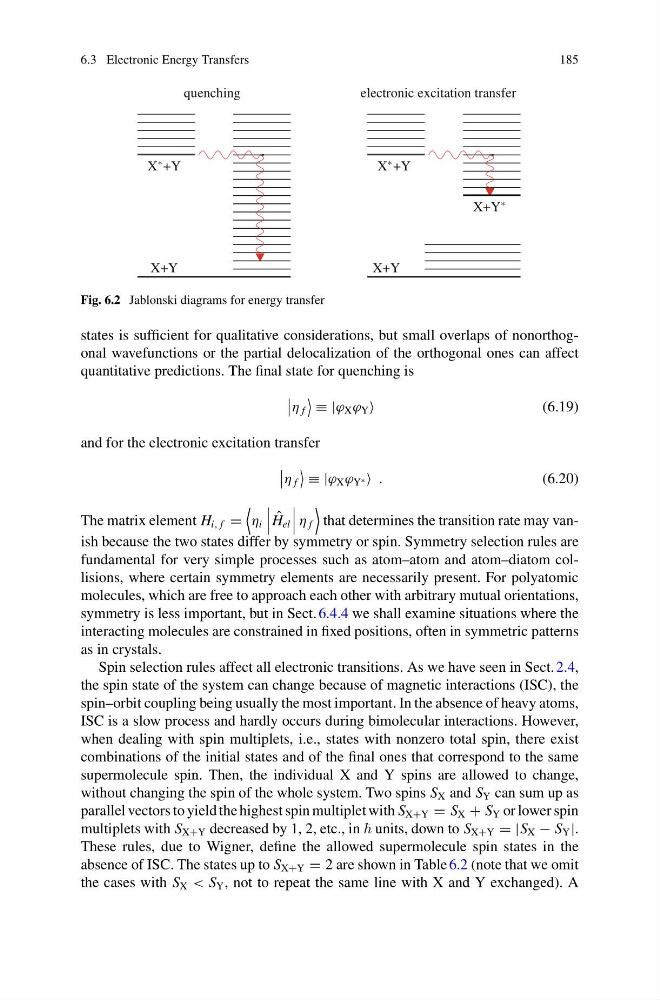
Fig. 6.2 Jablonski diagrams for energy transfer
states is sufficient for qualitative considerations, but small overlaps of nonorthogonal wavefunctions or the partial delocalization of the orthogonal ones can affect
quantitative predictions. The final state for quenching is
η f
≡ |ϕ X ϕ Y
(6.19)
and for the electronic excitation transfer
η f
≡ |ϕ X ϕ Y ∗ .
(6.20)
The matrix element H i, f =
η i
ˆ
H el
η f
that determines the transition rate may vanish because the two states differ by symmetry or spin. Symmetry selection rules are
fundamental for very simple processes such as atom–atom and atom–diatom collisions, where certain symmetry elements are necessarily present. For polyatomic
molecules, which are free to approach each other with arbitrary mutual orientations,
symmetry is less important, but in Sect. 6.4.4 we shall examine situations where the
interacting molecules are constrained in fixed positions, often in symmetric patterns
as in crystals.
Spin selection rules affect all electronic transitions. As we have seen in Sect. 2.4,
the spin state of the system can change because of magnetic interactions (ISC), the
spin–orbit coupling being usually the most important. In the absence of heavy atoms,
ISC is a slow process and hardly occurs during bimolecular interactions. However,
when dealing with spin multiplets, i.e., states with nonzero total spin, there exist
combinations of the initial states and of the final ones that correspond to the same
supermolecule spin. Then, the individual X and Y spins are allowed to change,
without changing the spin of the whole system. Two spins S X and S Y can sum up as
parallel vectors to yield the highest spin multiplet with S X+Y = S X + S Y or lower spin
multiplets with S X+Y decreased by 1, 2, etc., in units, down to S X+Y = |S X − S Y |.
These rules, due to Wigner, define the allowed supermolecule spin states in the
absence of ISC. The states up to S X+Y = 2 are shown in Table 6.2 (note that we omit
the cases with S X < S Y , not to repeat the same line with X and Y exchanged). A
185
X+Y ∗
X ∗ +Y
X+Y
electronic excitation transfer
X ∗ +Y
X+Y
quenching
Fig. 6.2 Jablonski diagrams for energy transfer
states is sufficient for qualitative considerations, but small overlaps of nonorthogonal wavefunctions or the partial delocalization of the orthogonal ones can affect
quantitative predictions. The final state for quenching is
η f
≡ |ϕ X ϕ Y
(6.19)
and for the electronic excitation transfer
η f
≡ |ϕ X ϕ Y ∗ .
(6.20)
The matrix element H i, f =
η i
ˆ
H el
η f
that determines the transition rate may vanish because the two states differ by symmetry or spin. Symmetry selection rules are
fundamental for very simple processes such as atom–atom and atom–diatom collisions, where certain symmetry elements are necessarily present. For polyatomic
molecules, which are free to approach each other with arbitrary mutual orientations,
symmetry is less important, but in Sect. 6.4.4 we shall examine situations where the
interacting molecules are constrained in fixed positions, often in symmetric patterns
as in crystals.
Spin selection rules affect all electronic transitions. As we have seen in Sect. 2.4,
the spin state of the system can change because of magnetic interactions (ISC), the
spin–orbit coupling being usually the most important. In the absence of heavy atoms,
ISC is a slow process and hardly occurs during bimolecular interactions. However,
when dealing with spin multiplets, i.e., states with nonzero total spin, there exist
combinations of the initial states and of the final ones that correspond to the same
supermolecule spin. Then, the individual X and Y spins are allowed to change,
without changing the spin of the whole system. Two spins S X and S Y can sum up as
parallel vectors to yield the highest spin multiplet with S X+Y = S X + S Y or lower spin
multiplets with S X+Y decreased by 1, 2, etc., in units, down to S X+Y = |S X − S Y |.
These rules, due to Wigner, define the allowed supermolecule spin states in the
absence of ISC. The states up to S X+Y = 2 are shown in Table 6.2 (note that we omit
the cases with S X < S Y , not to repeat the same line with X and Y exchanged). A